
How Much to Charge for Facebook Ads Management
Marta Kowalczyk
Agency Operations Lead
How much to charge for Facebook ads management depends less on what other agencies quote and more on three numbers of your own: the hours a client takes, what an hour costs you, and the margin you need. Get those right and the pricing model, whether a retainer, a percentage of ad spend or a hybrid, becomes a packaging choice on top of a price floor you already know.
Quick answer: Work out your floor price first: monthly hours per client × fully loaded cost per hour ÷ (1 − target margin). Then choose how to package it. A flat retainer suits small or seasonal accounts, a percentage of ad spend suits growing accounts, and a hybrid of base fee plus percentage protects your floor while sharing the upside.
This guide is about pricing. For who pays Meta for the media itself, read our guide to Meta ads agency billing, and for who should own the ad accounts, see agency ad account ownership. We do not quote market rates here: published surveys vary widely by country and service scope, so every number below is a clearly hypothetical example you should replace with your own.
What are the main pricing models for Facebook ads management?
Agencies and freelancers who run Meta ads for ecommerce clients use five building blocks, usually in combination rather than alone.
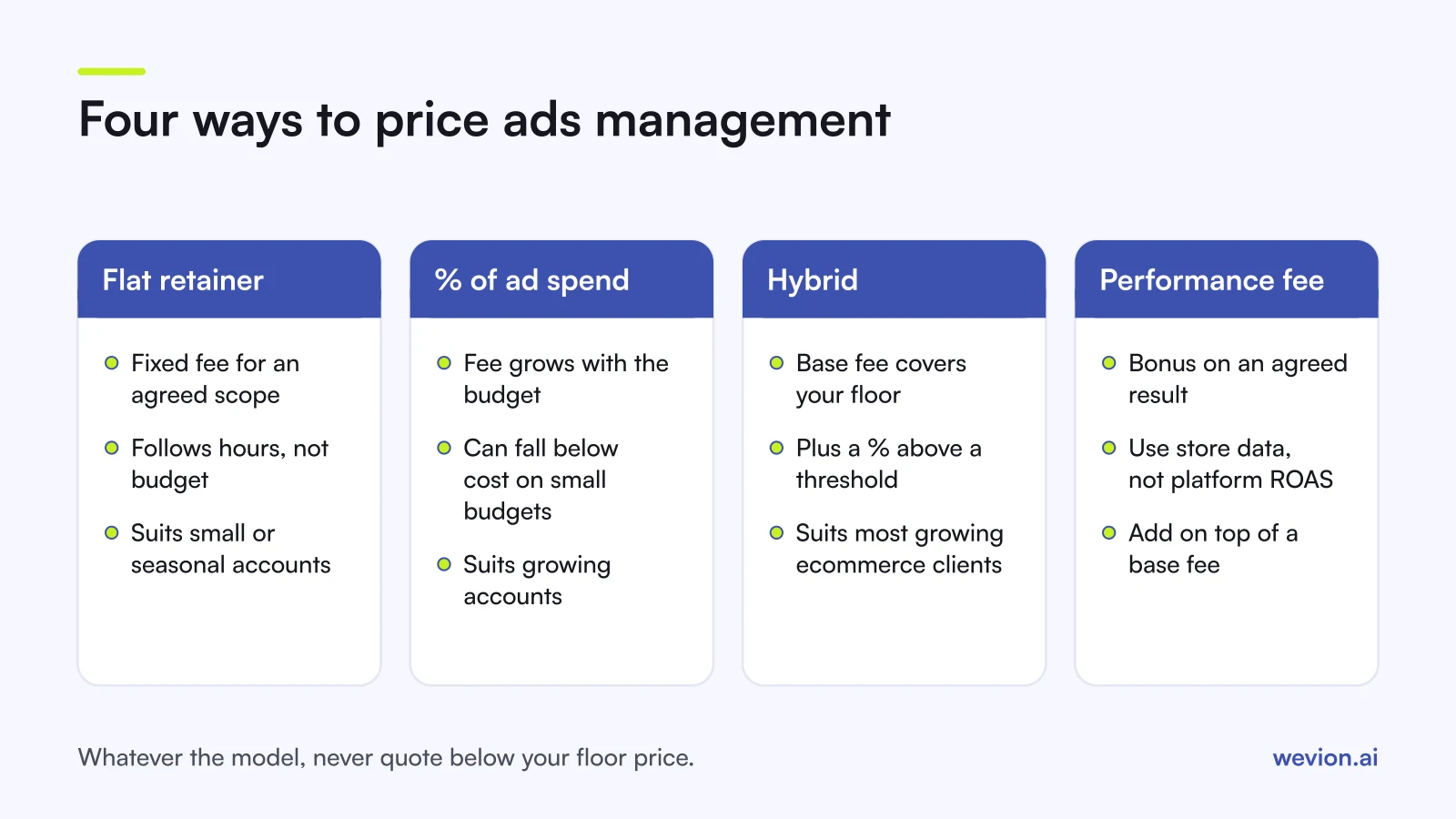
- Flat retainer. A fixed monthly fee for an agreed scope: platforms, campaigns, creative volume, reporting. Predictable for both sides.
- Percentage of ad spend. The fee is a share of the media budget the client spends that month. It grows as the account grows.
- Hybrid. A base fee that covers your floor, plus a percentage of spend above a threshold.
- Performance-based. A bonus or a share tied to an agreed result, such as revenue, MER or contribution margin.
- Setup fee. A one-off charge for the audit, tracking checks, account structure and first creative batch.
Each one shifts risk between you and the client. A retainer puts the risk of a busy month on you. A percentage puts the risk of a small budget on you. A performance fee puts the risk of bad tracking on both sides.
Agency retainer vs percentage of ad spend: which one fits?
The retainer versus percentage of ad spend debate is really about what your workload follows: the number of campaigns and creatives you manage, or the size of the budget behind them.
A flat retainer fits when the work is steady regardless of spend. A brand with a modest budget can still need weekly creative refreshes, catalogue checks and reporting, which take the same hours as a bigger account. A retainer also suits seasonal brands, where a percentage would swing your income with every sale period.
A percentage of ad spend fits when more budget really does mean more work: more campaigns, more audiences, more creative to test, more platforms. It also aligns your income with the client's growth. The weak spot is the low end: a small budget times a reasonable percentage often lands below what the account costs you to run.
Here is how the three main models behave on the same hypothetical client at three budget levels. The retainer is €1,700, the percentage is 10 percent, and the hybrid is €1,700 plus 4 percent of spend above €20,000.
| Monthly ad spend | Flat retainer | 10% of spend | Hybrid |
|---|---|---|---|
| €10,000 | €1,700 | €1,000 | €1,700 |
| €20,000 | €1,700 | €2,000 | €1,700 |
| €40,000 | €1,700 | €4,000 | €2,500 |
At €10,000 the percentage model pays less than the floor we calculate below. At €40,000 the retainer leaves the extra work unpaid, while the pure percentage may feel steep to the client. The hybrid stays above the floor at every level and grows at a gentler rate.
How do you calculate your floor price?
Your floor price is the lowest monthly fee at which a client still earns you your target margin, and you can calculate it with three inputs before any sales call.
Step 1: fully loaded cost per billable hour. Take everything a media buyer costs you in a year, salary, taxes, tools and a share of overheads, and divide it by the hours they can actually bill. In our hypothetical agency, one buyer costs €54,000 a year and carries €18,000 of overheads and tools, so €72,000 in total. They bill about 30 hours a week for 48 weeks, or 1,440 hours. Cost per billable hour: €72,000 ÷ 1,440 = €50.
Step 2: monthly hours per client. Count everything, not just time in Ads Manager: launches, optimisation, creative briefs, catalogue fixes, reporting, calls and email. Our example client takes 20 hours a month, so it costs €1,000 to serve.
Step 3: target margin. Decide what share of the fee should be left after delivery costs. With a 40 percent target margin, divide cost by 0.6: €1,000 ÷ 0.6 = €1,667. Round up to €1,700. That is the floor for this client.
Check the margin the other way to make sure the numbers hold. A €1,700 fee minus €1,000 of delivery cost leaves €700, which is 41 percent of the fee. If the client later takes 25 hours, delivery costs €1,250 and the margin falls to 26 percent. That is the signal to reprice, not to absorb the extra hours.
PPC agency profit margins are where most pricing goes wrong. Agencies quote from a competitor's rate card, then discover that one demanding client eats the margin of three easy ones. Tracking hours per client for even two months gives you the data to fix it. Our guide to scaling an agency from six to twenty clients covers how roles and workload change as you grow.
How should you price setup fees and minimums?
Setup fees and minimums protect you from the most expensive part of any client relationship: the first month, when you do the most work and have the least data.
Setup fee. The first month usually includes an account audit, tracking and catalogue checks, a new campaign structure and the first creative batch. Price it the same way as the retainer. If setup takes 15 hours at €50, the cost is €750; at a 40 percent margin, the fee is €750 ÷ 0.6 = €1,250. Our client onboarding guide lists what that first week usually involves.
Minimum monthly fee. Whatever model you use, write the floor into the contract as a minimum. A percentage deal then reads "10 percent of ad spend, with a minimum monthly fee of €1,700".
Minimum term. Meta campaigns need time to collect data, so a client who leaves after four weeks rarely sees results and often blames the agency. A minimum term of a few months, followed by a monthly notice period, gives both sides a fair test.
Minimum ad spend. Decide below which budget you would rather not take a client, because the account cannot generate enough data to learn from, or because your floor fee would be a large share of their total marketing cost.
When does a performance-based fee work?
A performance-based fee works only when you and the client agree on one source of truth and on what counts as a result, before the first campaign goes live.
Avoid paying yourself on platform-reported ROAS. Each platform counts conversions by its own attribution rules, and the totals across Meta, Google and TikTok can add up to more orders than the store actually took. Use a store-based measure instead: marketing efficiency ratio (MER), new-customer revenue or contribution margin. Our guides to MER vs ROAS, POAS vs ROAS and contribution margin explain how each one is calculated.
A workable structure, in hypothetical terms: a €1,700 base fee plus 5 percent of contribution margin above an agreed baseline of €30,000 a month, capped at €2,000 of bonus. If the client reaches €42,000 of contribution margin, the bonus is 5 percent of €12,000, or €600, and the total fee is €2,300. Write down the baseline, the measurement window, how refunds are treated and the cap.
When should you move a client to a different model?
Move a client between pricing models when the shape of the work changes, not only when you want more money, and plan the move at a contract review rather than mid-month.
- Spend grows past a band. A retainer client who doubles their budget usually means more campaigns and more creative. Move to a hybrid.
- Scope adds a platform. Adding Google or TikTok is new work. Price it as an extra retainer line or a new spend band.
- Spend becomes volatile. A client who swings between heavy sale months and quiet months may prefer a flat fee, and so might you.
- Tracking becomes reliable. Once store data and ad spend are joined and trusted, a performance component becomes fair to both sides.
- Hours drift. If your time logs show a client taking 30 percent more hours than priced for three months in a row, reprice.
What should the contract say?
The contract turns your pricing into something both sides can check, so it should cover money, ownership and scope in plain terms.
- Ad spend is paid by the client directly to Meta and other platforms, with their own payment method. Your invoice covers fees only. See Meta ads agency billing for the options.
- The client owns the ad accounts, pixel or dataset and catalogue, and gives your business portfolio partner access. Meta's page on partner access explains how the owner grants it.
- Scope: platforms, number of active campaigns, creative volume, reporting cadence and what counts as extra work.
- Fee formula: model, percentage, threshold, minimum fee and how spend is measured (platform billing reports for the calendar month).
- Performance terms, if any: metric, data source, baseline, window and cap.
- Term, notice and exit: minimum term, notice period and what you hand over when the client leaves.
Where Wevion fits
Every hour you save on routine account work goes straight into the margin you calculated above, so the tools behind each client matter as much as the price.
Wevion connects Meta, Google, TikTok, Snapchat, Taboola and Outbrain ad accounts through each platform's official API, syncs data about every 15 minutes, and gives every client its own workspace, so an agency sees spend and results for all clients in one dashboard instead of logging into each account separately.
Team roles such as manager, media buyer, finance and viewer keep each person to the clients they work on. Bulk Launch builds campaigns across platforms from one grid, and automated rules can pause, activate, change budgets or just notify you. If you also move budget across platforms, cross-platform rules are in beta.
You can try it on your own ad accounts with a 14-day trial on the Pro plan. No card to start. We ask for one on day 7, or earlier if you use up the trial credits, and billing starts on day 14 only if you add it.
Key takeaways
- Calculate a floor price first: monthly hours × cost per billable hour ÷ (1 − target margin).
- Flat retainers suit small, steady or seasonal accounts; percentage of ad spend suits growing ones.
- A hybrid of base fee plus a percentage above a threshold protects the floor and shares the upside.
- Charge a setup fee for the first month and write a minimum monthly fee into every deal.
- Tie performance fees to store-based metrics such as MER or contribution margin, never platform ROAS alone.
- Let the client pay ad spend directly and own the accounts; invoice only your fee.
- Track hours per client and reprice when the work changes.