
Real Estate Lead Generation Ads on Meta, Google and TikTok
Lena Brandt
Ad Policy & Compliance Analyst
Real estate lead generation ads are paid campaigns that collect contact details from people looking to buy, sell or rent property, usually through an instant form or a landing page. On Meta, Google and TikTok they count as housing ads, which brings targeting limits in the United States, Canada and, on Meta, Europe. Those limits change what you can target, so the form and the follow-up do more of the work.
Quick answer: Declare the housing category on every platform that requires it, as of November 2026: Meta for the US, Canada and Europe, TikTok for US-based advertisers and anyone targeting the US or Canada, and Google's housing policy for the US and Canada. Expect no age, gender or postcode targeting. Target by city or a wide radius, filter with the creative, and qualify with three or four form questions.
This guide covers the housing rules and how a lead campaign works within them. For the general form setup on each platform, see Facebook lead ads best practices, our guide to Google Ads lead form assets and our guide to TikTok lead generation ads. Nothing here is legal advice: read each platform's policy and check local law with the client's counsel.
Why are real estate ads treated differently?
Real estate ads are treated differently because housing is one of the areas where ad targeting could exclude people on the basis of protected characteristics, and fair housing laws, such as the US Fair Housing Act, forbid that. Meta, Google and TikTok each answer with a special category for housing, employment and credit ads that removes the targeting options most likely to discriminate.
The rules apply to more than property listings. TikTok's housing, employment and credit ad policy, last updated April 2026, defines a housing ad as any ad that promotes a housing product, service or opportunity, and its examples include rental or sale listings, realtor services, homeowners insurance, mortgage insurance and property appraisal services. If the client is a brokerage, a lettings agent or a mortgage broker, assume the rules apply.
What does Meta restrict for housing ads?
Meta restricts housing ads through its Special Ad Category, which you declare when you create the campaign. Meta's Special Ad Category documentation says the requirement started in the United States in 2019, in Canada on 3 December 2020 and for advertisers reaching Europe on 7 December 2021. The same page refers to Europe without listing countries, so check Meta's policy for the markets you run.
Once the housing category is declared, the documentation lists these limits:
- Age is fixed at 18 to 65+.
- Gender cannot be selected; all genders are included.
- Location must cover at least a 15 mile or 25 km radius in the US and Canada, and 15 km in Europe. Postcodes, neighbourhoods and similar small areas are not available, and location exclusions are not supported.
- Detailed targeting excludes demographics and behaviours, interests must come from an approved list, and exclusions are not available.
- Lookalike audiences are not available, and Saved Audiences are removed.
- Custom audiences can still be included or excluded, and Advantage+ audience is supported.
In practice, the custom audiences that remain are the most useful targeting a brokerage has: website visitors, people who opened a past form, video viewers. Broad delivery with strong creative often does the rest, as our guide to broad targeting on Meta explains.
What does Google restrict for housing ads?
Google restricts housing ads through its personalised advertising policy, which groups housing, employment and consumer finance as access to opportunities categories for the United States and Canada only. In those two countries, housing ads cannot target audiences by:
- gender;
- age;
- parental status;
- marital status;
- ZIP code.
The same page says radius targeting needs at least 1 km around any location, city and country targeting are allowed, and in Canada the first three characters of a postal code (the FSA) are acceptable. Predefined Google audiences are allowed, minus the restricted demographics. The page reserves advertiser-curated audiences, such as your own customer lists, for advertisers not promoting anything in these categories, so plan on Google's audiences and search intent rather than your own lists.
Search is where Google is strongest for property anyway: someone typing "3 bedroom house for sale in Leeds" has already done the targeting for you. Lead form assets can sit on those Search ads, but Google's lead form assets page requires an eligible vertical and a good policy history, so confirm eligibility in the client's account before you plan around them.
What does TikTok restrict for housing ads?
TikTok restricts housing ads through a Special Ad Category toggle in Ads Manager. Its housing, employment and credit policy says the toggle is required for advertisers based in the United States and for advertisers targeting audiences in the United States or Canada.
TikTok's list of targeting restrictions for Special Ad Categories, last updated April 2026, sets these limits:
- Age: 18+ only.
- Gender and ZIP code targeting are not allowed.
- Lookalike audiences are not allowed.
- Interest targeting is limited, and interest keywords and hashtag targeting are not allowed.
- Automatic targeting and targeting expansion are not allowed.
- Device price targeting is not allowed.
The HEC policy adds that ads cannot target by marital or parental status in the US and Canada either. With so little targeting left, TikTok housing campaigns live or die on the video: a walkthrough that shows the price, the area and the layout in the first seconds.
How do the housing rules compare across platforms?
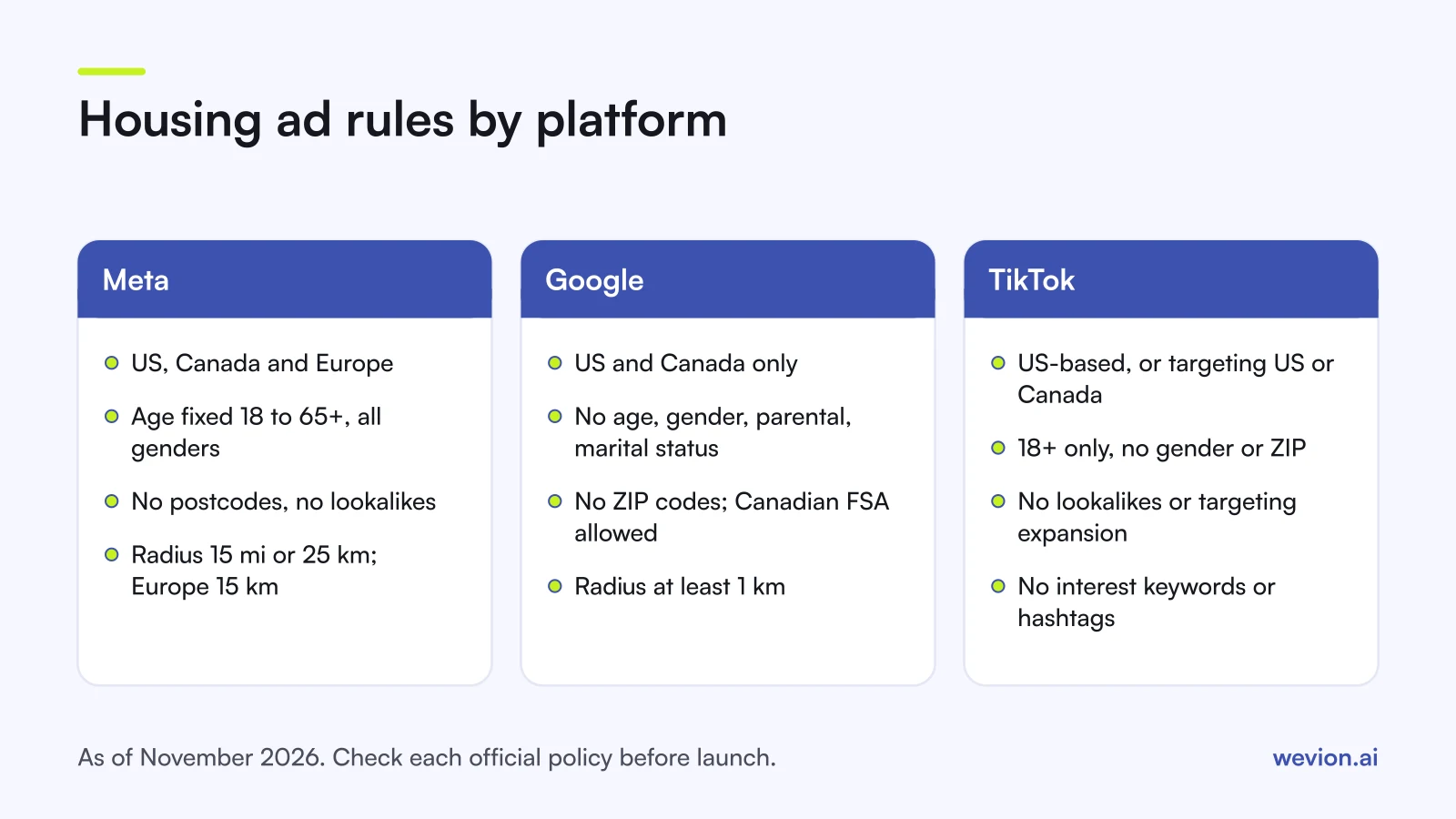
The housing rules share a core across the three platforms: no age, gender or postcode targeting in the countries they cover. The differences are in geography and in what audiences remain. The summary below reflects each platform's page as of November 2026:
| Meta | TikTok | ||
|---|---|---|---|
| Where it applies | US, Canada, Europe | US and Canada | US-based advertisers, or targeting US or Canada |
| Age | Fixed 18 to 65+ | Not targetable | 18+ only |
| Gender | All genders | Not targetable | Not allowed |
| Postcode or ZIP | Not available | ZIP not allowed; Canadian FSA allowed | ZIP not allowed |
| Minimum radius | 15 mi or 25 km (US, Canada); 15 km (Europe) | 1 km | Not stated |
| Lookalikes | Not available | Not listed for these categories | Not allowed |
| Own audiences | Custom audiences supported | Reserved for advertisers outside these categories | Not on the restricted list; anti-discrimination policy applies |
Outside the countries listed, the platform category may not apply, but local anti-discrimination and property advertising laws still do. That is a question for the client's lawyer, not for the media buyer.
How should you design the lead form?
A real estate lead form should qualify on intent, budget and timing, because the targeting no longer does it for you. Keep it short: contact details pre-filled, then three or four multiple choice questions.
Questions that sort property leads well:
- What are you looking to do? Buy, sell, rent, value my property.
- What is your budget range? Three or four bands that match the listings.
- When do you plan to move? Within 3 months, 3 to 6 months, just looking.
- Is your financing arranged? Yes, in progress, not yet.
Do not ask about household make-up, age, family plans or anything close to a protected characteristic. Those questions add nothing to qualification and create exactly the risk the housing rules exist to prevent.
Use the form type to trade volume for intent. Meta's Higher intent instant form adds a review step before submission, and Google's lead form assets offer a More qualified option. Our guide to lead scoring for paid ads shows how to turn these answers into a score and send it back to the platforms.
How should you follow up property leads?
Property leads need follow-up within minutes, because a buyer browsing listings on their phone may well contact several agents the same day. Route each lead by area or by listing to the agent who covers it, and send the first message with something useful: the listing details, similar properties or a viewing slot.
A worked example with hypothetical numbers shows why follow-up decides the result. A brokerage spends $3,000 a month and gets 100 leads at $30 each. If 25 of them are qualified, that is $120 per qualified lead. If slow follow-up means only 15 are ever reached and qualified, the same campaign costs $200 per qualified lead, without a single setting changing in Ads Manager.
Our guide to speed to lead covers routing, alerts and a follow-up cadence in detail. For buyers who prefer to chat, a click-to-WhatsApp ad can replace the form with a conversation.
Where Wevion fits
Wevion is not part of the compliance or lead path: it does not set special ad categories, check policy, store leads or send conversions to the platforms. The category is declared in each platform's own campaign setup.
Wevion connects Meta, Google, TikTok, Taboola, Snapchat and Outbrain ad accounts through each platform's official API, syncs data about every 15 minutes, and shows platform-reported leads, cost per lead and spend for every client in one view, so you can compare a brokerage's Meta, Google and TikTok campaigns side by side.
Each brokerage gets its own workspace, and team roles such as manager, media buyer, finance and viewer decide who can change what. Automation rules can pause ad sets, change budgets or just send an alert when cost per lead crosses a threshold you set.
You can try it on your own ad accounts with a 14-day trial on the Pro plan. No card to start. We ask for one on day 7, or earlier if you use up the trial credits, and billing starts on day 14 only if you add it.
Key takeaways
- Real estate lead generation ads count as housing ads on Meta, Google and TikTok, including listings, realtor services and related offers.
- Meta's housing category covers the US, Canada and Europe; Google's housing policy covers the US and Canada; TikTok's toggle covers US-based advertisers and anyone targeting the US or Canada.
- Expect no age, gender or postcode targeting, and no lookalikes on Meta or TikTok.
- Meta needs a radius of at least 15 miles or 25 km in the US and Canada and 15 km in Europe; Google needs at least 1 km.
- Qualify with the creative and three or four form questions on intent, budget, timing and financing; never on protected characteristics.
- Follow up within minutes and route by area, or the targeting rules will be the smaller problem.