
Best AI Ad Copy Generator in 2026: 7 Tools Compared, Prices Checked
Yuki Tanabe
Creative AI Strategist
An ai ad copy generator turns a brief, a product page or an existing ad into headlines and body text you can test. In 2026 you can pick from three kinds: free generators built into Meta, Google and TikTok, standalone AI writers such as Jasper, Anyword and ChatGPT, and tools where the copy is written inside the workflow that launches the ads. We checked every tool below on its official site in November 2026.
Quick answer: Start with the free generators inside Meta, Google and TikTok if you run one platform. Pick Jasper for brand voice across a team, Anyword for scoring copy before spend, ChatGPT for flexible prompting, and AdCreative.ai or Pencil when you need visuals too. Pick Wevion when the copy has to become live ads on six platforms.
This is a desk review, not a private benchmark. Prices, trials and features come from each vendor's own pricing and help pages, checked on 3 November 2026. We do not publish a head-to-head CTR table: without a sample size, a date range and a vertical, nobody can check it. To measure tools on your own account, use our AI ad copy testing framework.
How we evaluated
Every tool was judged on the five questions that decide a purchase for a media buyer, not on how impressive a single demo looks.
| Criterion | Why it matters |
|---|---|
| Usable output | If every line needs rewriting, the tool saves no time |
| Platform limits | Google caps responsive search ad headlines at 30 characters and descriptions at 90 |
| Variation range | Testing needs different angles, not five rewrites of one sentence |
| Workflow fit | Copy pasted between tabs is copy that ships late |
| Price and trial | Checked on the vendor's pricing page in November 2026 |
Google's responsive search ads help page sets those limits: up to 15 headlines of 30 characters and 4 descriptions of 90 characters. Meta's Ads Guide suggests a 27-character headline for Facebook Feed image ads. A good generator either knows these limits or lets you set them once.
Quick comparison
| Tool | Best for | Price checked Nov 2026 | Free start |
|---|---|---|---|
| Meta, Google and TikTok built-in | One platform, no extra cost | Included in the ad platform | Yes |
| ChatGPT | Flexible prompting | Check current pricing | Free plan |
| Jasper | Brand voice across a team | Pro $69/month, or $59/month yearly | 7-day trial |
| Anyword | Scoring copy before spend | Starter $49/month, Data-Driven $99/month | 7-day trial |
| AdCreative.ai | Copy plus visuals in volume | Check current pricing | 7-day trial |
| Pencil | Text, image and video assets | Core $14/month, Growth $55/month | 6 free ads |
| Wevion | Copy that goes straight to launch | See pricing page | 14-day trial |
1. Built-in generators: Meta, Google and TikTok
The cheapest AI ad copy generator is the one already inside your ad account, because it costs nothing extra and writes in the format the platform serves.
- Meta: text generation in Ads Manager creates variations of your primary text. Meta's help centre describes up to five variations based on your input, and Meta announced headline variations in May 2024.
- Google: in Performance Max, you enter your landing page and Google drafts headlines and descriptions from it, with "Generate headlines" and "Generate descriptions" buttons for more. Google's help page says it is rolling out to eligible advertisers and supports seven interface languages.
- TikTok: Smart Text pre-fills an AI ad text based on your asset and campaign context, with suggestions you can regenerate or edit.
Verdict: the right first step for a single-platform account. The limit is that each one only writes for its own platform, so a campaign running on Meta and Google gets two unrelated sets of copy.
2. ChatGPT: best for flexible prompting
ChatGPT is a general assistant, not an ad tool, so the output is only as good as the brief you give it. With a saved prompt that includes your brand voice, the character limits per platform and three of your best ads, it produces strong first drafts. Without one, it writes generic marketing filler.
- Pros: handles complex briefs, adapts to any format you describe, free plan to start.
- Cons: no built-in knowledge of your account, limits must be spelled out every time, results vary between sessions.
- Pricing: free plan available; paid plans change often, so check current pricing on OpenAI's site.
Verdict: best for a solo media buyer who is willing to build and maintain prompts.
3. Jasper: best for brand voice across a team
Jasper now positions itself as an AI platform for marketing teams. Its pricing page lists two plans: Pro at $69 per seat per month billed monthly, or $59 billed yearly, and Business at custom pricing, with a 7-day free trial on Pro. Ads sit alongside articles, emails and social posts in what it writes.
- Pros: stored brand voice and style rules that every generation follows, multiple voices for different clients or regions, shared workspace.
- Cons: priced per seat, and ads are one use case among many rather than the focus.
Verdict: a good fit for an agency that needs each client's voice kept separate across many writers.
4. Anyword: best for scoring copy before you spend
Anyword's difference is performance prediction: it scores copy before it goes live, so you can shortlist variations before testing. Its pricing page lists Starter at $49 a month ($39 billed yearly), Data-Driven at $99 ($79 yearly), and custom Business and Enterprise plans. The free trial lasts 7 days, capped at 2,500 words.
- Pros: a score next to every variation, a monthly allowance of predictions on each plan.
- Cons: predictions are a filter, not a result; you still need a live test with real spend.
Verdict: worth it when you produce many variations and need a fast way to decide which few to test.
5. AdCreative.ai: best for copy and visuals in volume
AdCreative.ai generates ad texts and headlines together with banners and videos, which suits teams that need complete ad units rather than text alone. Its site offers a 7-day free trial with 20 credits. Plan prices differed between sections of the site when we checked, so check current pricing before you subscribe.
- Pros: text and visuals from one brief, many angles per product.
- Cons: credit-based usage, and copy can feel formulaic after heavy use.
Verdict: suits ecommerce teams testing many product ads who lack a designer.
6. Pencil: best for text, image and video assets
Pencil describes itself as an AI platform for marketing that brings many AI models into one workspace, and its pricing page says it "creates text, image, and video ad assets". Core costs $14 a month ($11 yearly), Growth $55 ($44 yearly), and Pro is custom. You can create six ads free through a guided start.
- Pros: low entry price, text and visuals in one place, a free start without a subscription.
- Cons: wider than ad copy, so you set up more before the first ad.
Verdict: a low-cost way to produce full ad units for small teams.
7. Wevion: copy written where the campaign is launched
Wevion is a different category from a pure writer. Wavo, the AI copilot inside Wevion, drafts ad copy variations with context from your own accounts, and the same platform launches the campaign. As a copywriting surface, Jasper and Anyword go deeper; what Wevion removes is the copy and paste between a writing tool and six Ads Managers.
Wevion connects Meta, Google, TikTok, Snapchat, Taboola and Outbrain through each platform's official API, syncs data about every 15 minutes, launches campaigns in bulk across platforms, and gives each client its own workspace with roles such as manager, media buyer, finance and viewer.
- Pros: copy, bulk launch and results in one place; automated rules can then pause, activate or change budgets on the ads you shipped.
- Cons: not a standalone brainstorming tool, and only useful if you also run campaigns in Wevion.
Verdict: for agencies and media buyers who launch the same message on several platforms. When Wavo, the AI copilot, proposes a pause or budget change, you confirm it before anything happens.
What changed since our last review
Two tools left the list. Copy.ai now presents itself as a go-to-market AI platform with workflow plans for sales and marketing teams, and Writesonic as an AI search visibility platform; both still write text, but neither is built around ad copy any more. We added the free generators inside Meta, Google and TikTok, because for many single-platform advertisers they are now the sensible starting point.
How to choose an AI ad copy generator
Choosing well starts with where the copy has to end up, then how many platforms and people are involved, and only then the price.
| Question | Built-in (Meta, Google, TikTok) | Standalone writer (ChatGPT, Jasper, Anyword) | Copy plus visuals (AdCreative.ai, Pencil) | Wevion |
|---|---|---|---|---|
| Extra cost | None | Free to per-seat plans | Low to custom plans | Subscription after trial |
| Knows platform limits | Its own only | If you set them | For supported formats | Each platform checks at launch |
| One brief, several platforms | No | Yes | Yes | Yes |
| Can it launch campaigns? | Yes, on its own platform | No | No | Yes, on six platforms |
| Best for | One platform | Writers and brand voice | Full ad units | Multi-platform launch |
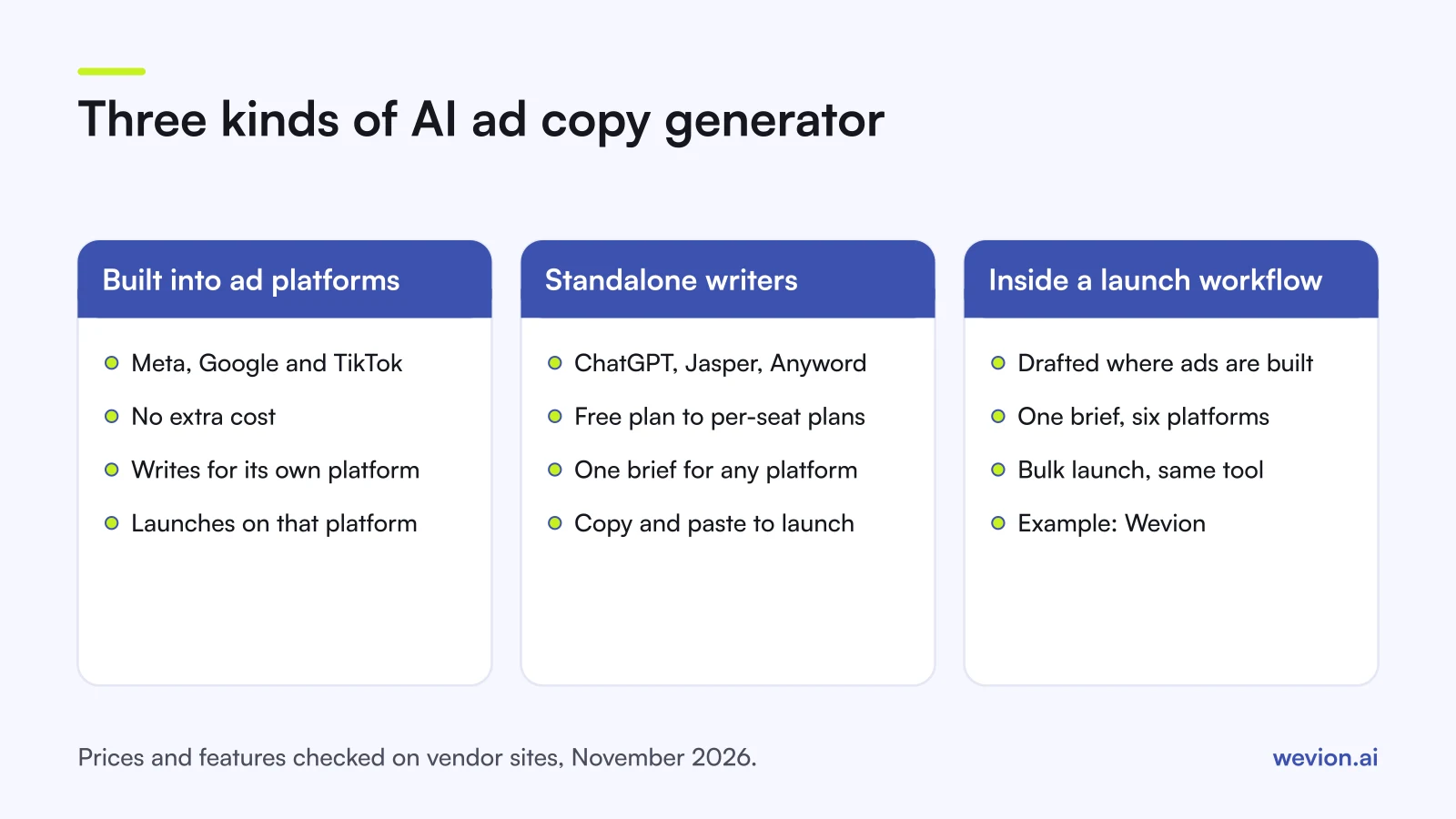
Match the verdict to your situation:
- One platform, small budget: the platform's built-in generator.
- Solo media buyer on several platforms: ChatGPT with a saved prompt per platform.
- Agency with many brand voices: Jasper.
- High volume of variations: Anyword to shortlist before you test.
- Ecommerce without a designer: AdCreative.ai or Pencil.
- Same campaign on several platforms: Wevion, or one of the writers above plus a plan for copying a Meta campaign to TikTok and Google.
If your work is mostly Meta, our roundup of Facebook ad copy generators goes deeper on that single platform. For where copy fits in a wider AI workflow, see our practical guide to AI in advertising.
How to test a generator on your own account
The only benchmark that decides your purchase is your own account, and a fair test takes an afternoon. Run the same brief through two tools and count three things:
- How many of the first ten outputs you could ship without rewriting.
- How many headlines break the limit or get truncated in the ad preview.
- How many minutes pass between the brief and the ad going into review.
Say tool A gives 6 usable lines out of 10 and tool B gives 3. If writing one line yourself takes 4 minutes, tool A saves about 24 minutes per batch of ten and tool B about 12. Then launch the best two or three variations from each with the same budget and audience, and compare cost per result once each has enough conversions to judge.
You can try Wevion on your own ad accounts with a 14-day trial on the Pro plan. No card to start. We ask for one on day 7, or earlier if you use up the trial credits, and billing starts on day 14 only if you add it.
Key takeaways
- Start with what is free. Meta, Google and TikTok all generate ad text inside their own tools, at no extra cost.
- Pay for a standalone writer when one brief must serve several platforms or several brand voices.
- Check limits before quality. A line that breaks Google's 30-character headline limit is unusable however good it reads.
- Prices move. Jasper, Anyword and Pencil list prices today; AdCreative.ai and ChatGPT should be checked on the day you buy.
- Judge on your own account. Usable lines per ten, truncations and minutes to launch beat any published CTR table.