
Outbrain Pricing: CPC, Minimum Budget and What Drives Cost
Rafael Moreira
资深效果营销专家
Outbrain pricing is auction-based and charged per click: Outbrain publishes no rate card, no fixed CPC and no monthly platform fee for self-serve advertisers. You set a CPC or let Conversion Bid Strategy set it, choose a budget, and pay for the clicks you get. What a click costs depends on your bid, targeting, creative and the competition for each placement.
Quick answer: Outbrain Amplify bills on cost per click. You set the CPC yourself or let Conversion Bid Strategy adjust it towards a CPA or ROAS goal. The minimum daily budget is 20 USD, EUR or GBP on Outbrain's help page (an API notice says 25 USD for campaigns created since 3 November 2025). Daily spend can run up to 20% over budget, and card payments carry a 3% fee.
This guide sticks to cost. For building the account and the first campaign, see our Outbrain ads setup guide; for the same questions on the other big native network, see Taboola pricing and Taboola vs Outbrain. Every Outbrain fact below comes from Outbrain's own help pages, opened on 17 November 2026.
How does Outbrain pricing work?
Outbrain pricing works as a cost-per-click auction, which means you pay for traffic delivered to your page rather than for a slot, a package or a monthly seat. Outbrain's pricing and billing model page states it plainly: "Outbrain runs on a Cost-Per-Click, or CPC, pricing model."
Two things follow from that. Impressions without a click cost nothing, so a weak headline wastes reach but not money. And the CPC you pay is the lever: raise it and you win more placements, lower it and delivery shrinks.
Outbrain does not publish average CPCs, a price list or country benchmarks on its help pages. Any "average Outbrain CPC" you find online is a third-party estimate, usually without a date, a country or a vertical, so plan on your own test results instead.
A note on the brand: Outbrain and Teads "combined on February 3, 2025 and are operating under the new Teads brand", according to Teads' announcement. The self-serve tool for native campaigns is still called Amplify, and its help pages still live on outbrain.com.
Which bid strategies does Outbrain offer?
Outbrain offers manual CPC bidding plus Conversion Bid Strategy, an automated layer with four modes that adjust your campaign CPC towards a goal. The mode you choose decides who sets the price of each click, you or Outbrain's algorithm, which makes it the biggest single choice behind your cost.
Outbrain's page on which Conversion Bid Strategy fits your objectives lists these modes:
| Mode | What it adjusts | Needs a conversion event? |
|---|---|---|
| Semi Manual | Sends traffic to the highest-converting sections; does not change campaign CPC | Optional, recommended |
| Max Conversions | Campaign CPC, to get the most conversions within budget | Optional, recommended |
| Target CPA | Campaign CPC, towards a CPA goal | Yes |
| Target ROAS | Campaign CPC, towards a return on ad spend goal | Yes, with a conversion value |
Semi Manual and Max Conversions can start before any conversion exists, using what Outbrain calls prior network learnings. Target CPA and Target ROAS cannot be switched on without a conversion event. The same page warns that section-level CPC adjustments override Conversion Bid Strategy, so remove them when you hand bidding to the algorithm.
For Target CPA, Outbrain's Target CPA page adds a cost warning: "Setting unrealistic goals will cause the system to decrease your CPCs in order to not spend the budget." A CPA goal far below what the campaign can reach does not make clicks cheaper in a useful way; it starves delivery.
Traffic campaigns have one more option. Outbrain's Engagement Bid Strategy optimises for clicks or GA4 engagement metrics on the Traffic objective only, and Outbrain says the system "might adjust your CPC up to 3x your entered CPC". Budget for that ceiling, not for the CPC you typed.
What is the minimum budget on Outbrain?
The minimum budget on Outbrain is set per day and is low, which is why it says little about what a test actually needs. Outbrain's budget and duration page says: "The minimum daily budget you need to create a campaign is 20USD, 20EUR, or 20GBP per day."
There is one wrinkle. A notice posted in Outbrain's Amplify API Google group in October 2025 announced that "The minimum daily budget for a new campaign will be increased from $20.00 to $25.00 USD" from 3 November 2025, with a $750 monthly minimum and $25 per day for campaign budgets. The help pages we opened still show 20. Treat 25 USD as the likely floor for new campaigns, and check what your own dashboard accepts.
Outbrain's CPC and budget page describes three budget types:
- Daily, the default, refreshed "at 12am EST the following day"
- Monthly, at least $600 on that page, the equivalent of $20 a day, reset on the first of the month
- Campaign, a total for a fixed period with start and end dates, which does not renew
The minimum is a technical floor. The budget a conversion campaign needs to learn is much higher, as the next section shows.
How much budget does Conversion Bid Strategy need?
Conversion Bid Strategy needs enough daily conversions to learn, so Outbrain ties its budget advice to conversion volume rather than to a fixed amount. Its Conversion Bid Strategy best practices set these starting points:
| Mode | Starting budget guidance | First changes |
|---|---|---|
| Target CPA or Target ROAS | Enough to generate at least 7 conversions a day; launch with your maximum budget | Wait 48 hours |
| Max Conversions | Enough to generate at least 5 conversions a day | Wait 48 hours; scale by 50% to 100% at the start of the day EST |
The Target CPA page is more specific: starting daily spend should be about seven times the CPA goal, aiming for 7 to 10 conversions a day, with a learning phase that "may last up to a week following launch". If you cannot reach 7 conversions a day, Outbrain suggests running Max Conversions with an upper-funnel conversion as the target. It recommends a lower-funnel event with a conversion rate of about 0.5% to 3% plus an upper-funnel event at about 10% to 20%.
For manual CPC campaigns, the budget page recommends starting "with a high CPC", expecting a discovery period of "usually around 2 weeks", and running for "at least 1 week" before judging.
Overspend, billing and card fees
Overspend and payment fees are the two costs most often missing from an Outbrain budget, because neither shows up in the CPC column. Both are documented, so add them to your plan from the start.
Overspend. Outbrain's CPC and budget page says daily spend "may be up to 20% more than your daily budget", and that with a Daily Target inside a monthly or campaign budget, "your actual spend can exceed your daily target by up to 35%". The billing page adds that "you may be charged up to 20% more than your budget for clicks delivered during this time", while the campaign catches up with its cap.
Pacing. Daily budgets only run on Accelerated pacing, which spends "as quickly as possible". Standard pacing, which spreads spend evenly, is available only on monthly or campaign budgets.
Billing. Outbrain's payment methods page offers two routes:
- Automatic billing, by MasterCard, Visa, Discover or American Express, charged "at round amounts" of the spend accrued. Its example is $230 of spend triggering a $200 charge.
- Prepayment, by wire, ACH (US only) or credit card, which needs access from your account manager or Customer Success.
Card fee. Outbrain charges "a processing fee of 3%" on top of media spend for accounts that pay by card. The billing page puts it at 4% for clients in Brazil. Bank transfers carry no fee on that page but can take a few days to clear, so fund prepaid accounts before a campaign runs dry.
What drives your Outbrain CPC up or down?
Outbrain's cost per click is set by competition in the auction, but most of the gap between a cheap test and an expensive one comes from settings you control in Amplify.
- Bid strategy and goal. On Max Conversions, Target CPA and Target ROAS the algorithm sets the CPC. A CPA or ROAS goal out of reach lowers CPCs until the budget stops spending; a loose one lets CPC rise.
- Section-level bids. Manual adjustments by publisher section override Conversion Bid Strategy. Leave them off on automated modes, or you are bidding against your own algorithm.
- Conversion event choice. A rare purchase event gives the algorithm little to learn from. Outbrain's advice to add an upper-funnel event exists to give it volume.
- Creative. Titles and thumbnails that earn more clicks per impression get more delivery at the same CPC. Our guide to native ads best practices covers what tends to work in feeds.
- Targeting. Narrow geographies, platforms or audiences leave fewer placements to compete for. Split campaigns by device and country so one costly segment does not hide inside an average.
Worked example: budgeting a first Outbrain test
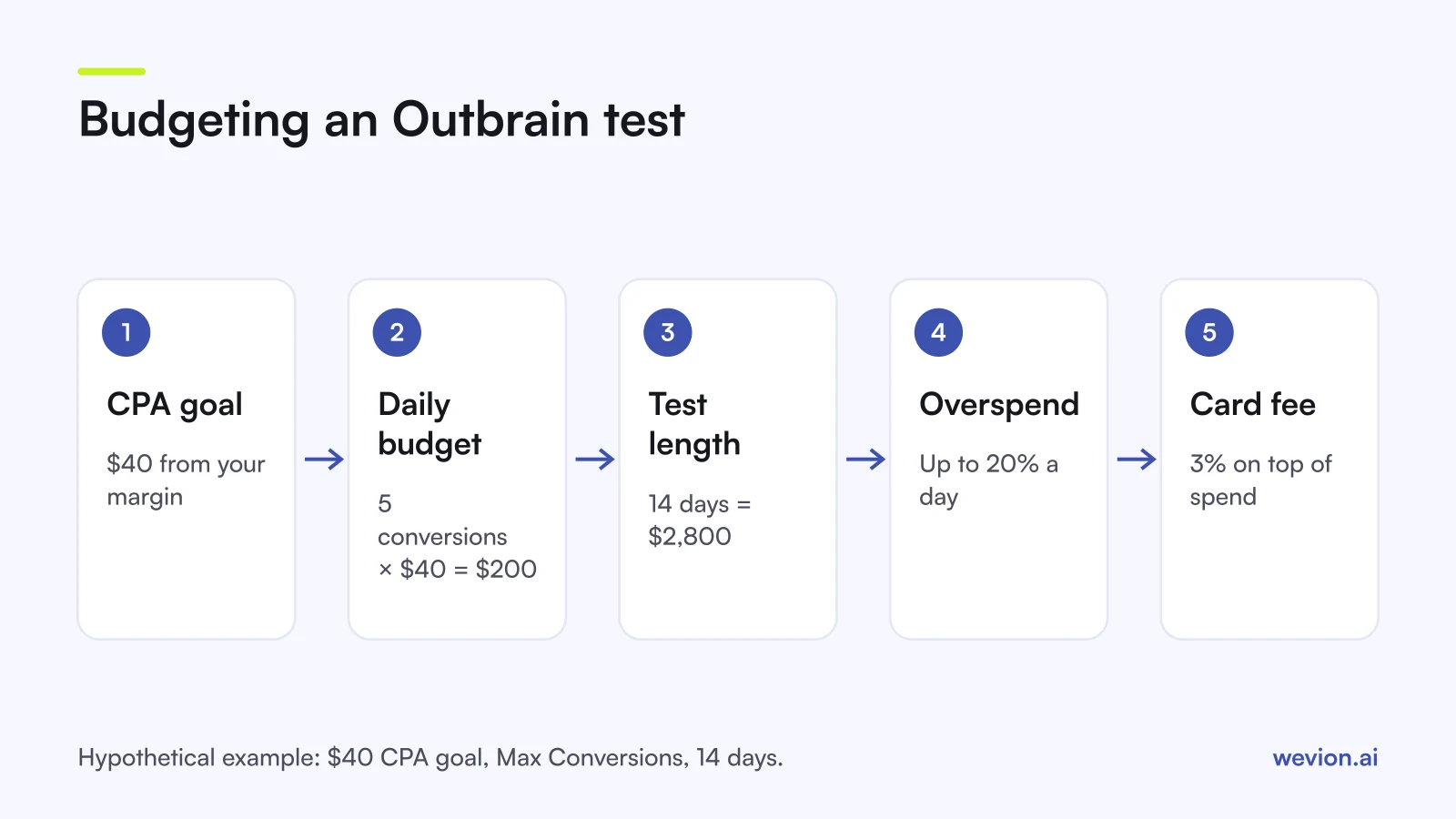
A worked example shows how the guidance turns into a test plan. Every figure here is hypothetical, chosen to make the maths readable, and none is an Outbrain benchmark.
A supplement brand can afford a cost per purchase of $40, worked out from its margin with our break-even ROAS calculator guide. It plans one desktop campaign in one country.
- Pick the mode. Target CPA would need about 7 × $40 = $280 a day. That is too much for a first test, so the brand starts on Max Conversions, which asks for at least 5 conversions a day: 5 × $40 = $200 a day.
- Check the click price it can afford. If the landing page converts 2% of clicks, the highest CPC that still hits a $40 CPA is $40 × 0.02 = $0.80. If early CPCs run well above that, the problem is the page or the offer, not the bid.
- Set the length. Outbrain describes a discovery period of about two weeks, so the test runs 14 days: 14 × $200 = $2,800 of planned spend.
- Add the extras. Daily spend can run 20% over budget, so a single day can reach $240; if every day did, the total would be $3,360. Paying by card adds 3%: $84 on $2,800, about $101 on $3,360.
- Write the budget down. Plan for $2,800 to $3,460 in total, and do not change budget or goal for the first 48 hours.
If purchases fall short of 5 a day, the brand follows Outbrain's own advice: keep Max Conversions and optimise for an upper-funnel event, such as Add to Cart, until purchase volume builds. For more on scaling native traffic once a test works, see our guide to scaling native arbitrage on Taboola and Outbrain.
How does Outbrain pricing compare with Taboola?
Outbrain and Taboola price the same way at heart, an auction charged mostly per click, so the practical differences sit in budget floors, guidance and fees.
| Point | Outbrain | Taboola |
|---|---|---|
| Pricing model | CPC | CPC or CPM |
| Published rate card | No | No |
| Minimum daily budget | 20 USD on the help page; 25 USD for new campaigns per an API notice | No hard minimum stated; recommends at least $50 or 10× CPA |
| Daily overspend | Up to 20% | Up to double the daily cap, overspend not charged |
| Billing | Card at round amounts, or prepayment | Card at set increments, monthly invoice or prepayment |
The Taboola column comes from our Taboola pricing guide, checked against Taboola's help pages on 29 October 2026. Which network costs less for you depends on your vertical and geography, so run both with the same offer, landing page and CPA goal before deciding.
Where Wevion fits
An Outbrain CPC means little on its own; what matters is whether an Outbrain customer costs more or less than one from Taboola, Meta or Google once each is measured the same way.
Wevion connects Outbrain through an API token you paste, next to Meta, Google, TikTok, Snapchat and Taboola through each platform's official API, syncs data about every 15 minutes and maps Outbrain's eCPM to CPM, so all six platforms sit side by side in one cross-channel view.
From there you read Outbrain's cost against the rest in cross-channel analytics, and automated rules can just notify you when cost per result crosses a threshold you set, with a cooldown and a daily cap on runs. Outbrain's bid strategy, budget and billing stay in Amplify. To move Outbrain data into a warehouse instead, see connecting Outbrain to BigQuery.
You can try it on your own ad accounts with a 14-day trial on the Pro plan. No card to start. We ask for one on day 7, or earlier if you use up the trial credits, and billing starts on day 14 only if you add it.
Key takeaways
- Outbrain pricing is cost per click, with no published rate card or average CPC.
- Conversion Bid Strategy has four modes: Semi Manual, Max Conversions, Target CPA and Target ROAS.
- The help page sets a 20 USD daily minimum; an API notice raised it to 25 USD for new campaigns from November 2025.
- Conversion bidding needs budget for at least 5 (Max Conversions) or 7 (Target CPA or ROAS) conversions a day.
- Plan for up to 20% daily overspend and a 3% card fee on top of media spend.
- Budget a first test from your CPA: daily budget, about two weeks, then overspend and fees.