
TikTok Spark Ads: Codes, Setup and Ecommerce Uses
Yuki Tanabe
Stratège Creative AI
TikTok Spark Ads let you run organic TikTok posts as paid ads, either from your own brand account or from a creator who gives you permission. For an ecommerce brand that is the cleanest way to put creator content in front of a paid audience without re-uploading the video, while keeping every like and comment on the original post.
Quick answer: Spark Ads are TikTok's native format for boosting organic posts. For your own posts, link the brand's TikTok account to the ad account. For a creator's post, the creator turns on Ad authorization in the post's Ad settings, generates a code valid for 7, 30, 60 or 365 days and sends it to you; you apply it in TikTok Ads Manager. Engagement earned while the ad runs goes to the original post.
This guide is about the format itself. Where Spark Ads sit in an account is covered in our TikTok campaign structure guide, and writing captions for them is in our ChatGPT prompts for TikTok ads.
What are TikTok Spark Ads?
TikTok describes Spark Ads as a native ad format that lets you publish ads using your own TikTok account's posts, or organic posts made by other creators with their authorisation. TikTok says all views, comments, shares, likes and follows gained from boosting the video during the promotion are attributed to the organic post.
Spark Ads are an ad-level choice, not a campaign type. TikTok lists them as available across the auction objectives Reach, Traffic, Video Views, Community interaction, App promotion, Conversions, Lead generation and Sales, so they sit in your normal ad groups next to other creative.
TikTok is also moving advertisers towards real accounts. In a January 2026 post, it said it would phase out Custom Identity starting in early 2026 and that new campaigns must be launched from a verified TikTok profile, naming Spark Ads as the easiest way to keep ads running through verified accounts.
How do Spark Ads differ from non-Spark ads?
The main difference is where a tap goes and where the engagement lands. A non-Spark ad behaves like an ad; a Spark Ad behaves like the organic post it came from.
| Spark Ads | Non-Spark ads | |
|---|---|---|
| Creative source | An organic post on a real TikTok account | A video uploaded in Ads Manager |
| Tapping the profile photo or name | Opens the account's profile | Opens the landing page |
| Engagement earned | Credited to the organic post | Stays with the ad |
| Caption | Comes from the organic post | Written in Ads Manager |
| Video length | Up to 10 minutes can be sparked | Up to 10 minutes for in-feed ads |
| Extra metrics | Paid likes, shares, followers, profile visits, comments | Likes, shares, comments |
Source: TikTok's Spark Ads overview and in-feed ad specs.
The call-to-action button and the caption still send people to your landing page. What changes is that the profile tap goes to the creator or brand account, so a strong profile helps.
How does the Spark Ads authorisation code work?
The code is how a creator gives an advertiser time-limited permission to run one post. TikTok's Smart+ Spark Ads guide sets out both sides.
Creator side, in the TikTok app:
- Tap the three dots on the video, then the Ad settings icon.
- Agree to the advertising content terms.
- Turn on Ad authorization.
- Tap Generate and choose an authorisation period of 7, 30, 60 or 365 days.
- Tap Copy Code and send it to the advertiser.
Advertiser side, in TikTok Ads Manager: go to Tools, open the Creative library, click Spark ads posts, then Apply for Authorization, paste the code and search. You can also add posts while building an ad: the creation guide shows a TikTok posts tab with Add post, where up to 20 codes can be authorised at once.
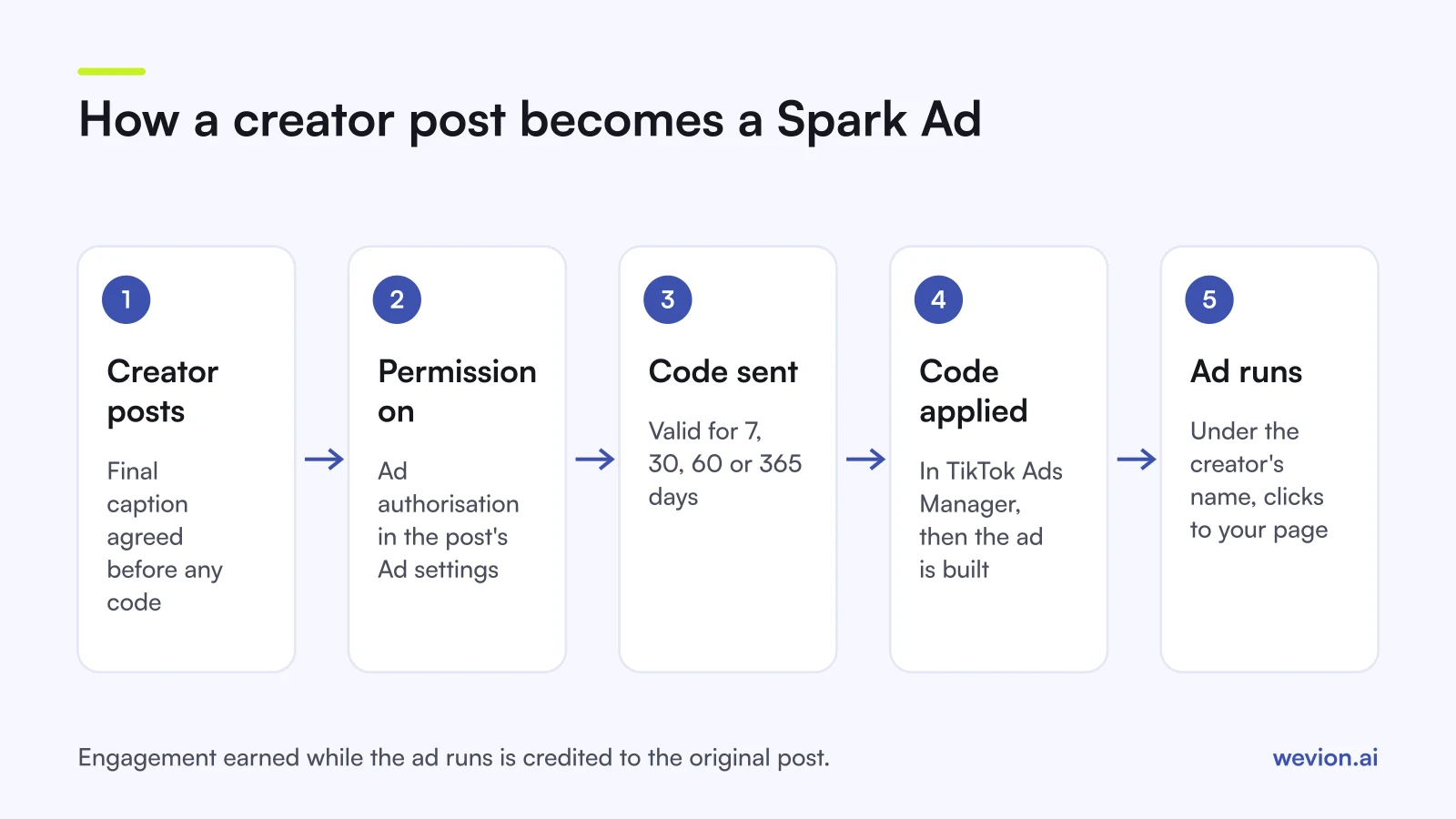
Three rules from TikTok's help centre to agree with the creator before the code is generated:
- The caption is locked. It cannot be edited after the post is authorised as an ad, so finalise it first.
- Private becomes public. A private video becomes public once it is used in a campaign.
- The post stays put. A video has to be un-authorised as a Spark Ad before it can be deleted from the organic account.
Pick the period to cover the whole campaign plus a margin. If the authorisation ends before the ad's end time, Ads Manager flags it. For an always-on creator ad, 365 days avoids chasing renewals.
Should you use your own posts or creator posts?
Both work, and most ecommerce accounts use both.
Your own posts. Link the brand's TikTok account to the ad account and it appears as an identity when you build the ad. In Business Center, an Admin can link a TikTok account to ad accounts under Accounts, TikTok accounts, then Linked accounts. TikTok notes that an account that is not a Verified Business Account may be blocked from linking. Agencies managing several brands should read our guide to TikTok Business Center for agencies.
Creator posts. These run under the creator's name, which is the point: the ad looks like a recommendation, not a brand message. Brief the creator as you would for any UGC ad, agree usage rights and the authorisation period in writing, and ask for the code only once the caption is final.
Which Spark Ads metrics count?
Spark Ads add social metrics, but an ecommerce brand should still judge them on sales.
- Paid social metrics. TikTok reports paid likes, paid shares, paid followers, paid profile visits and paid comments for Spark Ads. They tell you whether the post is building the account.
- Organic lift. Because engagement lands on the original post, a well-funded Spark Ad can keep collecting organic views and comments. That is a bonus, not the reason to run it.
- Video views. TikTok's video play metrics define 2-second and 6-second video views. Use them to compare one hook with another, as in our hook rate guide.
- Business metrics. Cost per purchase, return on ad spend and, where you can, store orders. A Spark Ad with thousands of likes and a high cost per purchase is a good post and a weak ad.
When you test Spark Ads against brand-made video, put them in the same ad group and label them in the ad name. If you are weighing video against images more widely, see static vs video ads for ecommerce.
How do ecommerce brands use Spark Ads?
- Creator reviews and unboxings. The classic use: a creator shows the product, you spark the post to a broad audience and send clicks to the product page.
- Brand account demos. Turn your best organic posts into always-on prospecting ads. Your organic results already tell you which ones hold attention.
- TikTok Shop. TikTok documents Spark Ads in Video Shopping Ads with single or multiple product links. Our TikTok Shop ads guide covers the Shop side.
- Next to catalogue ads. Spark Ads carry the story; TikTok catalogue ads carry the range. Running both covers discovery and product choice.
What are the common Spark Ads errors?
TikTok lists the Spark Ads code errors you will see in Ads Manager. The ones ecommerce teams hit most:
| Error | What it means | Fix |
|---|---|---|
| Authorization expired | The code's period has ended | Ask the creator to renew it |
| Authorization ends before the ad's end time | The period is shorter than the ad schedule | Ask for a longer period or shorten the ad |
| The post is not public | The creator changed visibility | Ask the creator to make it public |
| The video has been deleted | The post no longer exists | Choose another post |
| The code has been deleted | The creator removed the code | Ask for a new code |
| Story videos can't be used | Stories are not supported | Use a feed post |
Duets and multi-person posts can also be refused, so check those with the creator before you plan a campaign around them.
Where Wevion fits
Spark Ads usually run next to Meta creative, and the hard part is comparing them fairly when they live in different Ads Managers.
Wevion connects TikTok, Meta, Google, Snapchat, Taboola and Outbrain ad accounts through each platform's official API and syncs data about every 15 minutes, so creator ads on TikTok and their Meta counterparts sit side by side in one view. Automated rules can pause an ad, change a budget or just send an alert when cost per purchase moves past your limit, and each client gets its own workspace. Authorisation codes are still applied in TikTok Ads Manager.
Start a 14-day trial with no card. We ask for one on day 7, or earlier if you use up the trial credits, and billing starts on day 14 only if you add it.
Key takeaways
- TikTok Spark Ads run organic posts, yours or a creator's, as ads, and engagement goes to the original post.
- They are an ad-level choice across most auction objectives, so keep them in your normal ad groups.
- Creators turn on Ad authorization, generate a code for 7, 30, 60 or 365 days and send it; you apply it in Ads Manager.
- Finalise the caption first: it is locked once the post is authorised.
- Judge Spark Ads on cost per purchase and return on ad spend, with paid likes and follows as a bonus.
- Match the authorisation period to the campaign to avoid "Authorization expired" stops.