
Ad Creative Brief Template for Ecommerce Paid Social
Yuki Tanabe
Stratège Creative AI
An ad creative brief template turns "we need some new ads" into a one-page decision the whole team can check. For an ecommerce brand running paid social and video, the brief is where you decide who the ad is for, what it offers, which single message it carries and how you will know it worked. Skip those decisions and the creator makes them for you, one edit at a time.
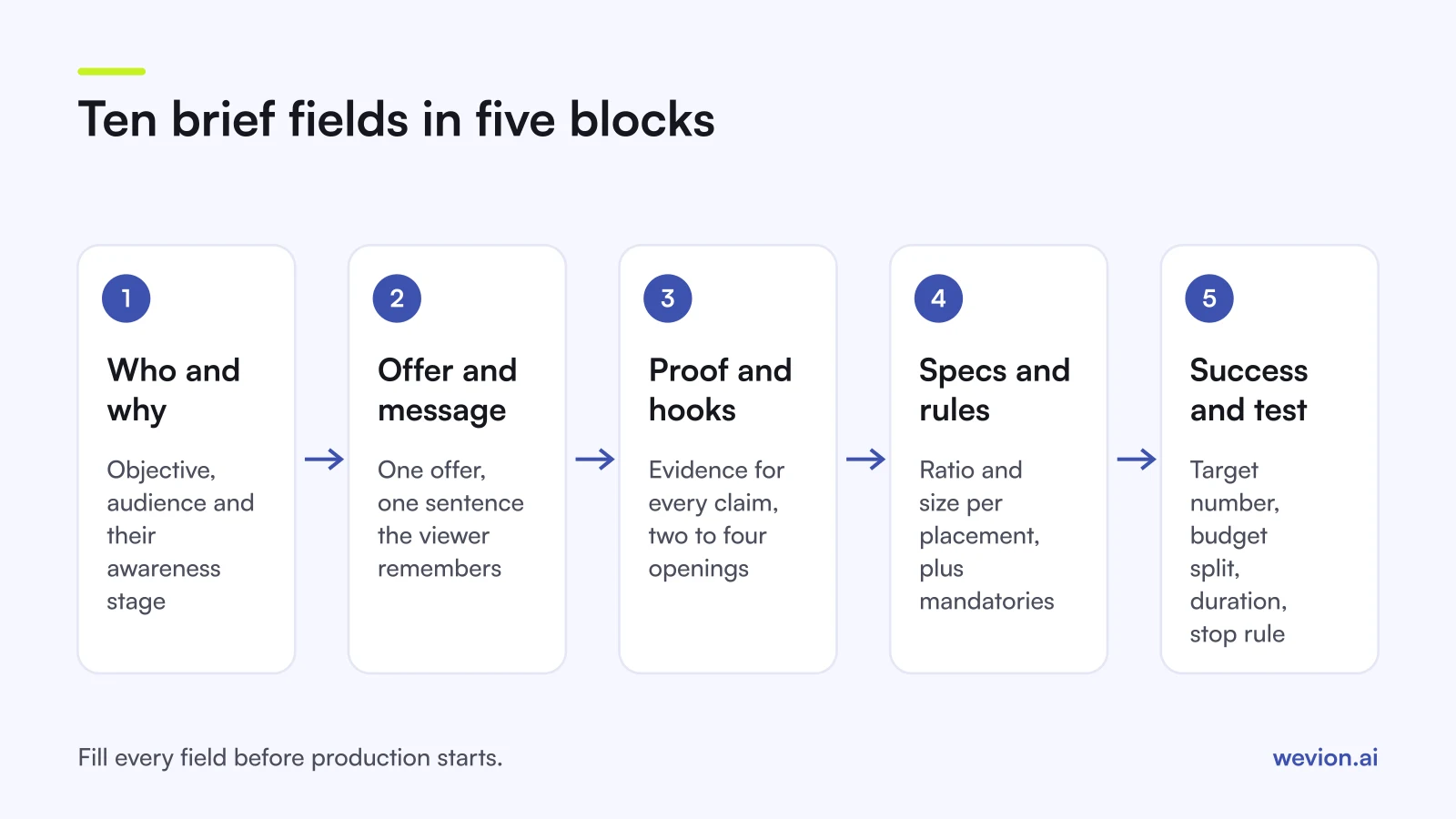
Quick answer: A good ad creative brief has ten fields: objective, audience and awareness stage, offer, one message, proof, hooks to test, format and specs per placement, mandatories, what success looks like, and the test plan. Fill all ten before production, keep it to one page, and write the success metric as a number you can check in the ad account.
This guide is about the creative itself: what goes into the ad and how you will judge it. If you want to turn a short brief into campaign structure instead, see from a one-line brief to a live campaign. If you are still deciding between images and video, start with static vs video ads for ecommerce.
Why does a paid social ad need its own brief?
A paid social ad has a few seconds and a small screen to stop someone scrolling, so it can carry one idea, not a brand book. A brief forces that choice before money is spent on production.
It also makes the result readable. If three videos differ in offer, message, hook and length, a winner tells you nothing you can reuse. If the brief fixes the offer and message and varies only the hook, the winning version tells you which opening works for this audience, and the next brief can build on it.
Without a brief, three things usually go wrong:
- Too many messages. Price, quality, sustainability and free returns all squeezed into fifteen seconds.
- No proof. A claim with nothing behind it, which viewers ignore and which can cause trouble with ad review or consumer law.
- No test plan. The ads go live in an existing ad set, compete with old winners and get judged on a week of noisy data.
The ad creative brief template: ten fields
Copy the table below into a doc or spreadsheet and fill one column per brief. Every field has a question that the answer must settle.
| # | Field | Question it answers | Good answer looks like |
|---|---|---|---|
| 1 | Objective | What should this ad make people do? | One action: first purchase, add to basket, sign-up |
| 2 | Audience and awareness stage | Who sees it, and what do they already know? | A person and a stage, not a demographic list |
| 3 | Offer | What do they get, at what price? | Product, price, any discount, its terms |
| 4 | One message | What single idea should they remember? | One sentence a viewer could repeat |
| 5 | Proof | Why should they believe it? | Reviews, test results, demo, guarantee |
| 6 | Hooks to test | How does the ad open? | Two to four first lines or first shots |
| 7 | Format and specs | Which placements, which sizes? | Ratio, resolution, length, safe zones |
| 8 | Mandatories | What must appear, and what must not? | Logo, terms, claims rules, words to avoid |
| 9 | Success | What number makes this a winner? | A target cost per purchase or ROAS |
| 10 | Test plan | How will it be compared, for how long? | Structure, budget, duration, decision rule |
1. Objective
Pick one action. "Awareness and sales" is two briefs. For most DTC prospecting ads the action is a first purchase, and the campaign optimises for purchases, so the creative should end on a reason to buy now.
2. Audience and awareness stage
Describe one person, then say how much they already know. A common way to frame this comes from Eugene Schwartz's book Breakthrough Advertising, which sorts prospects by awareness: unaware, problem aware, solution aware, product aware and most aware. The stage changes the opening. Someone unaware of the problem needs to see it first; someone who already knows your product needs the offer.
3. Offer
Write the product, the price and any discount with its terms. If the offer changes between versions, you are testing the offer, not the creative. Keep it fixed inside one brief.
4. One message
Write the one sentence a viewer should remember after the ad. If you cannot write it, the ad is not ready. Everything else in the ad, from the visual to the caption, should support that sentence.
5. Proof
List the evidence the creator can use: review quotes with permission, a product demo, a test result, a guarantee, a before-and-after the product can honestly deliver. Every claim in the message needs a line here. If the proof does not exist yet, change the message.
6. Hooks to test
The hook is the first line of copy or the first two or three seconds of video. Ask for two to four, each a different idea: a problem, a result, a question, an objection answered. Keep the rest of the ad the same so the hook is the variable. To find patterns worth borrowing, look at live ads in your category with the Meta Ad Library or TikTok's Top Ads in Creative Center.
7. Format and specs per placement
State the ratio and size for each placement you plan to run, because a 4:5 feed ad cropped into 9:16 Reels loses its edges. The table below uses the platforms' own recommendations as of November 2026.
| Placement | Ratio | Recommended size | Note from the platform |
|---|---|---|---|
| Facebook Feed (image or video) | 4:5 | 1440 x 1800 px | Meta ads guide |
| Instagram Reels | 9:16 | 1440 x 2560 px | Keep about 14% top, 35% bottom and 6% each side free of text and logos (Meta) |
| TikTok In-Feed (video) | 9:16 recommended | 540 x 960 px or more | Horizontal and square also supported (TikTok) |
Write the length you want too. Meta and TikTok both accept long videos, so the limit is a creative choice, not a platform one. If creators are making the ads, say whether they will run from your account or theirs: TikTok Spark Ads and Meta partnership ads both need the creator's permission.
8. Mandatories
List what must appear (logo, discount terms, product name), what must not (claims your proof does not support, competitor names, words your brand avoids) and any category rules. Health, finance and alcohol products have tighter rules on every platform, so check the platform's advertising policies before production, not after rejection.
9. What success looks like
Write a number. "Good engagement" cannot be checked. A cost per purchase below a set figure, or a ROAS above your break-even line, can. Our breakeven ROAS calculator shows how to set that line from your margin. Add one or two diagnostic metrics, such as hook rate for video, to explain why an ad won; our guide to hook rate and hold rate defines them.
10. How it will be tested
Say where the ads run, how budget is split, how long the test lasts and what decision you will take at the end. Decide the stop rule before launch. For the statistics behind a clean result, see our A/B testing guide; for a wider testing order across concept, format and hook, see the creative testing framework.
A filled-in example
The brand below is hypothetical, and so are its numbers. It sells an insulated steel water bottle at €35 and wants new prospecting ads for Meta and TikTok.
| Field | Answer |
|---|---|
| Objective | First purchase from new customers |
| Audience and stage | Commuters who already carry a plastic bottle and find their water warm by lunch. Problem aware, not yet solution aware |
| Offer | Bottle at €35, free shipping over €30, 30-day returns |
| One message | "Your water is still cold at 5pm." |
| Proof | Internal test: ice still in the bottle after 24 hours at room temperature (report on file); 4.7 average from 1,200 store reviews; demo of ice rattling at the end of a workday |
| Hooks to test | A: shot of warm plastic bottle on a desk, "Lunchtime. Warm water again." B: ice rattling at 5pm, "This was filled at 7am." C: a review read aloud by a customer |
| Format and specs | 9:16 video, 15 to 20 seconds, for Reels and TikTok; 4:5 cut for Facebook Feed; captions on, text inside the Reels safe zone |
| Mandatories | Logo in the last two seconds; "free shipping over €30" shown with the threshold; no claim of "keeps cold for days"; no comparison with named brands |
| Success | Cost per first purchase at or below €28, the brand's first-order break-even; hook rate reported to explain the result |
| Test plan | One new ad set per platform, the three hooks as separate ads, equal budget, same landing page; run for two weeks, then keep the hook with the lowest cost per purchase if the gap holds, and brief the next round on it |
Two details make this brief usable. The proof line has a source for every claim in the message, so the creator knows "cold at 5pm" is safe and "cold for days" is not. And the success line is a number the media buyer can check on day 14, with a clear action attached.
Common mistakes with creative briefs
- Briefing a format instead of a message. "Make a UGC video" is a production choice. Decide the message first, then pick the format that proves it best.
- Changing the offer between versions. A 20 percent discount on one hook and none on another tests the discount.
- Proof added after production. Claims without evidence get cut at review or, worse, run and mislead.
- One spec for every placement. Plan the 9:16 and 4:5 versions at the shoot, not in the edit.
- No decision rule. Without one, every result gets a new explanation and nothing is learned.
- Never closing the loop. Write what won and why at the top of the next brief, so each round starts from evidence.
Where Wevion fits
A creative brief usually ends in the same test on two or three platforms, and comparing three Ads Managers by hand is where the test plan breaks down.
Wevion connects Meta, Google, TikTok, Snapchat, Taboola and Outbrain ad accounts through each platform's official API and syncs data about every 15 minutes, so the results of every hook sit side by side in one view across platforms.
Bulk Launch builds matched test campaigns across platforms from one grid, so each version of the brief goes out with the same budget and settings. Automated rules can then pause a losing ad, change a budget or just send an alert when cost per purchase crosses the line you wrote in field 9.
Start a 14-day trial with no card. We ask for one on day 7, or earlier if you use up the trial credits, and billing starts on day 14 only if you add it.
Key takeaways
- A creative brief is ten decisions made before production: objective, audience and stage, offer, message, proof, hooks, specs, mandatories, success and test plan.
- Keep one offer and one message per brief, and vary only the hook between versions.
- Every claim in the message needs a line of proof; if there is none, change the message.
- Write specs per placement: 4:5 for Facebook Feed, 9:16 with safe zones for Reels and TikTok.
- Set success as a number tied to your break-even, and agree the stop rule before launch.
- Put what won, and why, at the top of the next brief.