
PPC Proposal Template for Ecommerce Clients
Marta Kowalczyk
Agency Operations Lead
A ppc proposal template saves you from rebuilding the same document for every pitch, but only if its structure answers what an ecommerce founder actually asks: what is wrong today, what you will do, what it will cost, and how both sides will know it worked. Below is a ten-section template you can copy, a fully filled example for a fictional brand, and the mistakes to cut before you hit send.
Quick answer: A PPC proposal for an ecommerce client needs ten sections: summary, audit findings, goals and KPIs, channel plan, budget and test plan, reporting cadence, pricing, terms, access needed and next steps. Base goals on store data such as MER or POAS, not platform ROAS, and put a written access list and a price floor in every proposal.
Before writing the proposal, you need two inputs: an audit of the prospect's accounts and your own price. Our cross-platform ad account audit checklist covers the first, and our guide on how much to charge for Facebook ads management covers the second.
What sections does a PPC proposal need?
A PPC proposal works best as a short decision document, where each section answers one question the client will ask before signing.
| # | Section | Question it answers | Length |
|---|---|---|---|
| 1 | Summary | What do you propose, and what does it cost? | 1 page |
| 2 | Audit findings | What is not working today? | 3-5 findings |
| 3 | Goals and KPIs | How will we measure success? | Half a page |
| 4 | Channel plan | Which platforms, and why? | Half a page |
| 5 | Budget and test plan | How much spend, split how, tested how? | 1 table |
| 6 | Reporting cadence | When and how will I hear from you? | A few lines |
| 7 | Pricing | What do you charge, and how does it change? | 1 page |
| 8 | Terms | What are the commitments on both sides? | A few lines |
| 9 | Access needed | What do you need from us to start? | Checklist |
| 10 | Next steps | What happens after I say yes? | 3 steps |
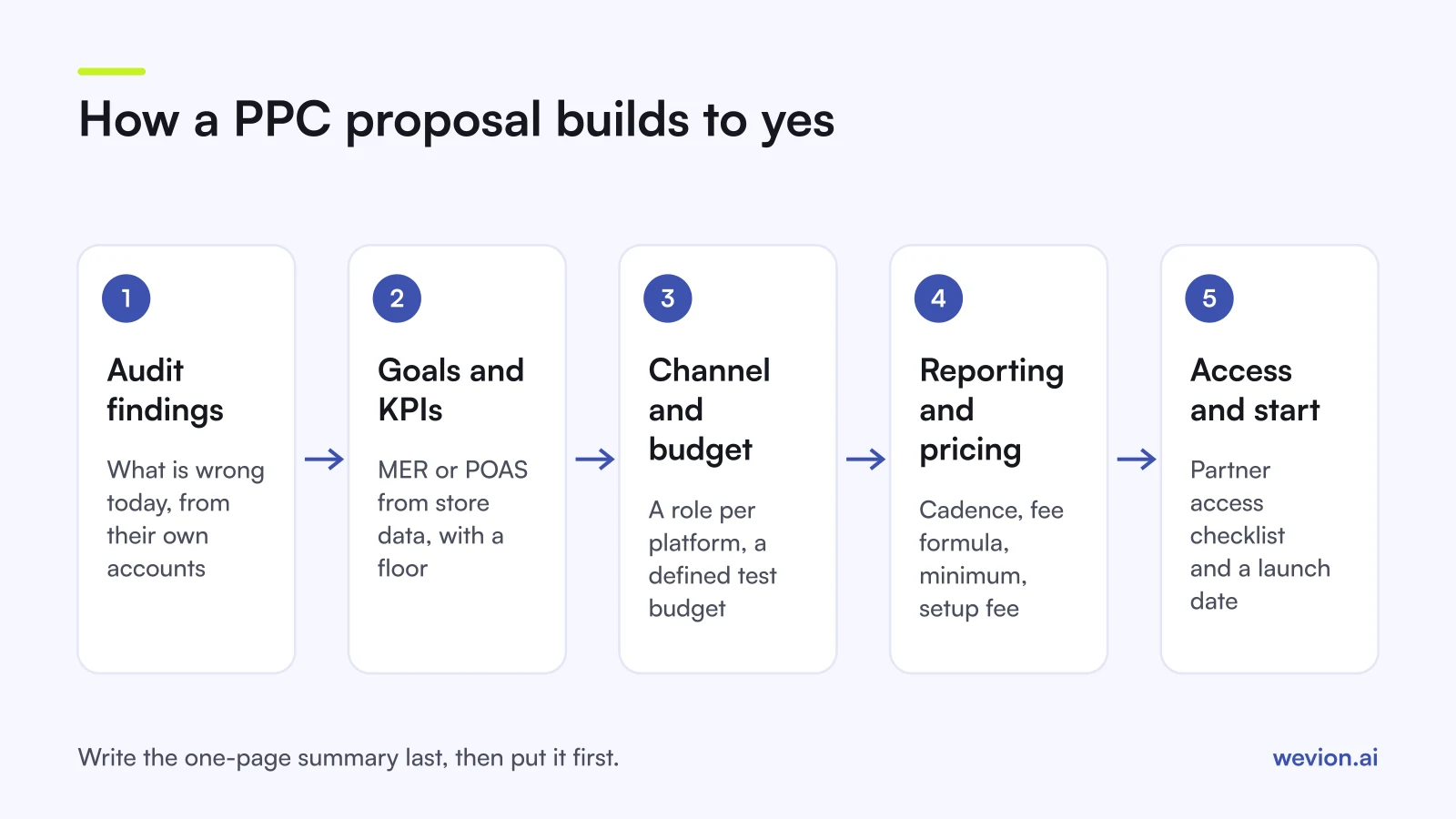
The copyable PPC proposal template
Copy the block below into your document editor and replace every bracket. Each line is a prompt for what that section must contain, not filler text to keep.
1. SUMMARY
- Where you are: [net sales, ad spend, MER, channels, last 90 days]
- What we propose: [channels, budget, main changes]
- Target: [KPI and floor, by when]
- Our fee: [model, monthly amount, setup fee]

2. AUDIT FINDINGS
- Finding 1: [what we saw] > [why it costs money] > [what we will do]
- Finding 2: ...
- Finding 3: ...

3. GOALS AND KPIS
- Primary KPI: [MER or POAS, from store data]
- Floor: [minimum KPI that triggers a budget review]
- Secondary: [new-customer revenue, CPA by channel]
- Data source: [store reports for revenue, platform billing for spend]

4. CHANNEL PLAN
- [Platform]: [role in the funnel], [campaign types]

5. BUDGET AND TEST PLAN
- Monthly budget by platform: [table]
- Tests in the first 90 days: [hypothesis, budget, success rule]

6. REPORTING CADENCE
- Weekly: [what, format]
- Monthly: [review call, what is decided]

7. PRICING
- Setup fee: [amount, what it covers]
- Monthly fee: [model, formula, minimum]
- Ad spend: paid by the client directly to each platform

8. TERMS
- Minimum term, notice period, scope, what counts as extra work

9. ACCESS NEEDED
- [Platform and asset]: [access level]

10. NEXT STEPS
- Sign > access > audit call > first launch on [date]
How do you write each section?
Each section has one job, and the most common failure is filling it with generic agency claims instead of facts about this one store.
Summary. Write it last, and make it the only page a busy founder needs. State the current numbers, your plan in two sentences, the target and the fee. If the summary does not mention their money, it is not a summary.
Audit findings. Three to five findings, each with the same shape: what you saw, why it costs money, what you will do. Specific beats long. "Catalogue ads run on a feed missing sale prices" is worth more than ten slides on best practice.
Goals and KPIs. Use metrics from the store, not from one platform. Platform ROAS counts conversions by each platform's own attribution rules, so the totals across Meta, Google and TikTok can add up to more orders than the store took. Marketing efficiency ratio (MER) divides total net sales by total ad spend; see MER vs ROAS. If the brand shares product costs, add POAS, profit divided by ad spend; see POAS vs ROAS. Always add a floor that triggers a review, so a bad month leads to a conversation rather than a surprise.
Channel plan. Give each platform a role. Prospecting on Meta, Shopping and brand search on Google, a small test on TikTok is a plan; "omnichannel growth" is not.
Budget and test plan. Show a monthly budget by platform and keep a defined share for tests, each with a hypothesis, a budget and a rule for calling it.
Reporting cadence. Say what the client gets and when: a weekly summary, a monthly review call, and what gets decided in that call.
Pricing. Put the fee formula, the setup fee and the minimum on one page. State in writing that ad spend is paid by the client directly to each platform. Our guide to Meta ads agency billing explains why.
Terms and access. List the minimum term, notice period and scope, then a checklist of the access you need. Ask the client to keep ownership of every asset and grant your agency partner access; agency ad account ownership explains the setup. On Meta, the owner grants partner access to your business portfolio. On Google Ads, you send a link request from your manager account and the client accepts it.
A filled example: Quillmoor Home (fictional)
Quillmoor Home is a fictional homeware brand, and every number below is hypothetical. The numbers are chosen to add up, so you can check the logic before using your own.
1. Summary. Over the last 90 days, Quillmoor averaged €80,000 of net sales and €16,000 of ad spend a month (Meta €14,000, Google €2,000), an MER of 5.0. We propose growing net sales to €100,000 a month within six months on €22,000 of spend, an MER of about 4.5, while raising monthly contribution after ads. Fee: €1,700 a month plus 4 percent of spend above €20,000, and a €1,250 setup fee.
2. Audit findings.
- Meta prospecting and retargeting overlap, so the same buyers see both, and frequency is high on past purchasers. We will separate audiences and cap retargeting spend.
- Google spend sits almost entirely on brand search. We will add Shopping campaigns on the best-selling collections.
- The product feed has no sale prices, so catalogue ads show full prices during promotions. We will fix the feed before the next sale.
3. Goals and KPIs. Quillmoor keeps 45 percent of net sales after product cost, shipping, payment fees and returns. That puts break-even MER at 1 ÷ 0.45, about 2.2. Today, €36,000 of contribution before ads minus €16,000 of spend leaves €20,000. At the target, €45,000 of contribution minus €22,000 of spend leaves €23,000. Primary KPI: MER of at least 4.5. Floor: MER below 3.5 for two consecutive weeks triggers a budget review. For the margin layers, see contribution margin for ecommerce.
4 and 5. Channel, budget and test plan.
| Platform | Role | Monthly budget |
|---|---|---|
| Meta | Prospecting and capped retargeting | €15,000 |
| Shopping and brand search | €5,000 | |
| TikTok | 90-day test on two best sellers | €2,000 |
| Total | €22,000 |
The TikTok test continues after 90 days only if its new-customer orders come in at a cost no higher than Meta prospecting over the same period.
6. Reporting. A weekly PDF summary every Monday, and a monthly call to review MER against the floor and agree next month's budget.
7. Pricing. Setup fee €1,250 for the audit fixes, feed correction and new campaign structure. Monthly fee €1,700 plus 4 percent of spend above €20,000: at €22,000 of spend, €1,700 + €80 = €1,780. Ad spend is paid by Quillmoor directly to each platform.
8 to 10. Terms, access and next steps. Three-month minimum term, then 30 days' notice. Access: partner access to Quillmoor's Meta ad account, dataset, Page and catalogue; a Google Ads link to our manager account; TikTok Business Center partner access for the test; read access to store sales reports. Next steps: sign, grant access, audit call in week one, first launch in week two. Our guide to Facebook ads agency client onboarding covers what happens next.
What mistakes make a PPC proposal fail?
Most proposals lose the deal, or the margin, through a handful of avoidable choices rather than a weak strategy.
- Promising a fixed ROAS. You do not control prices, stock or the market. Promise a method, a KPI and a floor.
- Using platform numbers as the goal. Each platform reports its own attributed revenue. Use store data for revenue.
- Pricing without a scope. Without platforms, campaign count and creative volume in writing, every request becomes free work.
- No access list. A signed client who takes three weeks to grant access burns your first month.
- Too many tests. Five tests on a €22,000 budget means none gets enough spend to call. Pick one or two.
- Agency-owned accounts by default. If you create accounts in your own portfolio, a client exit becomes a dispute.
Where Wevion fits
Once the proposal is signed, the plan inside it has to run on several platforms at once, and the reporting has to arrive on the cadence you promised.
Wevion connects Meta, Google, TikTok, Snapchat, Taboola and Outbrain ad accounts through each platform's official API, syncs data about every 15 minutes, and gives each client its own workspace, so the channel plan you sold sits in one dashboard instead of three separate ad managers.
You can launch the campaigns from the channel plan with Bulk Launch, track spend across platforms in cross-channel analytics, and send scheduled PDF or CSV reports weekly or monthly. Our first-week onboarding walkthrough shows the setup step by step.
You can try it on your own ad accounts with a 14-day trial on the Pro plan. No card to start. We ask for one on day 7, or earlier if you use up the trial credits, and billing starts on day 14 only if you add it.
Key takeaways
- A PPC proposal for ecommerce needs ten sections, led by a one-page summary written last.
- Audit findings follow one shape: what you saw, why it costs money, what you will do.
- Set goals on store data, such as MER or POAS, with a floor that triggers a review.
- Give every platform a role, and keep a defined test budget with a rule for each test.
- Put pricing, scope and the minimum fee on one page; the client pays ad spend directly.
- End with a written access list so the first month goes into campaigns, not chasing permissions.