
Conversion Leads Optimization on Meta: Setup and Requirements
Rafael Moreira
资深效果营销专家
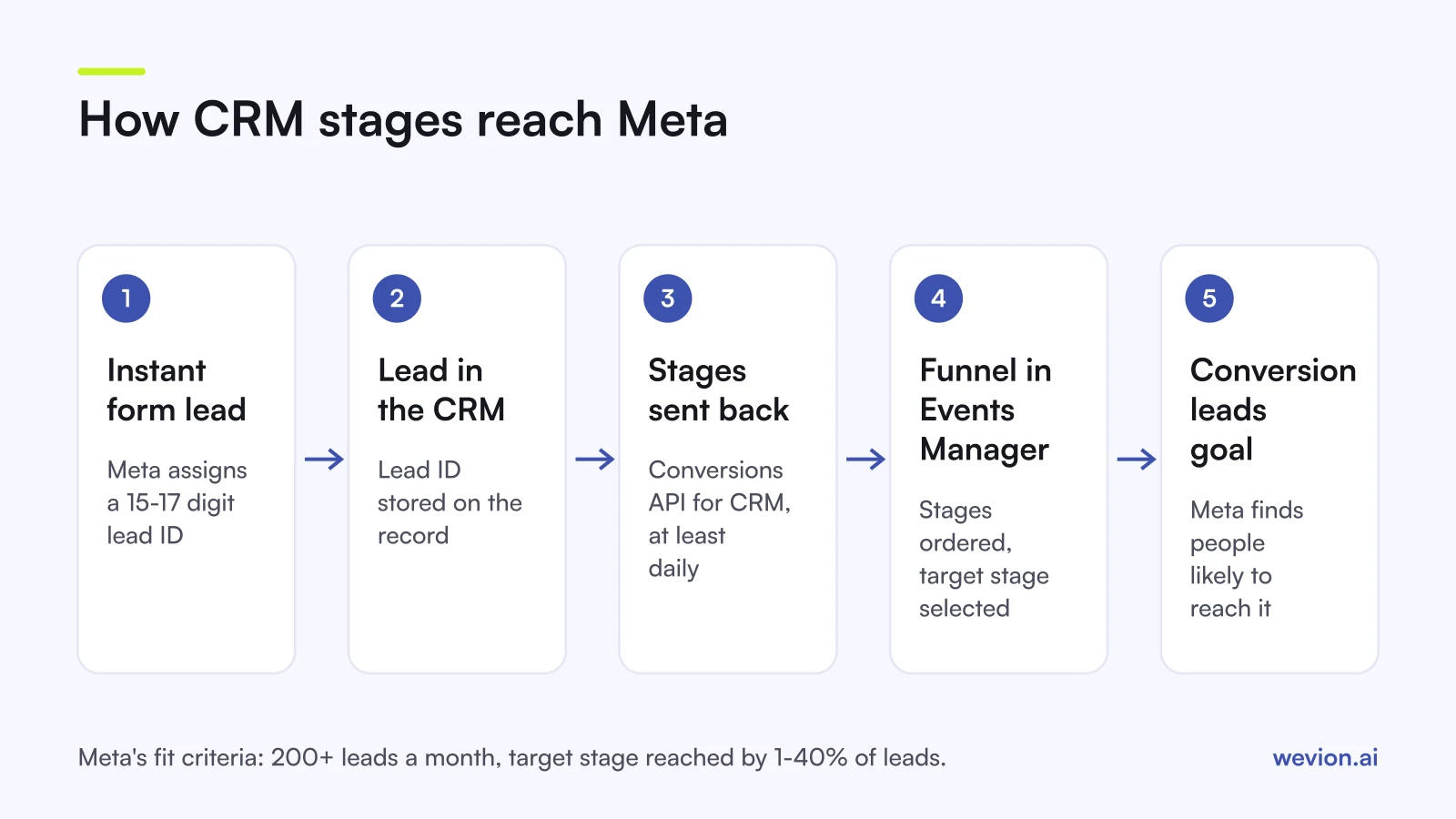
Conversion leads optimization is Meta's way of delivering lead ads to people likely to become qualified leads or customers, rather than to people likely to fill in any form. You choose the conversion leads performance goal, send each lead's progress from your CRM back to Meta through the Conversions API for CRM, and Meta uses those stages to decide who sees the ad.
Quick answer: Store Meta's lead ID with every instant form lead, connect your CRM to a CRM dataset in Events Manager, send every stage change at least once a day, order the stages in Events Manager and pick the earliest one you want more of. Meta's fit criteria are at least 200 leads a month and a target stage that 1% to 40% of leads reach within 28 days.
This guide is about optimising delivery. For measuring lead quality and building the CRM report, see our guide to tracking lead quality through your CRM. For the form itself, see Facebook lead ads best practices and our guide to the Higher intent instant form.
What is the conversion leads performance goal?
The conversion leads performance goal is an ad set setting that tells Meta to find people likely to reach a later stage in your sales funnel after they submit a lead form. The default Leads goal optimises for the form submission itself. Conversion leads optimises for what happens next, using the outcomes you report from your CRM.
| Leads goal | Conversion leads goal | |
|---|---|---|
| What Meta optimises for | Form submissions | Leads likely to reach a stage you choose |
| Data Meta learns from | Submissions on Meta | Submissions plus CRM stages you send back |
| Cost per lead | Usually lower | Often higher |
| Best judged on | Cost per lead | Cost per qualified lead or customer |
Meta's Conversions API for CRM documentation says the goal currently supports Facebook and Instagram lead ads with instant forms only. Meta's lead generation page also mentions optimising for lead quality with website forms, so check what Ads Manager offers for the client's campaign before you plan around a landing page.
Meta has published one figure on the goal. In an April 2024 post on instant forms, it said instant form campaigns with a CRM connected through the Conversions API and optimised for conversion leads cut cost per quality lead by 15% and increased quality lead conversions by 44% on average. Meta adds that performance may vary.
What data does Meta require?
Meta publishes a short list of fit criteria and a payload specification, and both matter before you promise this to a client. The integration overview and the payload specification give these rules:
| Requirement | What Meta says |
|---|---|
| Campaign type | Facebook and Instagram lead ads with instant forms |
| Lead volume | At least 200 leads a month |
| Target stage conversion rate | Between 1% and 40% of leads |
| Timing of the target stage | Within 28 days of the lead being generated |
| Upload frequency | At least once a day |
| Lead identifier | The 15 to 17 digit Meta lead ID, or customer details such as email, phone or click ID if you do not have it |
| Event age | event_time can be up to 7 days before you send the event, and must be after the lead was generated |
| Which stages to send | All stages as they are updated, including the initial lead stage |
The payload itself is small. Meta's specification sets action_source to system_generated and event_source to crm for every conversion leads event, and lead_event_source to the name of the tool the leads come from, such as HubSpot or an in-house CRM. event_name is free text: it carries your own stage name. A minimal event looks like this:
{
  "event_name": "Qualified",
  "event_time": 1793865600,
  "user_data": { "lead_id": 1234567890123456 },
  "action_source": "system_generated",
  "custom_data": {
    "lead_event_source": "HubSpot",
    "event_source": "crm"
  }
}
If you send a lead ID, it must be a valid one, or Meta rejects the event. If you send email or phone instead, they must be hashed.
Which lead stage should you optimise for?
The stage to optimise for is the earliest one that tells you a lead is worth having, as long as it meets Meta's range. Meta's sales funnel setup guide says to order your stages in Events Manager and select the earliest stage you want to optimise for, because the system also optimises for every stage below it.
Here is a worked example with hypothetical numbers for a client generating 400 instant form leads a month, with a 45-day sales cycle:
| Stage | Leads reaching it | Share of leads | Within 28 days? | Eligible? |
|---|---|---|---|---|
| Contacted | 240 | 60% | Yes | No, above 40% |
| Qualified | 60 | 15% | Yes | Yes |
| Proposal sent | 24 | 6% | Mostly | Yes, but slower to learn |
| Won | 8 | 2% | No, the cycle is 45 days | No |
Contacted is too common to tell Meta anything useful: most leads get there. Won is in the percentage range, but most deals close after 28 days. Qualified is the natural target, with 60 events a month and a decision made within days. Because Meta also optimises for the stages below the one you pick, proposals and wins still feed the model.
If no stage fits, change the definition before you change the goal. A client whose "qualified" means "called back" will see a share above 40%. Tighten it to "called back and confirmed a budget" and agree the definition in writing, since the sales team will apply it every day.
How do you set up conversion leads optimization?
Setting up conversion leads optimization follows the order in Meta's integration timeline, and Meta estimates about 3 to 4 weeks from start to full value. The steps:
- Connect the CRM to lead ads. Leads must reach the CRM with Meta's lead ID stored on each record. Without the ID, matching depends on email or phone.
- Create a CRM dataset. Meta's getting started guide says to go to Events Manager, click Connect Data Sources, select CRM and create a new dataset, so CRM events do not mix with existing website events.
- Implement the integration. Meta lists a developer build, which it estimates at 3 to 4 weeks, or Zapier, the Salesforce app or another partner integration, estimated at under a day.
- Let Meta verify the data. Meta estimates about 1 to 2 days, with no action needed.
- Configure the sales funnel. In Events Manager, your CRM stages appear as funnel stages. Remove the ones that do not belong, order the rest and select the stage to optimise for. You need admin access to the dataset.
- Allow for the learning phase. Meta estimates 2 to 4 weeks. You can run conversion leads campaigns during this time, but Meta says the full lift comes after it ends.
Then set the ad set's performance goal to conversion leads. Meta's getting started guide says the CRM integration is not a requirement to start running the goal, but results improve once it is in place. For agencies, the better order is to finish steps 1 to 5 first, so the first campaign learns from real stages.
The learning phase on the ad set still applies on top of the dataset's learning. Our learning phase guide explains which edits restart it.
How do you judge a conversion leads campaign?
A conversion leads campaign should be judged on the stage you asked Meta to find, not on cost per lead. Cost per lead often rises when Meta stops chasing the cheapest submissions, and that is expected.
A hypothetical comparison over the same month and budget:
| Leads goal | Conversion leads goal | |
|---|---|---|
| Spend | €6,000 | €6,000 |
| Leads | 400 | 300 |
| Cost per lead | €15 | €20 |
| Qualified rate | 15% | 24% |
| Qualified leads | 60 | 72 |
| Cost per qualified lead | €100.00 | €83.33 |
Here conversion leads costs a third more per lead and still brings 12 more qualified leads for the same spend. Compare the two only after the conversion leads campaign has finished learning, and use stages from the CRM, not leads reported in Ads Manager.
What are the common conversion leads mistakes?
Most conversion leads problems come from the data, not from the campaign settings. Watch for these:
- Not storing the lead ID. Without it, every event depends on matching email or phone.
- Sending only the final stage. Meta asks for every stage, including the initial lead, as it happens.
- Weekly uploads. Meta asks for at least daily, and events older than 7 days fall outside the limit.
- A target stage outside 1% to 40%. Too common teaches Meta nothing, too rare gives it too little.
- Renaming stages mid-campaign. event_name is free text, so a new spelling looks like a new stage.
- Mixing clients in one dataset. Give each client its own CRM dataset in its own business assets. Our guide to agency ad account ownership explains why that matters when a client leaves.
TikTok has a similar setup called lead quality optimisation, covered in our guide to TikTok lead generation ads. Using the same stage names on both platforms keeps reporting comparable.
Where Wevion fits
Conversion leads optimization lives between the client's CRM and Meta, and Wevion is not part of that connection: it does not send events to Meta and does not deduplicate or fix attribution.
Wevion connects Meta, Google, TikTok, Taboola, Snapchat and Outbrain ad accounts through each platform's official API, syncs data about every 15 minutes, and shows spend and platform-reported results for every account in one view, so a conversion leads campaign and a Leads campaign sit side by side.
Each client gets its own workspace, and team roles such as manager, media buyer, finance and viewer decide who can change what. Automation rules can pause ad sets, change budgets or just send an alert when cost per lead crosses a threshold you set. If you move budget between platforms, cross-platform rules are in beta.
You can try it on your own ad accounts with a 14-day trial on the Pro plan. No card to start. We ask for one on day 7, or earlier if you use up the trial credits, and billing starts on day 14 only if you add it.
Key takeaways
- The conversion leads goal optimises for leads likely to reach a CRM stage you choose, not for form submissions.
- Meta's fit criteria: at least 200 leads a month, a target stage reached by 1% to 40% of leads within 28 days, and daily uploads.
- Store the 15 to 17 digit lead ID, and send every stage with action_source system_generated and event_source crm.
- Order stages in Events Manager and pick the earliest one worth optimising for; later stages still count.
- Expect about 3 to 4 weeks to full value, and judge the campaign on cost per qualified lead.