
Law Firm Facebook Ads and Google Ads: A Lead Generation Guide
Marta Kowalczyk
Agency Operations Lead
Law firm Facebook ads, together with Google Search and Local Services Ads, are how most firms buy enquiries from people who need a lawyer now: after an accident, an arrest, a separation or a dispute with an employer. The ads themselves are standard lead generation. What makes legal different is the value of one signed case, the speed at which people call the next firm, and the professional conduct rules that sit on top of the platforms' own policies.
Quick answer: Use Google Search and, where available, Local Services Ads for people already looking for a lawyer, and Meta for practice areas you can explain with an offer, such as a free consultation. Qualify with practice area, location and timing, call back within minutes, and send consultations and signed cases back to Meta and Google so the platforms learn which leads matter. Check every ad against your jurisdiction's lawyer advertising rules.
For the form setup on each platform, see our guides to Facebook lead ads best practices and Google Ads lead form assets. This guide covers what changes for law firms. Nothing here is legal or ethics advice: the firm is responsible for its own advertising and should check it against its regulator's rules.
Which campaign types fit law firms?
The campaign type that fits a law firm depends on whether the client is already searching for help and how urgent the matter is. Someone arrested last night searches; someone thinking about a will may only act when an ad prompts them.
| Practice area example | Client is | First channel | Main conversion |
|---|---|---|---|
| Criminal defence, DUI | Searching urgently | Search, Local Services Ads | Phone call |
| Personal injury | Searching within days or weeks | Search, Local Services Ads, Meta | Call or form |
| Family law | Researching, often privately | Search, then Meta | Form or call |
| Wills, estate planning | Not yet looking | Meta, Search | Form or booking |
| Immigration | Researching for weeks | Search, Meta | Form with consultation booking |
Meta instant forms or a landing page? Instant forms bring more leads at a lower cost per lead because the form opens inside Facebook or Instagram with contact details pre-filled. A landing page asks more of the person and usually brings fewer, more deliberate enquiries, plus the chance to show the firm's credentials and practice areas. Many firms test both. If an intake team calls every lead, Meta's Higher intent instant form adds a review screen before submission, which trades some volume for intent.
Google Search is the base for most firms, because the query states the need: "car accident lawyer near me" or "immigration solicitor Manchester". Add a call asset for urgent practice areas and track calls as conversions, as covered further down.
Where are Local Services Ads available for lawyers?
Local Services Ads for lawyers are Google's pay-per-lead ads that show on Search and Maps, and their availability depends on country, city and practice area. Google's page on business screening and verification requirements lists, for the United States, 17 lawyer categories, including bankruptcy, criminal, DUI, family, immigration, personal injury, estate and traffic lawyers. Each comes with these checks:
- business owner identity verification;
- state bar licence checks for each lawyer in the firm in that practice area;
- professional liability insurance, where local law requires it;
- business and representative checks for select users.
The UK version of the same page lists 15 legal categories, such as personal injury, family, employment, immigration and probate lawyer services. It says professional services categories are being piloted and are only available in Greater London, and it asks for professional indemnity insurance and active membership with the solicitors' or barristers' regulator for each member of the firm. For other countries, Google's Local Services overview points to an eligibility check by area.
Local Services Ads are also changing format. Google's page on the move to Performance Max campaigns with pay-per-lead goals says the migration began in August 2026 with select US home services, widens in late 2026 and reaches non-US accounts and remaining categories in 2027. It does not name legal categories, so ask the account team when the firm's account will move. Billing stays per lead, while historical reports do not carry over and manual lead disputes end, so download the firm's lead history before the switch.
What should a law firm lead form ask?
A law firm lead form should sort enquiries by whether the firm can take the matter, not collect the story of the case. Practice area, location and timing decide most of that, and the details belong in a confidential intake call.
Four or five multiple choice questions cover it:
- What do you need help with? The practice areas the firm handles, plus "something else".
- Where is the matter? State, county or region, because the firm's lawyers must be able to act there.
- When did it happen? Within the last month, in the last year, longer ago. Time limits differ by matter and place, so the intake team checks them on the call.
- Do you already have a lawyer for this? Yes or no.
- How should we contact you? Phone, email or text, and a good time.
On Meta, conditional logic in lead ads can send each practice area to its own follow-up question and close the form politely for work the firm does not do.
Leave out questions about health, injuries in detail, criminal history or finances. Meta's personal attributes policy says ads must not ask for personal attributes such as criminal record, physical or mental health or vulnerable financial status. The same policy shapes the copy: its examples reject "Are you a convicted felon?" and "Are you bankrupt?", and accept wording that describes the service, such as services to clear previous offences. A headline such as "Injured in a car accident?" speaks to the reader's situation, so check it against the policy; "Car accident lawyers: free consultation" names the service and is the safer pattern.
Which advertising rules apply to law firms?
Law firm ads sit under two sets of rules: the ad platforms' policies and the professional conduct rules of the firm's regulator. The platform rules are mostly the general ones above, plus a few product-specific limits.
Platform rules. Legal services are not one of Meta's special ad categories, so firms keep normal targeting unless an ad promotes something that is, such as debt relief tied to credit, property services or job vacancies. On Google, the other restricted businesses policy does not allow ads for bail bond services that act as surety, which matters for criminal defence firms that offer bail help alongside legal work.
Professional conduct rules. These vary by jurisdiction, so check your own regulator's rules before launch. As one example, the California Rules of Professional Conduct say:
- Rule 7.1: a lawyer shall not make a false or misleading communication about the lawyer or the lawyer's services, and the comments treat an express guarantee of a result as misleading.
- Comments to Rule 7.1: a truthful report of past results or a testimonial can still mislead if it creates an unjustified expectation that others will get the same result; qualifying language often helps.
- Rule 7.3: targeted written or electronic solicitations of people known to need legal services must carry the word "Advertisement" or similar unless the context makes that clear.
Other US states, the UK and other countries have their own versions, some stricter on testimonials, case results, fee wording or follow-up calls. Run the ad copy, the landing page and the follow-up script past whoever handles compliance at the firm.
How fast should intake call back?
Intake should call back within minutes during opening hours, because people who need a lawyer urgently often contact several firms in one sitting and hire the first that answers properly. A missed call on a criminal or injury enquiry is often a lost case.
Three habits make the difference:
- Route by practice area. The enquiry goes straight to someone who can talk about that area, not to a general inbox.
- Cover the hours the ads run. If ads run at night or at weekends, either staff intake or schedule ads to hours when someone answers.
- Confirm in writing. An automatic text or email tells the person when they will hear from the firm.
Our guide to speed to lead covers routing, alerts and call cadence in detail, and our guide to lead scoring for paid ads shows how to turn intake outcomes into a score.
How do you track signed cases back to Meta and Google?
You track law firm ads by following each lead from the ad to a consultation and a signed case, then sending those stages back to the platforms, because cost per lead says little about whether the firm took on work. The chain runs through the firm's CRM or case management system.
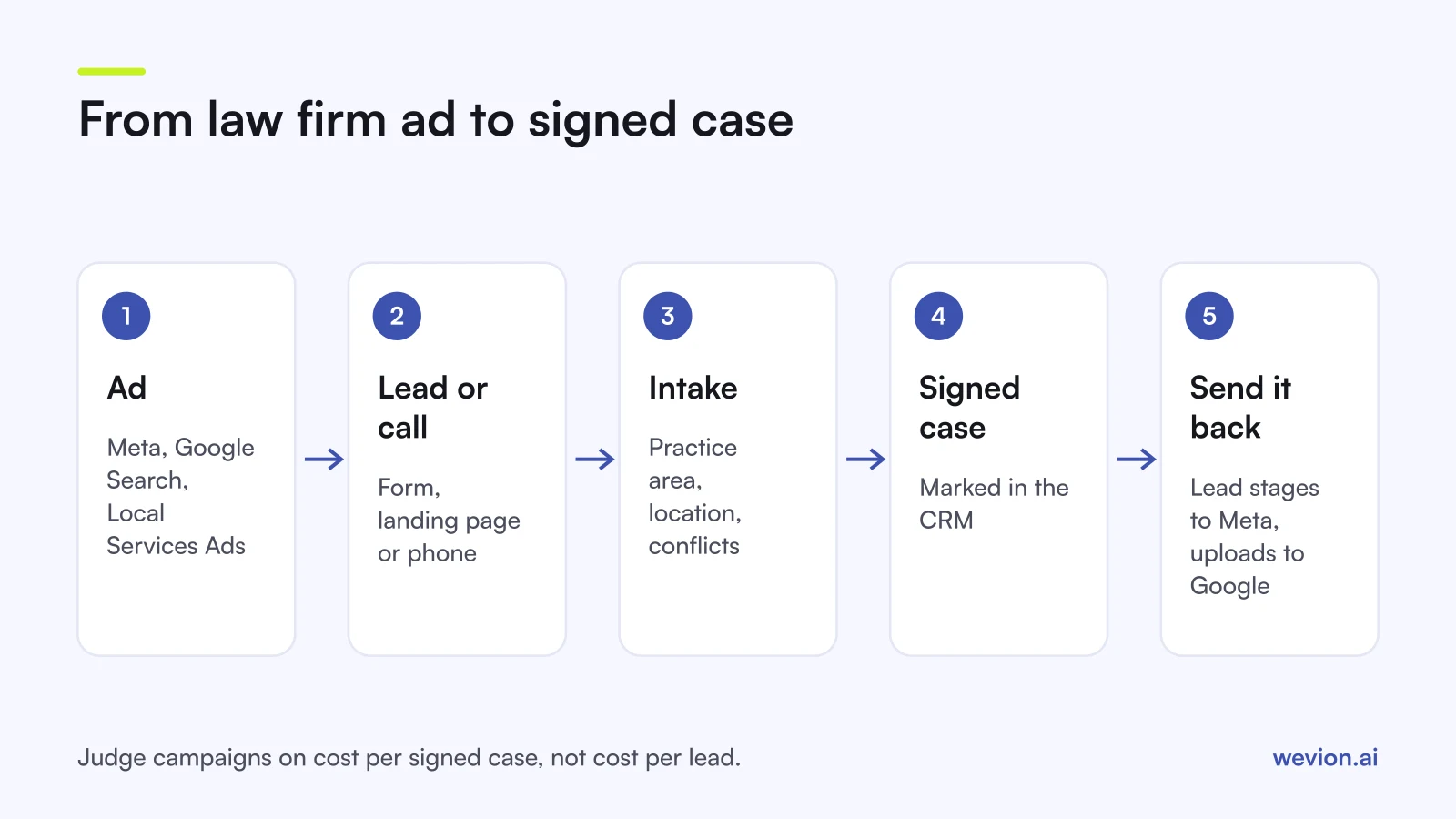
A hypothetical example shows why. A personal injury firm spends $6,000 a month on Meta and Google and gets 120 leads at $50 each. Intake qualifies 30 for a consultation, and 6 become signed cases: $1,000 per signed case. If a change in targeting doubles the leads at the same spend but the number of signed cases stays at 6, cost per lead halves while cost per signed case does not move.
Meta. Send lead stages from the CRM so campaigns can optimise for leads that become consultations or cases. Our guides to conversion leads optimisation and connecting Meta lead ads to a CRM cover the setup.
Google calls. Google's call conversion tracking covers calls from ads, calls from website visits and calls imported by upload, and counts calls longer than a minimum duration you set. Agree that duration with the firm, so a short wrong number is not counted as a lead.
Google forms and signed cases. Google's enhanced conversions for leads matches conversions imported from the CRM to ad clicks using hashed contact details, such as an email address, captured on the website form. The page says uploads go through the Data Manager or the Google Ads API, and that from 15 June 2026 these uploads move to the Data Manager API. Our Google Ads conversion tracking guide covers the base setup.
Keep what you send to the platforms to the stage and the contact match. Case details and anything covered by client confidentiality stay in the firm's systems.
Where Wevion fits
Wevion is not part of the intake or compliance path: it does not track calls, store leads, review ads against conduct rules or send conversions to Meta or Google. Leads and signed cases live in the firm's CRM or case management system.
Wevion connects Meta, Google, TikTok, Snapchat, Taboola and Outbrain ad accounts through each platform's official API, syncs data about every 15 minutes, and shows platform-reported leads, cost per lead and spend for every client in one view, so a firm's Meta and Google campaigns can be read side by side.
Each law firm client gets its own workspace, with team roles that decide who can change what. Automated rules can pause an ad set, change a budget or just send an alert when cost per lead crosses a threshold you set, with a cooldown and a daily cap on runs, which helps when intake is full and spend should slow.
You can try it on your own ad accounts with a 14-day trial on the Pro plan. No card to start. We ask for one on day 7, or earlier if you use up the trial credits, and billing starts on day 14 only if you add it.
Key takeaways
- Put urgent practice areas on Google Search and Local Services Ads with calls; use Meta for areas you can sell with a clear offer.
- In the US, Local Services Ads list 17 lawyer categories with state bar licence checks; in the UK, legal categories are a Greater London pilot.
- Qualify on practice area, location, timing and existing representation, and keep case details for the intake call.
- Meta's personal attributes policy rules out copy and questions that assert criminal record, health or financial status.
- Send consultations and signed cases back to Meta and Google, and judge campaigns on cost per signed case.
- Check every ad, landing page and follow-up script against your own regulator's advertising rules.