
Existing Customer Budget Cap: How to Rebuild It on Meta
Rafael Moreira
Senior Performance Marketer
The existing customer budget cap was a setting in Meta's Advantage+ shopping campaigns that limited the share of budget spent on people who had already bought from you. New Advantage+ sales campaigns do not have it. Meta's own documentation now describes a replacement built from two ad sets and a spend limit, and agencies running several ecommerce clients need to rebuild the control that way.
Quick answer: Meta's Marketing API documentation says the existing customer budget percentage is not available for new Advantage+ campaigns. To cap spend on past buyers, define existing customers as a custom audience, then run two ad sets under one campaign budget: one that targets that audience with a maximum spend limit, and one that excludes it. Report the split with the Audience segments breakdown in Ads Manager.
This guide is narrower than our Advantage+ campaigns overview, which covers the whole Advantage+ suite. Here the focus is one control and how to report it. To measure whether acquisition is working, pair it with new customer acquisition cost.
What was the existing customer budget cap?
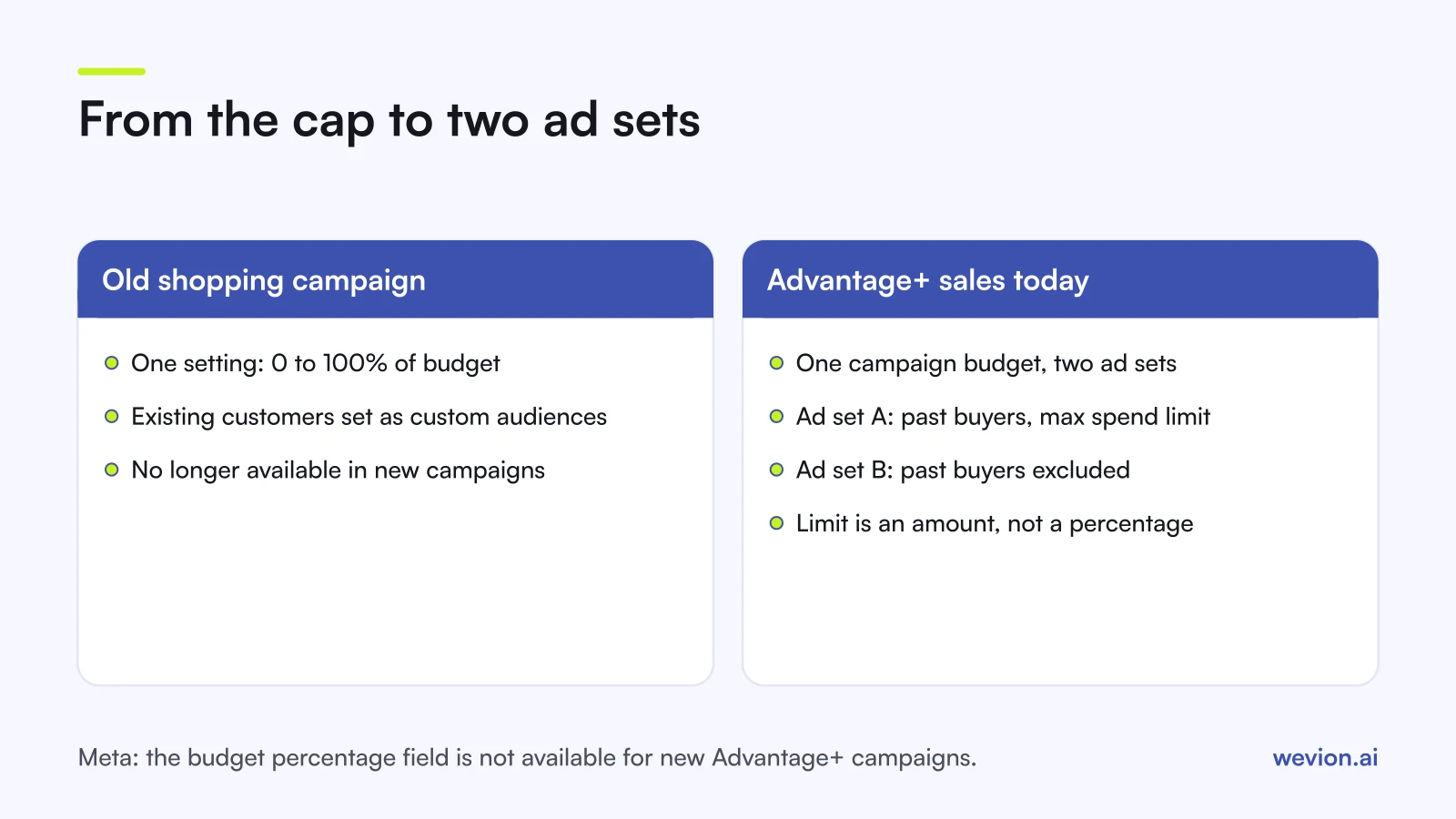
The existing customer budget cap was a percentage that set the most an Advantage+ shopping campaign could spend on your existing customers. Meta's Advantage+ shopping campaigns documentation defines the field as "the maximum percentage of the budget that can be spent on the existing customers associated with this ad account", with values from 0 to 100, and warns that "lower values may lead to higher costs per conversion".
Existing customers were not something Meta guessed. You defined them as a collection of custom audiences, and the same page lists the supported sources: website, app activity, customer list, catalogue and offline activity.
Agencies liked the cap because it gave one number to agree with a client. "No more than 20% of spend on past buyers" fits in a brief and is easy to check.
What happened to the cap?
The cap disappeared as Meta moved Advantage+ shopping campaigns to a new format called Advantage+ sales. Meta's Advantage+ campaign experience documentation says Advantage+ sales campaigns use the same automation features as Advantage+ shopping campaigns and appear in Ads Manager as Advantage+ sales campaigns.
The same page states that "the existing_customer_budget_percentage field is not available for new Advantage+ campaigns". It also sets out the timeline for old campaigns through the API, which is worth knowing if a client still has one:
| Marketing API version | Release date | What Meta's documentation says happens to old Advantage+ shopping campaigns |
|---|---|---|
| v25.0 | 18 February 2026 | No new ones can be created through the API |
| v26.0 | 29 July 2026 | Legacy campaigns are blocked from edits and paused |
Release dates come from Meta's Graph API changelog. Meta says old campaigns can be moved to the new structure by duplicating them in Ads Manager, not through the API. If you inherit a client account with an old shopping campaign, check its status first, then rebuild it as described below.
How do you define existing customers now?
Existing customers are still defined by you, now in two places: as custom audiences you use in ad sets, and as audience segments for reporting. Getting both right is the first job on every client account.
Custom audiences for targeting. Build one combined audience that represents past buyers. For a store, that usually means a customer list exported from the shop plus a website audience of people who fired a Purchase event. Meta's customer list help page covers the upload. Our custom audiences guide explains how to combine sources.
Audience segments for reporting. Meta covers this in its Business Help Centre article Create audience segments in Meta Ads Manager. According to Jon Loomer's walkthrough, you define an engaged audience and existing customers in the ad account's advertising settings, people who match both count only as existing customers, and the segments then apply to sales campaigns in that ad account.
Refresh the customer list on a schedule. An exclusion only covers people who are in the list, so a list last uploaded six months ago lets recent buyers back into prospecting.
How do you rebuild the cap with two ad sets?
The replacement for the cap is a campaign with Advantage+ campaign budget (CBO) and two ad sets, which is the structure Meta itself describes on its Advantage+ campaign experience page. Here are the steps:
- Create a sales campaign with the budget set at campaign level.
- Ad set A, existing customers. Target the custom audience of past buyers. Set it as a strict audience, not as a suggestion Meta can widen.
- Give ad set A a maximum spend limit. This is your new cap.
- Ad set B, new customers. Same settings and creatives, with the existing customer audience excluded.
- Name both ad sets consistently across clients, for example "existing" and "new", so reports can group them.
A worked example with hypothetical numbers: a client's campaign spends €1,000 a day and the brief says no more than 15% on past buyers. Set the maximum on ad set A to €150 a day. Ad set B can then take the remaining €850 or more on days when ad set A spends less. Unlike the old percentage, the limit is a fixed amount, so update it whenever you change the campaign budget: at €1,400 a day, 15% becomes €210.
Ad set spend limits behave as described in our CBO vs ABO guide: a maximum holds well, while a minimum is only a best effort. Do not add a minimum to ad set B to force acquisition; the exclusion already does that job.
How should you pick the cap?
The right cap comes from the client's business model, not from a benchmark, so agree it in writing at onboarding. Ask three questions:
- Is the brief acquisition or revenue? An acquisition brief needs a low cap and a target for new customer acquisition cost.
- How much is a repeat buyer worth? If repeat orders carry most of the margin, a higher cap can make sense. Our LTV to CAC ratio guide shows how to put a number on it.
- Are other channels already reaching past buyers? If email and SMS bring them back cheaply, paid spend on them is likely to overlap.
Then review monthly. If ad set A always hits its maximum with a low cost per purchase, the client may be underspending on retention. If it rarely spends, the audience may be small or out of date.
How do you report new versus existing customer spend?
Reporting the split takes two views, because Meta's numbers show where spend went and the store shows who actually bought for the first time. Use both every month for every client.
In Ads Manager. Once audience segments are defined, the Breakdown menu offers Audience segments, which splits results into new audience, engaged audience and existing customers (Jon Loomer shows where to find it). With the two ad set structure, ad set A's spend is also your existing customer spend.
In the store. Count first-time customers from the store for the same dates and divide total ad spend by that number to get nCAC. If Meta reports a healthy new audience share but first-time orders in the store do not rise, the platform is reaching people who are new to Meta's segments but not new to the brand, usually because the customer list is stale.
A simple monthly table per client keeps this honest: total spend, existing customer ad set spend and its share, first-time customers from the store, and nCAC.
Where Wevion fits
Rebuilding the cap means the same structure, the same naming and the same monthly check on every client account, which is exactly the kind of routine that slips when an agency grows.
Wevion connects Meta with OAuth through the official API, together with Google, TikTok, Snapchat, Taboola and Outbrain, syncs data about every 15 minutes, and gives every client its own workspace, so the existing customer ad sets for every client can be checked from one place.
Bulk Launch lets you build the two ad set structure from templates, so every client gets the same setup and naming. Cross-channel analytics shows spend by account and campaign in one currency. Automated rules can pause ad sets, change budgets or just send an alert when a metric crosses a threshold you set.
You can try it on your own ad accounts with a 14-day trial on the Pro plan. No card to start. We ask for one on day 7, or earlier if you use up the trial credits, and billing starts on day 14 only if you add it.
Key takeaways
- The existing customer budget cap is not available in new Advantage+ sales campaigns.
- Meta's documented replacement is two ad sets under one campaign budget: existing customers with a maximum spend limit, and new customers with them excluded.
- The limit is a fixed amount, so recalculate it whenever the campaign budget changes.
- Define existing customers with a combined customer list and purchase audience, and refresh it on a schedule.
- Report the split with the Audience segments breakdown, then check it against first-time customers and nCAC from the store.
- Meta's documentation says old Advantage+ shopping campaigns are blocked from edits and paused from version v26.0 of the Marketing API, so rebuild any you inherit.