
Best Ad Platforms for Ecommerce: A Founder's Guide
Priya Raghunathan
مدير أداء التجارة الإلكترونية
The best ad platform for ecommerce is the one that matches how your customers buy, the creative you can produce every week and the budget you can give it to learn. Meta, Google, TikTok, Snapchat, Pinterest and native networks such as Taboola and Outbrain all sell products online, but they do it in different ways, and a channel that works for a skincare brand can waste money for a furniture brand.
Quick answer: If people already search for your product, start with Google Search and Shopping, which capture existing demand. If they do not, start with Meta, which creates demand by showing your product to people who were not looking. Add TikTok when you can make short videos every week, and Pinterest, Snapchat or native ads once one or two channels are profitable.
This guide is for founders deciding where the next euro goes. Once you have picked a channel, our guides on when to start Google Ads and how to diversify beyond Meta cover the next steps.
What decides the best ad platform for your store?
Four questions decide which ad platform fits an ecommerce store, and none of them is "where is traffic cheapest". Cheap clicks from people who will never buy cost more than expensive clicks from people who will.
- Do people already search for what you sell? If they type your product category into Google, a search ad meets them at the moment they want to buy. If your product is new or visual, you need a platform that shows it to people first.
- What creative can you make? Google Shopping needs a good product feed. Meta needs images and videos. TikTok and Snapchat need vertical video that looks native to the app. Native networks need headlines and often an article page.
- Can you afford the platform's learning budget? Every platform's algorithm needs a number of conversions before it delivers well. A channel you cannot fund to that level will look worse than it is.
- Can you measure it? You need the platform's pixel or tag firing purchase events with order values, and a way to check the result against your store's own revenue.
How do the main ecommerce ad platforms compare?
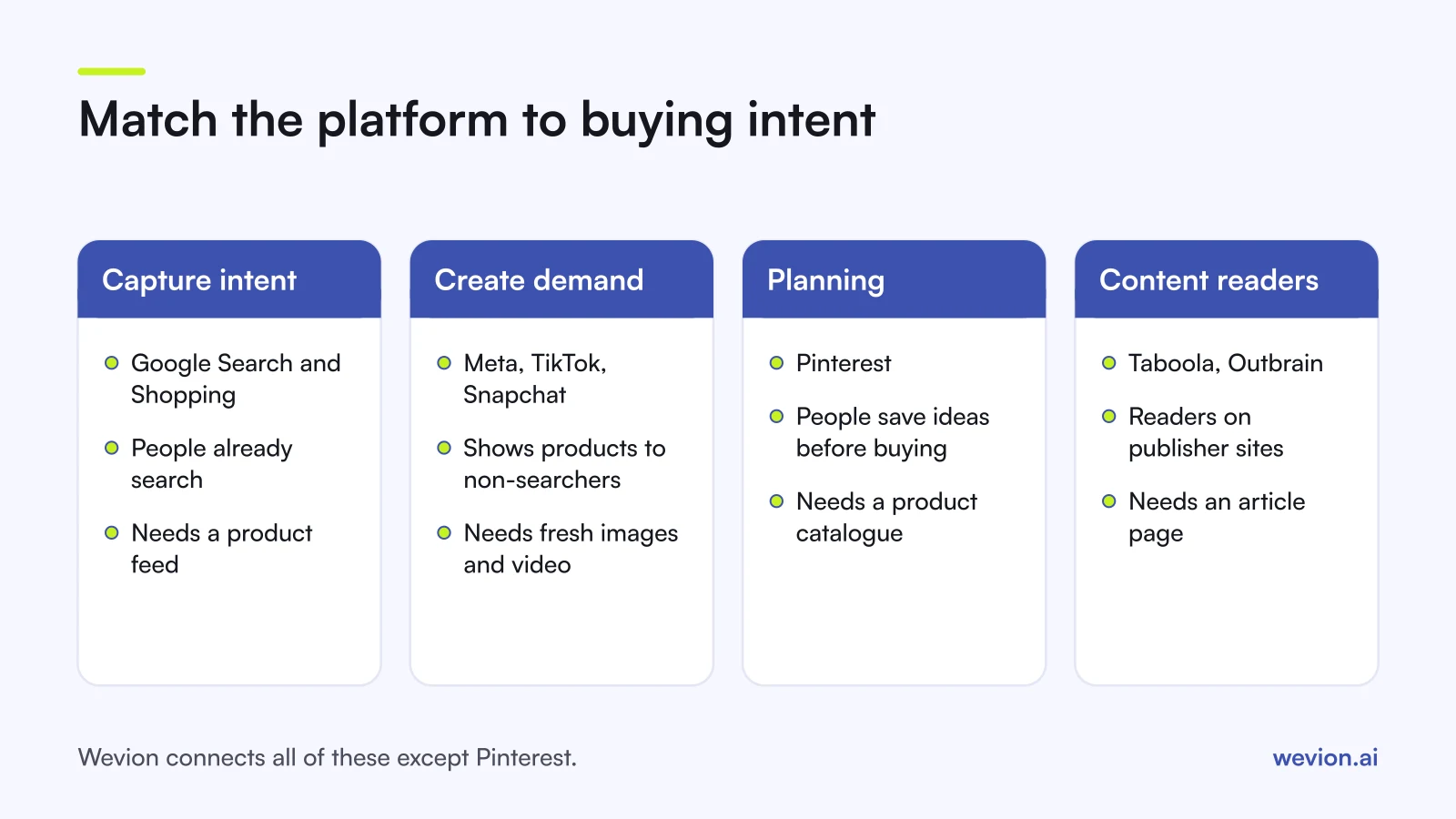
The platforms split into two groups: those that capture demand people already have, and those that create demand by putting a product in front of people who were not looking for it. The table summarises each one.
| Platform | Buying intent | Creative you need | Product catalogue ads | Wevion connects it |
|---|---|---|---|---|
| Google Search and Shopping | High: people are searching | Feed, text ads | Yes, via Merchant Center | Yes |
| Meta (Facebook, Instagram) | Low to medium: discovery | Images, video, UGC | Yes | Yes |
| TikTok | Low: entertainment feed | Vertical video, often weekly | Yes | Yes |
| Snapchat | Low: mobile feed and stories | Vertical video | Yes | Yes |
| Medium: people planning purchases | Images, video | Yes | No | |
| Taboola, Outbrain | Low: readers on content sites | Headlines, images, article pages | Not the core format | Yes |
Meta: where most DTC brands create demand
Meta is the default first channel for many direct-to-consumer brands because it can find buyers who were not searching, using broad targeting and the conversion data from your pixel. Facebook and Instagram ads show your product in feeds, Stories and Reels, so it works well for products people want once they see them.
Meta also runs catalogue ads that pull products, prices and images from your product catalogue and show each person the items they are most likely to buy. Our Meta catalogue ads guide covers the setup.
The cost is creative volume. Meta's delivery depends on fresh images and videos, and a single winning ad wears out. Plan for new creatives every few weeks, not once a quarter.
Google: where buyers already search
Google is the first channel to consider when people already type your product or brand into a search box. Shopping ads, according to Google's Shopping ads page, "display a product photo, title, price, store name, and more", and they use your Merchant Center product data instead of keywords to decide where to show.
You buy that inventory through Standard Shopping campaigns or Performance Max. Google describes Performance Max as one campaign that reaches inventory "including YouTube, Display, Search, Discover, Gmail, and Maps". Our guides on Google Shopping ads and Performance Max campaign structure explain the choice.
Google's weak spot is new categories. If nobody searches for what you sell yet, there is little demand to capture.
TikTok: video-first discovery
TikTok suits brands that can show a product in action in a few seconds and can keep making new videos. Ads appear in a full-screen entertainment feed, so content that looks like a polished TV advert tends to stand out for the wrong reasons.
TikTok's budget help page sets daily budgets above $50 at campaign level and above $20 at ad group level, and its learning phase page says volatility usually starts to decline after about 25 campaign results or 7 days. TikTok also runs catalogue ads from a product feed. For how its numbers compare with Meta's, see our TikTok vs Meta benchmark.
Snapchat: mobile reach with product ads
Snapchat is a mobile, vertical-video platform where ads run full screen between pieces of content. For ecommerce, its main draw is dynamic product ads built from a product catalogue, much like Meta's catalogue ads.
The entry cost is low. Snap's Ads API reference sets the minimum ad squad daily budget at 5,000,000 micro units of the account currency, which is 5 units such as $5. A budget that small will not exit learning for a purchase goal, so treat it as a floor. Our Snapchat Ads Manager guide walks through the setup.
Pinterest: people planning a purchase
Pinterest sits between search and social: people use it to plan purchases, from a kitchen to a wardrobe. Pinterest's shopping ads page says its ads "help you engage with customers early, while people on Pinterest are looking for inspiration", and it builds shopping ads from a product catalogue uploaded through its Catalogs tool.
It tends to fit categories where people save ideas before they buy, such as home and fashion. Note that Wevion does not connect Pinterest, so you would manage it in Pinterest's own ads tool.
Taboola and Outbrain: readers on content sites
Native networks show ads as recommendations on news and content sites. As of November 2026, Taboola's advertiser page describes "a global network of vetted publishers, reaching 600M daily active users". Outbrain now operates under the Teads brand.
The audience is reading, not shopping, so ecommerce brands usually send these clicks to an article or advertorial that explains the product before the shop page. That suits considered purchases. Taboola's budget article recommends a daily campaign budget of "10 times your CPA goal, or at least $50 USD". Our Taboola vs Outbrain comparison covers both networks.
How much budget do you need to test a platform?
A fair test budget comes from the number of conversions a platform needs to learn, multiplied by what you expect a conversion to cost. Pick the number before you launch, or a channel that never had enough data will be judged as a failure.
Here is a hypothetical example on Meta. Meta's learning limited page says an ad set is limited when it is unlikely to get about 50 optimisation events in the week after its last significant edit.
| Input | Value |
|---|---|
| Expected cost per purchase | €40 |
| Events needed per week | 50 |
| Weekly budget for one ad set | 50 × €40 = €2,000 |
| Daily budget | €2,000 ÷ 7 ≈ €286 |
If €286 a day is more than you can spend, you have three options: run one ad set instead of several, optimise for an earlier event such as add to cart, or accept a slower test and judge it over a longer window. The same maths applies on other platforms with their own thresholds. Our learning phase guide covers the details.
In which order should you add ad platforms?
The order that works for most stores is one demand channel, then one intent channel, then a third that reaches a gap the first two miss. Adding platforms in that sequence keeps each test funded and readable.
- Start with the channel that fits your demand. Meta if you need to create demand, Google if people already search.
- Get it profitable at a steady budget. Check results against your contribution margin, not platform ROAS alone.
- Add the other half. A Meta-first brand adds Google brand search and Shopping. A Google-first brand adds Meta to reach new buyers.
- Add a third channel for a specific gap. TikTok for video-led products, Pinterest for planned purchases, native for products that need explaining.
- Judge the mix with store numbers. Use MER vs ROAS to see whether total revenue grew with total spend.
Common mistakes when choosing ad platforms
Most wasted test budgets come from judging a platform on the wrong terms. Watch for these:
- Choosing by cost per click. Cheap clicks with no intent cost more per sale.
- Running the same creative everywhere. A Meta image ad cut to vertical rarely works on TikTok.
- Testing below the learning threshold and calling the platform a failure.
- Trusting each platform's own ROAS when two platforms can claim the same order.
- Adding three channels at once, so you cannot tell which one moved revenue.
Where Wevion fits
Once you run two or three platforms, the daily job becomes comparing them, and each one reports in its own dashboard with its own attribution rules.
Wevion connects Meta, Google, TikTok, Taboola, Snapchat and Outbrain ad accounts through each platform's official API, syncs data about every 15 minutes, and shows spend and results for every account in one view, so you can compare a new channel with the ones you already run.
You can launch campaigns across platforms in bulk from one grid and set automated rules on each platform that pause ads, change budgets by a percentage or just send an alert, with a cooldown and a daily cap on runs. Cross-platform rules are in beta. Wevion does not connect Pinterest.
You can try it on your own ad accounts with a 14-day trial on the Pro plan. No card to start. We ask for one on day 7, or earlier if you use up the trial credits, and billing starts on day 14 only if you add it.
Key takeaways
- The best ad platform for ecommerce depends on buying intent, creative capacity and the budget you can give a platform to learn.
- Google captures demand that already exists. Meta, TikTok and Snapchat create it. Pinterest reaches people planning a purchase. Native reaches readers.
- Set a test budget from conversions needed times expected cost per conversion, before launch.
- Add channels one at a time, each for a gap the others miss.
- Judge the mix with store revenue and margin, not each platform's own ROAS.