
Static vs Video Ads: Which Wins for Ecommerce?
Yuki Tanabe
Creative AI Strategist
Static vs video ads is one of the first creative questions an ecommerce brand faces, and the honest answer is that neither format wins everywhere. A product photo with a price can beat a polished video in retargeting, and a 20-second demo can beat ten photos with people who have never heard of you. What decides it is the job the ad has to do, the product, the placement and how much you can spend making it.
Quick answer: Use video where people need to see the product working, where the placement is built for vertical video (Reels, Stories, the TikTok feed) and when you need attention from cold audiences. Use static images for retargeting, offers, simple products and high-volume testing, where they are cheaper and quicker to produce. Then test both on the same offer and audience, and judge on cost per purchase, not views.
This guide is about choosing between the two formats. For a full creative testing process see our creative testing framework, and for the video metrics themselves see our guide to hook rate and hold rate.
What is the real difference between static and video ads?
A static ad has to make its point in one frame, so it works best when the point fits in one frame: the product, a benefit, a price, an offer. A video ad has time to show something happening, so it works best when the selling point is a change, a use or a reaction.
| Static image ads | Video ads | |
|---|---|---|
| What it communicates well | The product, a price, an offer, one benefit | Use, texture, before and after, a person's reaction |
| Production cost per asset | Lower | Higher, especially with people on camera |
| Speed to make 10 variants | Hours | Days, unless you cut one shoot many ways |
| Native fit | Feed placements, catalogue ads | Reels, Stories, the TikTok feed |
| Attention metrics available | None beyond impressions and clicks | Video plays, watch time, completion |
| Typical weak spot | Easy to scroll past in vertical video feeds | Expensive to get wrong; slow to iterate |
Neither column is a ranking. A brand that sells phone cases and a brand that sells skincare will land in different places, and so will the same brand at different stages of the funnel.
Which format works best at each funnel stage?
The funnel stage changes what the ad has to do, so it is the first filter for the static vs video ads choice.
- Cold audiences (prospecting). People do not know the brand or the product. They need to understand what it is and why it matters, which is easier to do with movement, demonstration and a person talking. Video usually has the advantage here, especially in vertical placements.
- Warm audiences (engaged, visited, added to cart). People already know the product. They need a reason to come back: a reminder, a review, an offer, free shipping. A clear static image often does that job at a fraction of the production cost. Dynamic catalogue ads, covered in our Meta catalogue ads guide, are built from product images for exactly this reason.
- Existing customers. Cross-sell and launch messages are mostly about showing what is new. Static works for a new colour or a bundle; video works for a new product that needs explaining.
In practice most ecommerce accounts end up with video weighted towards prospecting and static weighted towards retargeting, with both formats present at every stage so the algorithm can pick per placement.
Which format suits your product?
The product type matters as much as the funnel stage. Ask one question: can a shopper understand why they want it from one photo?
Static tends to be enough when:
- The product is visually obvious: prints, jewellery, homeware, fashion basics.
- The main message is price, discount or bundle.
- You have strong product photography or customer photos already.
Video tends to earn its cost when:
- The product solves a problem the shopper has to see: cleaning, fitness, kitchen tools, skincare routines.
- Texture, size or movement matter: fabric drape, how a bag opens, how a gadget clicks together.
- Trust is the barrier, and a real customer talking to camera answers it. Our UGC ads guide covers briefing creators for this.
What does each format cost to produce?
Production cost changes the maths of testing, because the number of variants you can afford decides how quickly you find a winner. The figures below are hypothetical, for illustration only:
| Static batch | Video batch | |
|---|---|---|
| Brief | One product photo day | Three creator videos |
| Cost | €600 | €750 (3 × €250) |
| Usable assets | 12 images | 3 videos, cut into 9 hook variants |
| Cost per asset | €50 | About €83 per variant |
| Time to first ad | 2 to 3 days | 2 to 3 weeks |
Cutting one video into several hooks closes much of the gap, which is why many brands brief creators for multiple openings. If you use AI tools to stretch the video budget, our AI UGC video ads guide sets out what they can and cannot do.
Which placements need which format?
Placements decide what shape the creative must be, and some reward one format more than the other. These specs come from the platforms' own guides as of November 2026.
Meta. For Facebook Feed, Meta's ads guide recommends a 4:5 ratio at 1440 x 1800 pixels for both images (JPG or PNG) and video. For image ads on Instagram Reels, it recommends 9:16 at 1440 x 2560 pixels and keeping roughly the top 14 percent, the bottom 35 percent and 6 percent on each side free of text and logos, so the profile icon and call to action do not cover them.
Meta encourages advertisers to run Reels ads with whatever assets they have, images included. On its Reels ads page, Meta also reports that 9:16 video with audio and key messages inside the safe zone had a 34.5 percent lower cost per result than image ads, based on its own meta-analysis of 15 A/B tests run only on Reels. That is Meta's figure, from one placement, and it does not predict what will happen in your account. It is a good reason to test vertical video in Reels, not a reason to drop images everywhere.
TikTok. TikTok's in-feed ad specs are written for video, with vertical 9:16 recommended at 540 x 960 pixels or more. Static images run as Carousel Ads, a set of images that people swipe through, and music is required. If you work with creators on TikTok, Spark Ads let you run their posts as ads.
How do you test static vs video ads fairly?
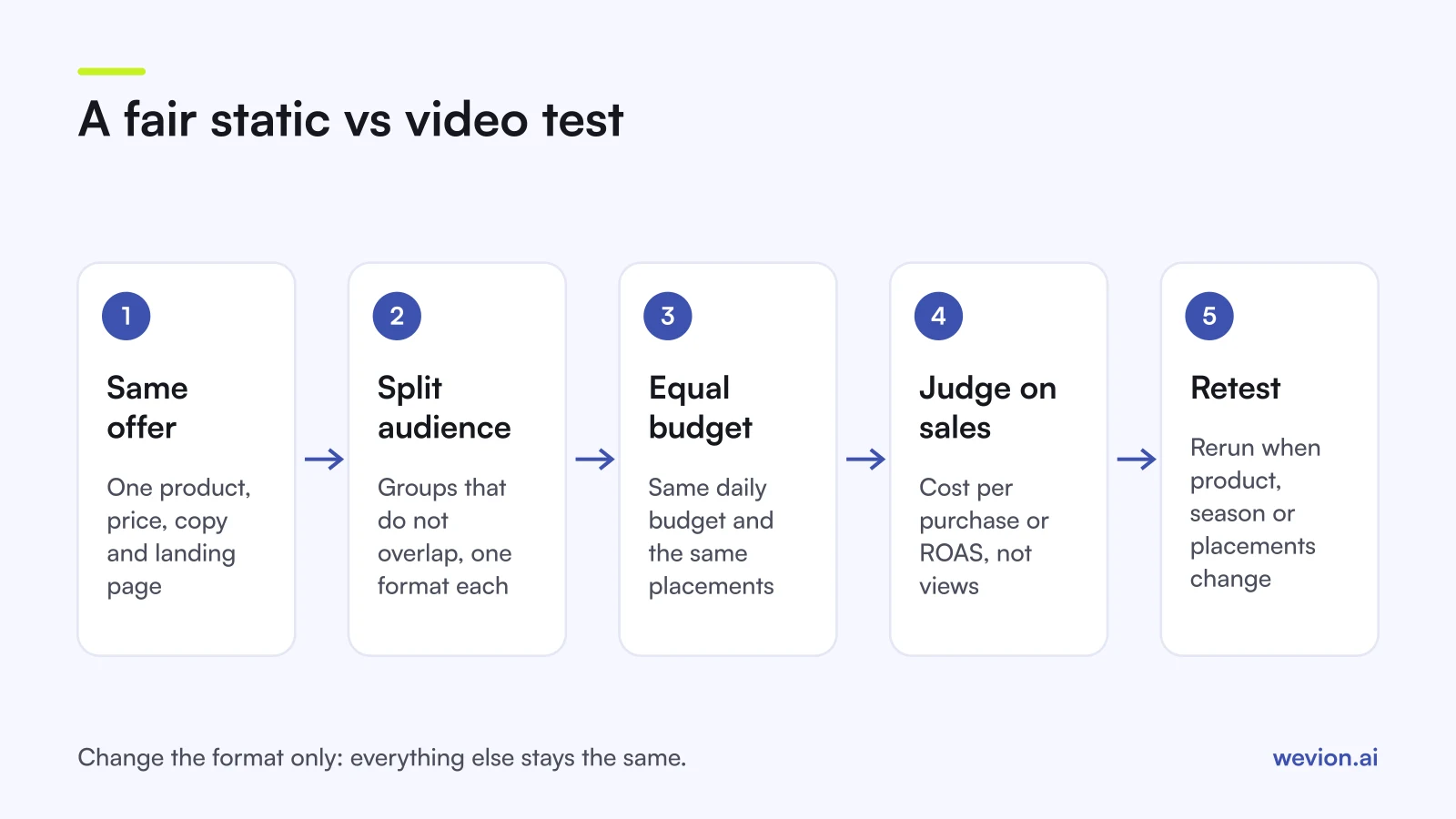
A fair test changes the format and nothing else. If the video has a different offer or lands on a different page, you have tested the offer, not the format.
- Pick one product and one offer. Same price, same discount, same landing page.
- Match the message. The static ad and the video should make the same claim, with the same headline and primary text where the placement allows.
- Split the audience cleanly. On Meta, the A/B test tool in Ads Manager runs on audiences that do not overlap; Meta's split testing documentation describes it as testing "on mutually exclusive audiences". Two ad sets with the same targeting in one campaign can work too, but they compete for the same people.
- Give each side the same budget and placements. If the video gets Reels and the image does not, placement is the variable.
- Run long enough. Meta's guidance on its A/B tests is at least two weeks or up to 30 days. Decide your stop rule before you start.
- Judge on a shared business metric. Cost per purchase or return on ad spend, ideally checked against store orders.
Here is a hypothetical two-week test with numbers that add up:
| Static ad set | Video ad set | |
|---|---|---|
| Budget | €50/day × 14 = €700 | €50/day × 14 = €700 |
| Link clicks | 700 | 560 |
| Cost per click | €1.00 | €1.25 |
| Purchases | 20 | 25 |
| Cost per purchase | €35 | €28 |
The static ad won on clicks and lost on purchases. If you had stopped at cost per click, you would have picked the wrong format. With only 20 to 25 purchases per side the gap is still noisy, so rerun it, or read our statistical guide to A/B testing before calling it.
How should you read the results?
Only compare metrics that both formats share, and use the platform's own definitions for the rest.
- Shared metrics: impressions, link click-through rate, cost per click, cost per purchase, purchase conversion value and return on ad spend.
- Video-only on Meta: 3-second video plays and ThruPlays. Meta's ThruPlay definition counts a play of at least 15 seconds, or to 97 percent of the video if it is shorter.
- Video-only on TikTok: 2-second and 6-second video views, as defined on TikTok's video play metrics page.
Hook rate and thumb-stop ratio are not metrics the platforms report. They are calculations teams build from those plays, usually 3-second plays divided by impressions on Meta. They help you compare one video with another. They cannot compare a video with a static image, because an image has no plays.
What are the common mistakes?
- Testing two different offers. A discount in the static and none in the video makes the result about the discount.
- Judging video on views. Cheap views from a video do not mean cheap purchases.
- One video against ten images. The side with more variants has more chances to find a winner. Match the number of creatives.
- Ignoring fatigue. A winning format still wears out. Our guide to when to refresh ad creatives covers the signals.
- Deciding once, forever. Rerun the test when the product, season or placement mix changes.
Where Wevion fits
A static vs video test often runs on Meta and TikTok at once, and comparing two Ads Managers by hand is where mistakes creep in.
Wevion connects Meta, Google, TikTok, Snapchat, Taboola and Outbrain ad accounts through each platform's official API and syncs data about every 15 minutes, so the results of both formats sit side by side in one view. Bulk Launch builds matched test campaigns across platforms from one grid, and automated rules can pause a losing ad, change a budget or just send an alert when cost per purchase crosses your line.
Start a 14-day trial with no card. We ask for one on day 7, or earlier if you use up the trial credits, and billing starts on day 14 only if you add it.
Key takeaways
- Neither format wins everywhere: video tends to suit cold audiences and vertical placements, static tends to suit retargeting, offers and simple products.
- Ask whether one photo can explain why someone wants the product. If not, budget for video.
- Static is cheaper per asset and faster to iterate; cutting one video into several hooks narrows the gap.
- Follow each platform's specs: 4:5 for Meta feeds, 9:16 with safe zones for Reels, vertical video or Carousel Ads on TikTok.
- Test with the same offer, audience, budget and placements, and judge on cost per purchase or return on ad spend.
- Hook rate compares videos with videos; it cannot compare a video with a static image.