
Native Ads Best Practices for Taboola and Outbrain
Rafael Moreira
Senior Performance Marketer
The native ads best practices that hold up on Taboola and Outbrain come down to five habits: test headlines and thumbnails as a system, keep pre-sell pages inside the networks' rules, make the landing page keep the ad's promise, leave bidding alone while it learns, and block sites on evidence rather than on a bad first day. Every rule in this guide comes from Taboola's or Outbrain's own help pages, linked so you can check them.
Quick answer: Launch with 3 to 4 headlines and 3 to 4 images, each with one clear idea. Send clicks to a labelled advertorial or a product page that delivers exactly what the headline promised. Start on Maximize Conversions (Taboola) or Conversion Bid Strategy (Outbrain), budget about 10 times your CPA goal on Taboola, and wait out the learning days. Block a Taboola site after it spends 2.5 to 3 times your CPA without converting; on Outbrain's automated bidding, avoid blocking at all.
This is not a setup guide. For account creation, pixels and targeting, see our Taboola ads setup guide and Outbrain ads setup guide. If you are still choosing a network, read Taboola vs Outbrain.
Why does native need its own playbook?
A native ad is a headline and an image placed among article recommendations on a publisher's site. The reader is not shopping; they are reading. They click because the headline made them curious, so two things decide results: whether the headline and image earn the click, and whether the next page keeps the promise. Social habits such as text-heavy creative, hard-sell hooks and urgency timers either fail or break the networks' rules here.
How should you test headlines and thumbnails?
Treat titles and images as two separate variables you combine, not as finished ads.
How many to start with. Outbrain's content best practices recommend 3 to 4 title variations and 3 to 4 image variations, depending on budget. Taboola's creative best practices suggest testing two or three creatives for video.
What each network asks for.
| Taboola | Outbrain | |
|---|---|---|
| Headline length | 35 to 45 characters, 60 maximum | About 60 characters; up to 100 allowed but truncated beyond 60 |
| Image size | At least 1000 x 600 px (feed), 1 MB maximum | 1200 x 800 px recommended |
| People in images | "Always preferable", shoulders up or closer | Portraits and close-ups over people in action |
| Other image advice | One focal point, no clutter | No text inside the image; lifestyle over cartoons or stock |
What to write. Outbrain suggests questions and, where relevant, odd numbers, and warns against unsupported promises, heavy capitalisation, sensational claims and extreme words such as "never" and "worst". Taboola's content checklist rules out exaggerated tone and multiple exclamation marks. Put the specific idea first, since longer titles get cut on some placements.
A worked example. You write three angles (a problem, a customer story, a how-to) and pick three images (a face, the product in use, a close-up detail). That is nine combinations. On Taboola, with a $30 CPA goal, the 10x rule below means at least $300 a day, so each combination gets around $33 a day if spend split evenly. It will not split evenly, which is the point: the network shifts spend towards the combinations people click. After the learning days, pause the bottom performers and replace them with new variants of the winning angle. Taboola's optimisation guide gives its own example of when to pause: ads with a viewable CTR below 0.5% or excessively high CPCs. Treat that as Taboola's illustration, not a universal benchmark.
What makes a pre-sell page compliant?
Many native campaigns send clicks to a pre-sell page, such as a listicle, a founder story or a review-style article, before the product page. Both networks allow this, within clear rules.
Outbrain's advertiser guidelines require:
- "Advertisement" or "Advertorial" clearly at the top of the page.
- A contact section with a real email address, phone number or physical address, and a privacy policy link.
- An Impressum for pages promoted in Germany, Austria or Switzerland.
- No pages designed to make readers believe they are reading real editorial content or news, and no fake navigation.
- No fake testimonials, no countdown clocks for offers that do not expire, and no before and after photos in thumbnails.
Taboola's content checklist requires:
- Company details and contact information, and a link to the privacy policy.
- Advertorial disclosures where appropriate, plus licensing details and linked sources on finance and health pages.
- No guarantees, money-making promises or unsubstantiated health claims, and statistics with a valid source.
- No countdown timers, auto-updating timestamps or suggestions that an offer is time-limited.
Taboola says it typically reviews ads within 1 to 3 business days, so build that into launch plans. Our ad launch checklist covers the rest of the pre-launch routine.
Why does landing page match matter so much?
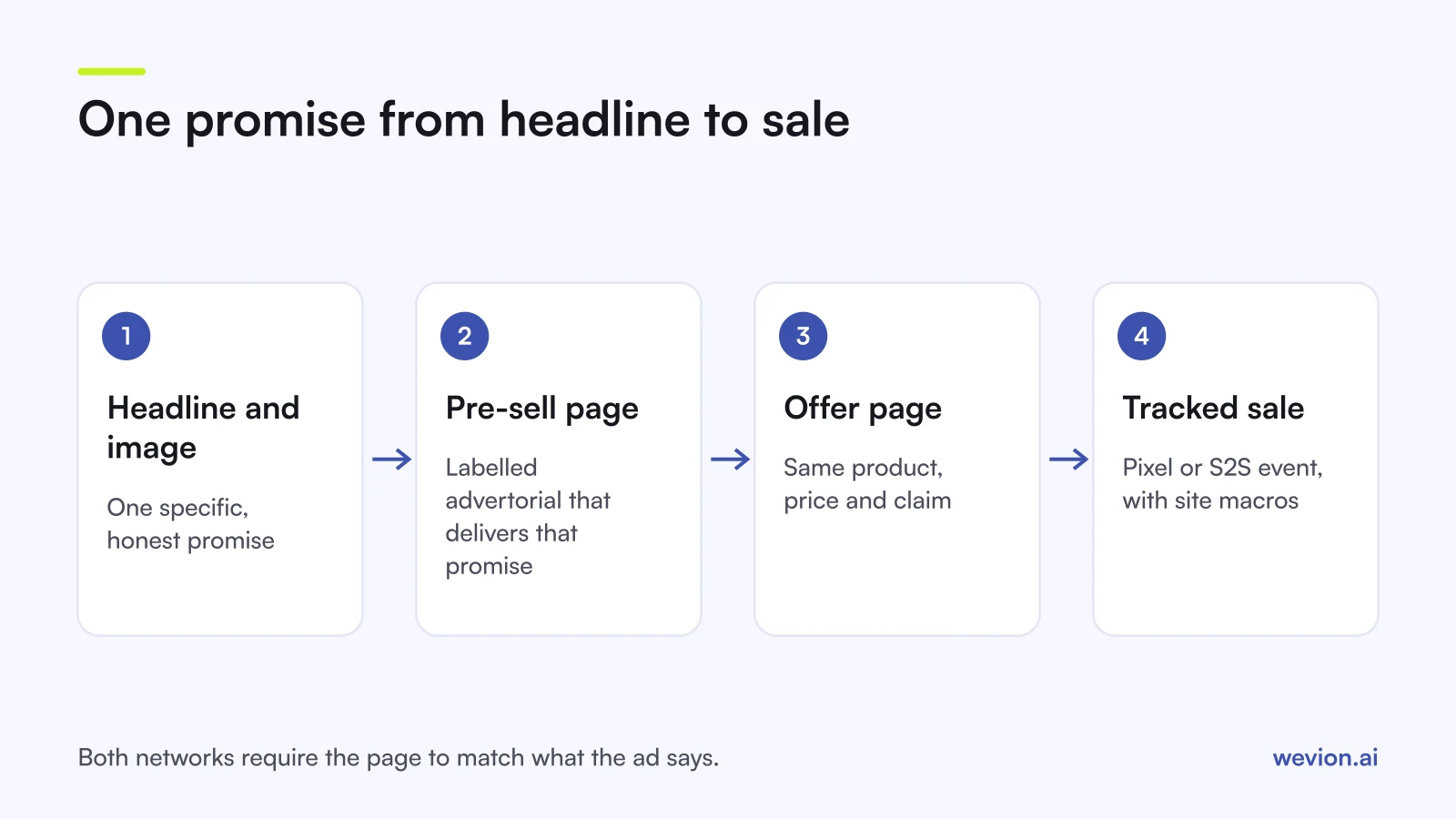
Both networks check that the page delivers what the ad said. Taboola's checklist says the title and text "must accurately represent your product and offering and be relevant to your landing page". Outbrain's guidelines prohibit headlines that do not accurately depict the content, and images unrelated to the linked content.
Match is also what converts. Outbrain's best practices say to "always lead to relevant landing pages to avoid high bounce rates", to limit click-outs such as other ads and pop-ups, to link straight to product or service pages for sales, and to include a clear call to action for conversion goals.
In practice: if the headline promises "three ways to fix a squeaky door", the page opens with those three ways, not with a discount banner. The product appears as the answer, with the same name, price and claim on the pre-sell page and on the product page.
How should you bid while campaigns learn?
Both networks favour automated bidding and ask you to leave it alone at first.
Taboola. Its Maximize Conversions guide says the algorithm learns in the first 2 to 5 days and that changes during learning prolong it. It advises against setting a target CPA at the start; add one only after at least 50 conversions in 7 consecutive days and once CPA has levelled off for 3 to 4 days. Set a daily budget of at least 10 times your expected CPA (or $50 for CPAs under $5). A target CPA needs the Taboola Pixel or server-to-server tracking in place.
Outbrain. Its Conversion Bid Strategy best practices ask you to wait 48 hours after launch before adjusting. For Target CPA and Target ROAS, start with a budget that can generate at least 7 conversions a day; for Max Conversions, at least 5. If a bottom-funnel event is too rare, Outbrain suggests optimising towards an upper-funnel event that correlates well with it.
Both rules point the same way: if your budget cannot buy enough conversions for the network to learn, optimise towards an earlier event rather than cutting bids.
When should you block sites and sections?
Blocking is the main manual lever on native, and both networks warn against overusing it.
Taboola. The optimisation guide suggests considering an exclusion when a site has spent roughly 2.5 to 3 times your CPA goal with no conversions, plus a blocklist for sites that do not fit your brand. Taboola's SpendGuard is a predictive model that caps or blocks under-performing sites at campaign level, so check its Sites report before blocking by hand. Example: with a $40 CPA goal, a site that has spent $110 without a conversion is at 2.75 times the goal and is a candidate.
Outbrain. The publisher exclusion page recommends blocking by section per campaign first and blocking publishers at account level only as a last resort. Limits are 30 publishers and 100 sections per campaign, and Outbrain warns that excluding too many can cut reach. On Conversion Bid Strategy campaigns it recommends not excluding sections or publishers at all.
How should you tag native clicks?
You cannot block or scale by site if you cannot see which site sent the sale. Add macros to every campaign's tracking code.
- Taboola lists macros such as
{site},{site_id},{campaign_name},{title}and{platform}in its URL parameters guide. Add them at campaign or ad level, not both. For server-to-server tracking, Taboola's S2S help asks you to add the{click_id}macro. - Outbrain recommends
{{ad_title}},{{publisher_name}},{{section_name}}and{{section_id}}in its UTM tracking guide, withutm_source=outbrainalways set.{{ob_click_id}}carries the click ID for server-to-server conversions.
Our guide to building a UTM tracking system shows how to keep naming consistent across networks, and connecting Taboola and Outbrain to Looker Studio covers reporting.
What are the common native mistakes?
- Launching one headline and one image, so there is nothing to learn from.
- Text-heavy or stock images where a close-up face or real product would fit.
- A pre-sell page dressed as news, with no advertorial label or contact details.
- A headline the page does not deliver, which hurts both approval and conversion.
- Bid edits in the first days, which restart learning.
- Blocking every site after one bad day, or blocking at all on Outbrain's automated bidding.
- No site macros in the tracking code, so decisions rest on guesses.
Where Wevion fits
Native campaigns need daily checks: which sites are spending, which combinations are winning, how native compares with Meta or Google.
Wevion connects Taboola, Outbrain, Meta, Google, TikTok and Snapchat ad accounts through each platform's official API, syncs data about every 15 minutes and shows spend and results for every account in one view. You can launch variants in bulk with Bulk Launch, and automation rules on a single platform can pause, activate, change budgets or just send an alert when a metric crosses your threshold. If you also move budget between native and social, cross-platform rules are in beta.
You can try it on your own ad accounts with a 14-day trial on the Pro plan. No card to start. We ask for one on day 7, or earlier if you use up the trial credits, and billing starts on day 14 only if you add it.
Key takeaways
- Start with 3 to 4 headlines and 3 to 4 images and test them as combinations.
- Follow each network's specs: Taboola 35 to 45 character titles, Outbrain about 60; people and close-ups, no text in images.
- Pre-sell pages need an advertorial label, contact details, a privacy policy and honest, sourced claims.
- The landing page must deliver the headline's promise, with the same product, price and claim.
- Leave automated bidding alone while it learns; on Taboola add a target CPA only after 50 conversions in 7 days.
- Block Taboola sites after 2.5 to 3 times CPA with no conversion; on Outbrain block sections first, and not at all on Conversion Bid Strategy.
- Tag every click with site and title macros so decisions rest on data.