
First Order Profitability: Does Your First Sale Make Money?
Priya Raghunathan
E-commerce Performance Manager
First order profitability answers one blunt question: after the product, the shipping, the payment fees, the discount, the returns and the ad that found the customer, did the first sale make or lose money? For a DTC brand the answer decides how hard you can push acquisition, and it is often worse than the ROAS in Ads Manager suggests.
Quick answer: First-order profit = first-order net sales − product cost − shipping and packaging − payment fees − returns allowance − new customer acquisition cost. Losing money on the first order is acceptable only when your own cohort data shows repeat orders that recover the loss within a payback window your cash can carry. Measure it per channel and per entry product, because the averages hide the losers.
Two companion guides cover the neighbouring questions. How to count new customers and set a target cost per new customer is in new customer acquisition cost. How long a cohort takes to repay that cost, month by month, is in the CAC payback period guide. This one zooms in on the first order itself.
What goes into first-order profit?
First-order profit is a per-order P&L that ends with the cost of acquisition, so every line below belongs to the first order and to nothing else.
| Line | What to include | Where it usually hides |
|---|---|---|
| Net sales | Price paid after the welcome discount, excluding VAT | Reports showing gross sales before discounts |
| Product cost | Landed cost: purchase price, inbound freight, duties | Missing cost per item on some products |
| Fulfilment | Shipping to the customer, pick and pack, packaging | "Free shipping" that you pay for |
| Payment fees | Card and wallet fees on the order | Payout statements, not order reports |
| Returns allowance | Share of orders returned × cost per return | Refunds that land weeks later |
| Acquisition cost | New customer acquisition cost (nCAC) for that channel | Platform CPA that counts returning buyers |
The first five lines give contribution margin after delivery, often called CM2; our guide to contribution margin for ecommerce defines each layer. Subtract nCAC and you have first-order profit.
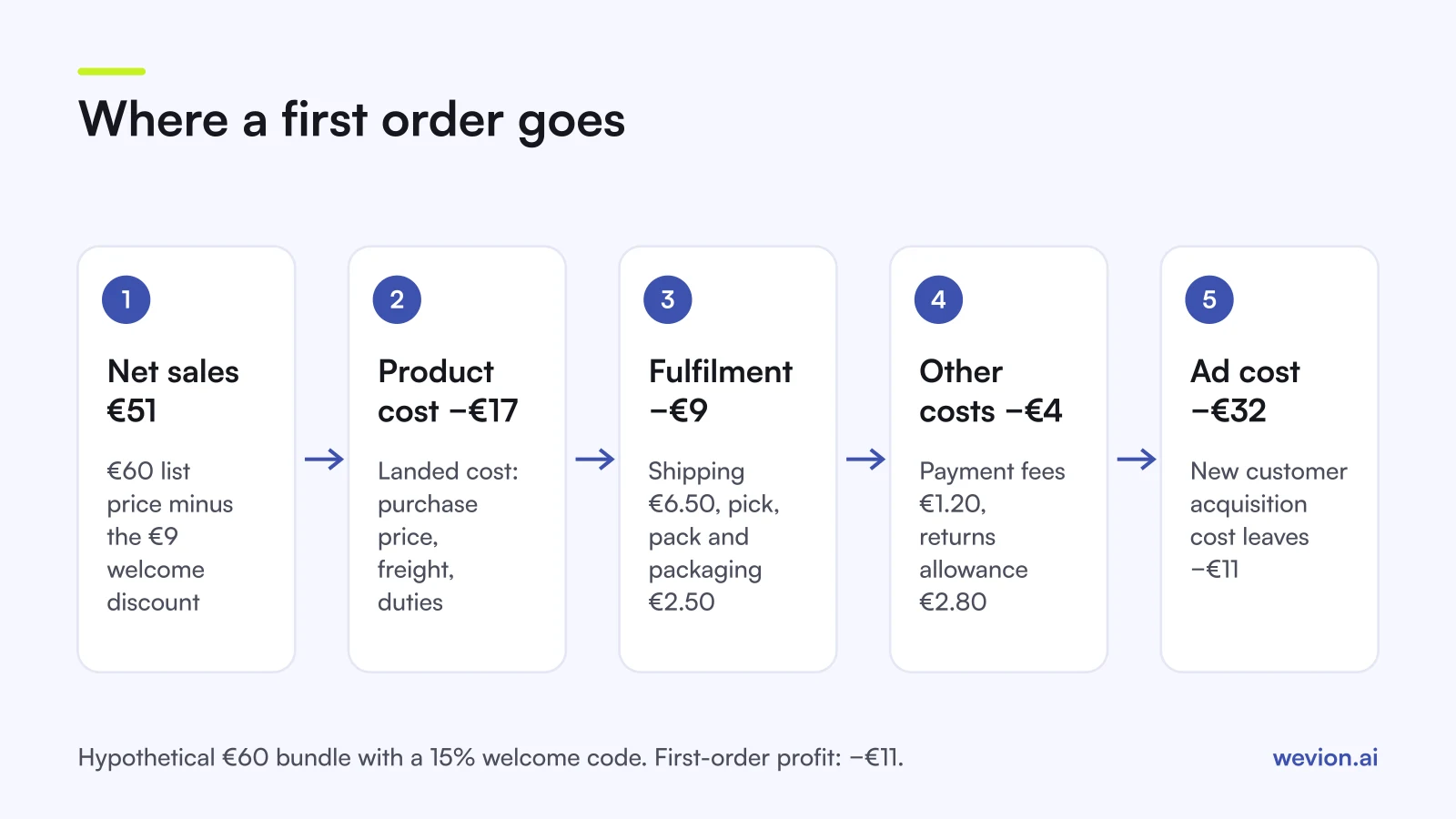
Two lines deserve extra care. The discount is a real cost even though it never shows as an expense: a 15 percent welcome code on a €60 order costs €9 of margin on every first order that uses it. And the returns allowance has to be estimated, because returns arrive after you judge the campaign. Work it out as the return rate on first orders multiplied by what each return costs you: the refund you cannot recover through resale, plus return shipping and handling.
A worked example: one first order
The brand below is hypothetical, and so are its numbers. It sells coffee, and most new customers start with a €60 starter bundle bought with a 15 percent welcome code.
| Line | Amount |
|---|---|
| List price | €60.00 |
| Welcome discount (15%) | −€9.00 |
| Net sales | €51.00 |
| Product cost (landed) | −€17.00 |
| Shipping | −€6.50 |
| Pick, pack and packaging | −€2.50 |
| Payment fees (simplified to a flat figure) | −€1.20 |
| Returns allowance (10% returned × €28 lost per return) | −€2.80 |
| First-order contribution (CM2) | €21.00 |
| New customer acquisition cost | −€32.00 |
| First-order profit | −€11.00 |
The store's platform-reported ROAS on this order would be €51 ÷ €32, about 1.6, which some teams would call acceptable. On contribution, every new customer starts €11 in the hole.
Without the welcome code, the same order would contribute €30, and first-order profit would be −€2. That does not prove the code should go, because removing it may raise nCAC if fewer people convert. It does mean the discount is worth testing like any other cost.
When is it fine to lose money on the first order?
A first-order loss is an investment only when you can see the return on it. Before you accept one, check four conditions:
- Repeat orders are measured, not assumed. Your own cohort data shows what share of new customers come back, and when. Shopify's Customer cohort analysis report groups customers by the date of their first order and tracks their repeat purchases.
- The loss is recovered inside your payback window. Decide the window from cash, not hope. The CAC payback period guide shows how much cash a long window ties up.
- Repeat orders make money on their own. If customers only come back for another discount, the repeat margin may not cover the first loss.
- The product invites repeat buying. Consumables, refills and subscriptions do; a mattress or a one-off gadget usually does not.
From those, set one number: the maximum acceptable first-order loss, equal to the repeat contribution you expect within the payback window. In the coffee example, 25 percent of new customers place a second order within 90 days, and a full-price repeat order contributes €30. Expected repeat contribution is 0.25 × €30 = €7.50. With a 90-day window, a first-order loss of up to €7.50 is defensible. The current loss is €11, so this brand is €3.50 per customer past its own line.
It is not fine to lose money on the first order when:
- You have no cohort data yet. A new store should aim for first-order profit at or near zero until it has some.
- Cash is short. A sound long-term bet can still empty the account before it pays back.
- Returns are high or rising. The allowance grows, and the loss with it.
- The channel brings bargain hunters. Customers acquired on a deep discount often repeat less than your average.
How do you measure it per channel?
Measure first-order profit per channel because the store average blends good and bad sources into one comfortable number.
Count first-time customers and their first orders in your store, then assign each to a channel using one consistent attribution method. Shopify's New vs returning customers report gives the first-time count. Consistent UTM parameters and, where useful, a post-purchase survey help connect those orders to channels. Remember that platform-attributed results overlap, so channel totals may not add up to the store total.
Continuing the hypothetical coffee brand, with a full-price repeat order worth €30 of contribution:
| Channel | nCAC | First-order contribution | First-order profit | Second order within 90 days | Profit per customer at 90 days |
|---|---|---|---|---|---|
| Meta prospecting | €32 | €21 | −€11 | 25% (+€7.50) | −€3.50 |
| Google Search | €24 | €23 | −€1 | 30% (+€9.00) | +€8.00 |
| TikTok | €26 | €19 | −€7 | 10% (+€3.00) | −€4.00 |
Google Search wins here on both counts: larger first baskets and more repeat buyers. TikTok has a cheaper nCAC than Meta but a weaker 90-day result, because its buyers place smaller first orders and come back less often. In this example, Meta needs either a cheaper nCAC (about €28.50 would bring the 90-day result to zero) or a better first basket, while TikTok needs a repeat rate it has not shown yet. Before cutting a channel on numbers like these, check whether it adds customers you would not get anyway; our guide to incrementality testing explains how.
How do you measure it per product?
The entry product, the one a new customer buys first, often decides first-order profit more than the channel does, because shipping and packaging cost much the same whatever the basket.
| Entry product (hypothetical) | Net sales | First-order contribution | nCAC | First-order profit |
|---|---|---|---|---|
| Starter bundle | €51.00 | €21.00 | €32 | −€11.00 |
| Single bag, no discount | €18.00 | €1.30 | €20 | −€18.70 |
| Grinder | €120.00 | €38.40 | €30 | +€8.40 |
The single bag looks cheap to acquire, but at €18 it barely covers its own €9 of fulfilment, so it can never pay for an ad on the first order. The grinder makes money at once but is rarely bought twice. The starter bundle sits in between and depends on repeat orders. Our per-SKU profit teardown shows how to find products like the single bag in a real catalogue.
Practical moves that follow from a table like this:
- Raise the first basket with bundles or a free-shipping threshold set above your fulfilment cost.
- Point prospecting ads at products that can carry acquisition, and let low-value items be add-ons.
- Test the welcome discount against a smaller one or a free gift.
- Set a breakeven line per product: 1 ÷ CM2 % gives the ROAS each one needs, as our breakeven ROAS calculator shows.
Where Wevion fits
Measuring first-order profitability means joining ad spend from every platform with store orders and costs on the same dates, and most brands rebuild that join by hand.
Wevion connects Meta, Google, TikTok, Snapchat, Taboola and Outbrain ad accounts through each platform's official API, brings Shopify or WooCommerce orders next to that spend in one dashboard, and syncs data about every 15 minutes, so the acquisition side of the sum is already totalled.
Wevion's Profitability Analytics, in beta, syncs cost per item from your store plus the shipping and fees you set once, then shows profit, margin and POAS, with margin per SKU. First-time customer counts and cohort repeat rates still come from your store's own reports. For setting the overall budget from these numbers, see how much should ecommerce spend on ads.
Start a 14-day trial with no card. We ask for one on day 7, or earlier if you use up the trial credits, and billing starts on day 14 only if you add it.
Key takeaways
- First-order profit = net sales after discount − product cost − fulfilment − payment fees − returns allowance − nCAC.
- Count the welcome discount and the returns allowance as real costs of the first order.
- A first-order loss is sound only with measured repeat orders, a payback window your cash can carry and profitable repeat orders.
- Set a maximum acceptable first-order loss equal to the repeat contribution you expect within that window.
- Measure per channel and per entry product; averages hide the sources and products that lose money.
- Raise the first basket and point prospecting at products that can carry acquisition cost.