
How to Diversify Beyond Meta Ads: A DTC Channel Mix
Priya Raghunathan
E-Commerce Performance Manager
Brands that diversify beyond Meta ads usually do it after a scare: a disabled ad account, a month when costs jumped, or a change that made results harder to measure. A better time is before that happens, while Meta is still working and you can fund a calm test. This guide covers why concentration is a risk, which channel to add second and third, how to fund the test and how to measure it.
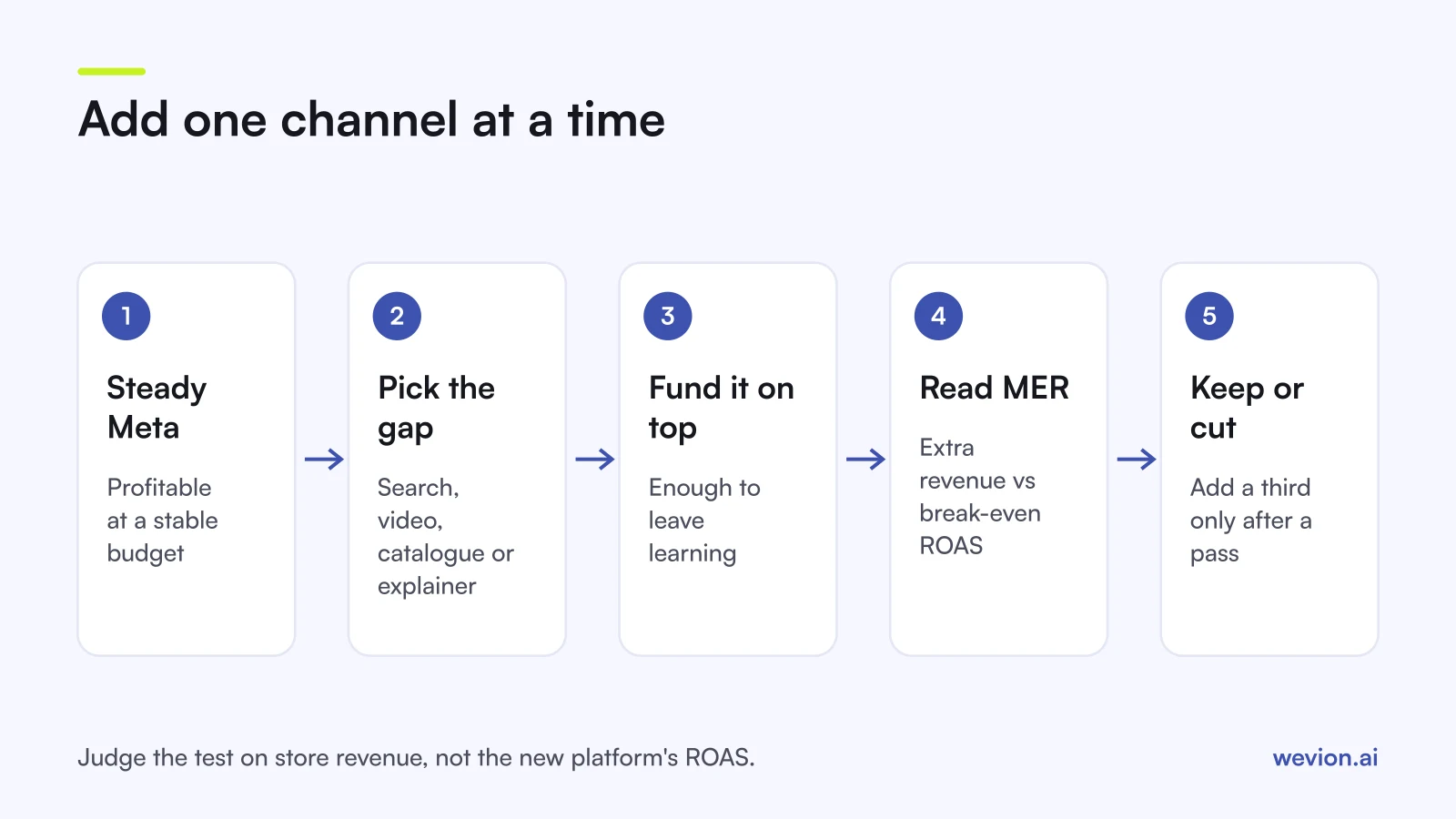
Quick answer: Add a second channel once Meta is profitable at a steady budget. For most DTC brands that is Google brand search and Shopping, or TikTok if your product sells through video. Fund the test with enough budget to leave the learning phase, keep Meta spend steady while it runs, and judge the new channel by how much total store revenue grew, using MER, not by its own reported ROAS.
This is about the mix, not the weekly split. For ratios between two channels see our Google vs Meta budget split framework, and for moving money each week once several channels run, our cross-channel budget reallocation framework.
Why is relying on Meta alone a risk?
Relying on Meta alone means one company's systems decide whether your paid growth works this week, and three kinds of event can hit all of it at once.
Account restrictions. Meta can disable an ad account or a business portfolio, and appeals take time. If every campaign lives in that account, revenue from paid ads stops until it is restored. Our guide to the first 48 hours after a disabled ad account covers what to do, and what evidence to gather for an appeal.
Auction costs. CPMs move with competition. In busy retail periods many advertisers bid for the same people, and a brand with one channel has nowhere else to put the budget when costs rise.
Measurement changes. Since iOS 14.5, Apple's App Tracking Transparency requires apps to get "the user's permission through the App Tracking Transparency (ATT) framework in order to track them". Changes like this shift how many conversions every platform can see. A brand that judges itself on one platform's reporting feels each change in full.
A second channel does not remove any of these risks. It limits how much of the business each one can touch.
When should a DTC brand add a second channel?
The right time to add a second channel is when Meta is stable and profitable, because a test needs a calm baseline to be readable. These signals say you are ready:
- Meta results have been steady for several weeks at your current budget, with no big structure changes planned.
- Each order is profitable after ad cost. Check it against your contribution margin, not against platform ROAS.
- Extra Meta spend buys less. When each budget increase brings a smaller gain in orders, the next euro may work harder elsewhere.
- You can make the new creative. A new channel needs its own format, and someone has to produce it every week.
If Meta itself is not profitable yet, fix that first. A second channel will not rescue an offer, a margin or a landing page that does not convert.
Which channel should come second, and which third?
Pick the second channel for the gap Meta leaves, not for the lowest cost per click. The table maps common gaps to the channel that usually fills them. Our guide to the best ad platforms for ecommerce covers each one in more depth.
| The gap you see | Channel that fills it | What it needs from you |
|---|---|---|
| People search your brand after seeing Meta ads | Google brand search and Shopping | Approved Merchant Center feed, purchase values |
| Product sells best when shown in use | TikTok | New vertical videos every week |
| Strong product catalogue, mobile-heavy buyers | Snapchat dynamic product ads | Product catalogue, vertical video |
| Product needs explaining before people buy | Taboola or Outbrain | Article or advertorial page |
For a Meta-first brand the most common second channel is Google, because it captures searches your Meta ads already create. Our guide on when to start Google Ads covers the launch order. For TikTok, see our TikTok vs Meta benchmark.
Add a third channel only after the second one has passed its test. Two tests at once make it impossible to tell which one moved revenue.
How should you fund a new channel test?
A new channel test needs enough budget to get through the platform's learning phase and a fixed length agreed before launch. The cleanest design adds the test budget on top of Meta rather than taking it out of Meta, so any change in total revenue belongs to the new channel.
Here is a hypothetical example for a brand spending €30,000 a month on Meta and testing TikTok.
| Item | Value |
|---|---|
| Meta spend, held steady | €30,000 a month |
| TikTok test budget | €4,500 a month, about 15% of Meta spend |
| Daily TikTok budget | €4,500 ÷ 30 = €150 |
| Test length | 8 weeks |
| Decision rule set before launch | Keep if incremental ROAS beats break-even ROAS |
The €150 a day clears TikTok's stated minimums of more than $50 per campaign and $20 per ad group. TikTok's learning phase page says volatility usually starts to decline after about 25 campaign results or 7 days, so do not judge the test in its first week.
If you cannot add budget on top, move a fixed share out of Meta and expect a noisier read, because Meta's results will also change.
How do you measure whether the new channel adds sales?
Measure a new channel by how much your store's total revenue grew against the extra spend, because every platform reports conversions by its own rules and two platforms can claim the same order. MER, total revenue divided by total marketing spend, is the simplest store-level check. Our MER vs ROAS guide explains it in full.
Continuing the hypothetical example, with a 45% contribution margin, so a break-even ROAS of 1 ÷ 0.45 ≈ 2.22:
| Before the test | During the test | |
|---|---|---|
| Meta spend | €30,000 | €30,000 |
| TikTok spend | €0 | €4,500 |
| Total store revenue | €105,000 | €117,000 |
| MER | 3.50 | 3.39 |
| Revenue TikTok reports | none | €15,750 (ROAS 3.5) |
TikTok claims €15,750, but the store grew by €12,000. The incremental ROAS is €12,000 ÷ €4,500 ≈ 2.67, above the 2.22 break-even, so in this example the channel adds profit even though blended MER dipped slightly. If the store had grown by only €8,000, incremental ROAS would be about 1.78 and the test would fail, whatever TikTok reported.
Two cautions. Compare like with like: a test month that includes a sale or a holiday will flatter the result. And for a cleaner read, run a region holdout, where the new channel runs in some regions and not others, then compare revenue between the two groups. Watch new customer acquisition cost too, because a channel that only reaches existing buyers adds little growth.
Common mistakes when diversifying ad channels
Most failed diversification tests fail on design, not on the channel itself:
- Reusing Meta creative on TikTok or Snapchat without making it native to the format.
- Judging the new channel by its own ROAS, which counts orders other channels also claim.
- Spreading a small budget across three new channels, so none of them leaves learning.
- Changing Meta at the same time, which muddies the read.
- Stopping in week one because results are volatile while the platform learns.
Once two or three channels are running, the operating work changes. Our guide on how to manage ads across multiple platforms covers the routine.
Where Wevion fits
Reading a new channel against MER means joining spend from every ad platform with your store's revenue, every week, for the whole test.
Wevion connects Meta, Google, TikTok, Taboola, Snapchat and Outbrain ad accounts through each platform's official API, syncs data about every 15 minutes, and shows spend and results for every account in one view, so a new channel sits next to Meta from its first day.
Shopify or WooCommerce orders can sit next to that spend in the same dashboard. You can set automated rules on each platform that pause ads, change budgets by a percentage or just send an alert when a test overspends, with a cooldown and a daily cap on runs. Cross-platform rules and Profitability Analytics are in beta.
You can try it on your own ad accounts with a 14-day trial on the Pro plan. No card to start. We ask for one on day 7, or earlier if you use up the trial credits, and billing starts on day 14 only if you add it.
Key takeaways
- A Meta-only brand has all its paid revenue exposed to one platform's account decisions, auction costs and measurement changes.
- Add a second channel when Meta is steady and profitable, for the gap Meta leaves.
- For most DTC brands the second channel is Google brand search and Shopping; TikTok fits video-led products.
- Fund the test on top of Meta, for a fixed length, with a decision rule set before launch.
- Judge it by incremental store revenue against break-even ROAS, not by the new platform's own ROAS.
- Add a third channel only after the second has passed.