
Snapchat Lead Generation Ads: Lead Forms, Setup and CRM
Marta Kowalczyk
Agency Operations Lead
Snapchat lead generation ads are campaigns built on Snapchat's Leads objective that collect contact details through a native lead form inside the app, your own website, or a call or text. For agencies already running lead forms on Meta and TikTok, Snapchat follows the same pattern, but the form fields, the export options and the audience are different enough to plan for separately.
Quick answer: In Snapchat Ads Manager, choose the Leads objective, collect leads with a native lead form and let the ad set optimise for lead form submissions. Keep the form short, add one qualifying question, connect a CRM through Snap's partner integrations before launch, and judge results on cost per qualified lead.
This guide covers Snapchat only. For the sister setup on TikTok, see our guide to TikTok lead generation ads. For the account basics, start with our Snapchat Ads Manager guide.
What are Snapchat lead generation ads?
Snapchat lead generation ads are ads that run under the Leads objective and send people to a place where they leave their details. Snap's Marketing API documentation maps the older Lead Generation objective to Leads and lists four conversion locations for it, each with its own optimisation goals:
| Conversion location | What happens after the tap | Optimisation goals in Snap's API |
|---|---|---|
| Lead form | A native form opens inside Snapchat | Swipes, lead form submissions |
| Web | The person lands on your website | Swipes, story opens, pixel sign up, landing page view |
| Call | A phone call starts | Impressions, swipes |
| Text | A text message starts | Impressions, swipes |
These are the API names, and the labels in Ads Manager may read slightly differently. For most agency lead generation, the lead form with lead form submissions as the goal is the place to start. The web option needs the Snap Pixel firing a sign up event on the client's site, which our Snapchat Ads Manager guide covers.
Snap's lead generation page says its native forms are automatically pre-filled with the Snapchatter's profile information, and that leads can be measured directly in Ads Manager without a landing page.
How do you set up a Snapchat lead form campaign?
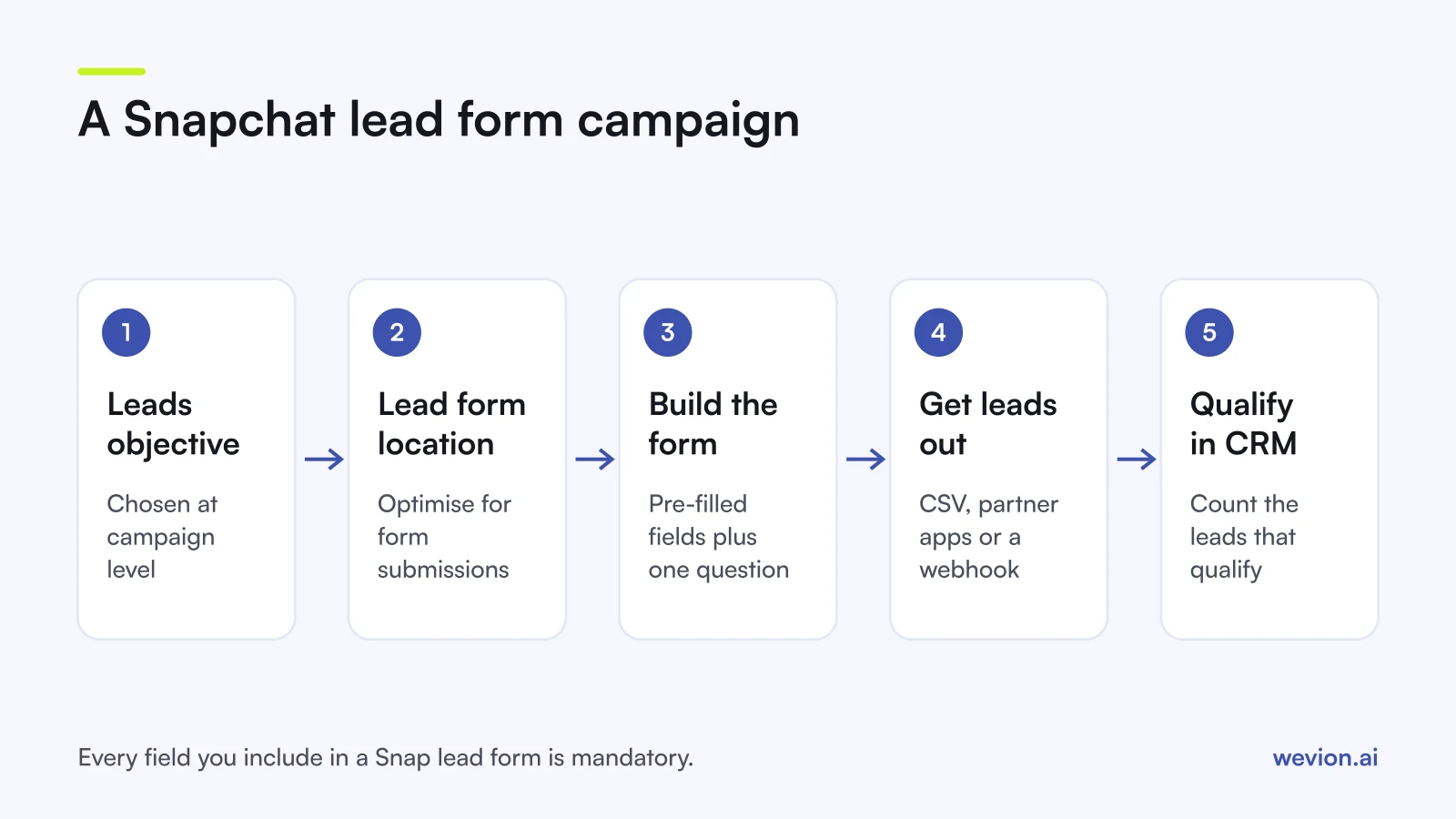
A Snapchat lead form campaign takes three choices at three levels: the objective, where leads are collected, and the form itself. Snap's lead generation page gives the starting point: select Leads as the campaign objective, then choose Simple Instant Form for a quick native form, or Manual Build for more control.
- Campaign: choose the Leads objective.
- Ad set: collect leads with a lead form, then set the audience, budget, bid and optimisation goal. Snap's API calls ad sets "ad squads", so you will see both names.
- Bid: Snap suggests testing auto-bid, or setting a target cost bid about 20% above your actual cost per lead goal, to give the system room to learn. For a client targeting €25 per lead, that means a target cost of about €30.
- Ad: add the creative and build or attach the lead form.
- CRM: connect the form to the client's CRM before the ad goes live, so the first leads are not sitting in Ads Manager.
Snap also suggests testing several ad sets with different audiences, such as broad, lookalike, interest-based or location targeting, and repeating the ad's offer at the top of the form.
What can a Snapchat lead form ask?
A Snapchat lead form can ask for standard contact fields and custom questions, and the rules are stricter than on Meta. Snap's lead generation ads API guide lists the field types and limits:
- Standard fields: first name, last name, email, phone number, address, postal code, birthday, job title and company name.
- Required fields: first name and last name, plus email or phone number, or both. Address and postal code cannot both appear on the same form.
- Custom questions: text, date, and multiple choice with one or several answers.
- Consent: up to two consent fields, plus an optional privacy policy link shown before the person submits.
- Copy limits: a form title of 25 characters and a description of 180.
Snap's help centre adds two details for the form builder. Its lead form design article says questions are split across several pages and the end page can carry up to two calls to action, each with URL macros and custom parameters for tracking. Its lead form fields summary says most fields are optional to include, but once you include a field, people must complete it.
That last rule matters for quality. Every field you add is a field people must fill in, so a long form cuts volume quickly. Snap's own advice is to use qualifying questions when quality matters and essential fields only when volume matters. For a client whose sales team calls every lead, one multiple choice question on budget or timing is usually enough.
Snap's API treats the privacy policy link as optional, but include the client's privacy policy URL anyway. People should be able to see who will contact them and how their details will be used before they submit.
How do you get Snapchat leads into a CRM?
Leads turn into revenue only when someone contacts them quickly, so the export route is the first thing to agree with the client. Snapchat offers three routes.
- CSV download. Snap says CSV downloads are available in Ads Manager at ad account level, through a Download Leads button that appears once there are leads. Fine for a test, too slow for daily follow-up.
- Partner integrations. Snap's lead generation page lists HubSpot, Zapier, LeadsBridge, Datahash, Google Sheets and Driftrock. For Google Sheets, Snap's help centre says to use Connect Form to CRM in Ads Manager, and the Google account needs edit permission on the sheet.
- Webhook through the API. Snap's API guide lets developers create one webhook integration per form, which needs Organization Admin access and returns a secret to verify that events came from Snap.
The HubSpot route is the newest. In July 2026 Snap launched a native HubSpot integration, reported by Marketing Dive, that sends leads into existing HubSpot lists and pipelines, maps form fields to HubSpot properties and sends conversion events tracked in HubSpot workflows back to Snapchat.
Whatever the route, two habits make the CRM side easier. Name each form after the client, offer and date, so the sales team knows where a lead came from. Use the URL macros on the end page calls to action, as Snap's design article describes, so the CRM can tell which campaign brought someone who clicked through.
When does Snapchat lead generation make sense?
Snapchat lead generation makes sense when the client's buyers use Snapchat and the offer is simple enough to sign up for on a phone. It is a test channel next to Meta, rarely a replacement for it.
Snap gives a few numbers on its lead generation page: 946 million people use Snapchat monthly, according to Snap internal data for Q4 2025, and nearly 1 in 4 Snapchatters are 35 or older, according to GWI data from 2024. Snap also told Marketing Dive that click-through rates on its native lead ads rose 77% in January 2026 against a year earlier, while cost per lead fell 26%. These are Snap's own figures, so treat them as a reason to test, not as a forecast.
Snapchat tends to fit:
- Offers for younger adults, such as education, courses, fitness, events and entry-level financial products.
- Simple sign-ups, such as a callback, a trial class, a quote request or a waitlist.
- Clients already testing TikTok, where the vertical video creative can be adapted.
It fits less well when:
- The form needs many qualifying fields, because every included field is mandatory.
- The client cannot follow up fast. Mobile sign-ups go cold quickly.
- The budget cannot support a proper test. Spread across several ad sets, a small budget gives each one too few leads to judge.
Here is a hypothetical test plan. A client wants €40 per qualified lead and qualifies about 40% of leads, so the target cost per lead is €16. Following Snap's 20% suggestion, the target cost bid is about €19. Three ad sets at €60 a day spend €180 a day, or €1,260 a week. At €16 per lead that is about 79 leads and about 32 qualified leads in the first week, which is enough to see whether Snapchat is in range.
How is Snapchat different from TikTok and Meta lead ads?
Snapchat, TikTok and Meta all offer native lead forms, but the options around them differ. Here is the comparison for an agency running all three.
| Snapchat | TikTok | Meta | |
|---|---|---|---|
| Objective | Leads | Lead generation | Leads |
| In-app form | Native lead form | Instant Form | Instant form |
| Other places to collect leads | Website, call, text | Website, TikTok direct messages, messaging apps | Website, messaging apps, calls |
| Form type with a review step | Not in Snap's form documentation | Higher Intent | Higher intent |
| Built-in export | CSV from Ads Manager | CSV, in-app lead inbox | CSV or XLS, in-app lead inbox |
| Sending CRM results back | Conversion events through the HubSpot integration | Lead quality optimisation | Conversion leads goal |
For the Meta side, see our guide to the Higher intent instant form. Whatever the platform, a shared list of CRM stages is what makes the numbers comparable. Our guide to tracking lead quality through your CRM sets up those stages, and the story of a lead-gen agency proving cost per qualified lead across six platforms shows how one agency compared them.
Where Wevion fits
Agencies adding Snapchat to a client's lead generation mix usually end up with one more ad manager to open and one more export to merge before every report.
Wevion connects Meta, Google, TikTok, Taboola, Snapchat and Outbrain ad accounts through each platform's official API, syncs data about every 15 minutes, and shows spend and platform-reported results for every account in one view, so you can compare Snapchat lead campaigns with Meta and TikTok side by side.
Each client gets its own workspace, and team roles such as manager, media buyer, finance and viewer decide who can change what. You can launch ad sets across platforms with Bulk Launch, and set automation rules that pause ad sets, change budgets or only send you an alert. If you move budget between platforms, cross-platform rules are in beta. Lead status still lives in the client's CRM. If you are comparing tools for Snapchat specifically, see our roundup of Snapchat Ads Manager alternatives.
You can try it on your own ad accounts with a 14-day trial on the Pro plan. No card to start. We ask for one on day 7, or earlier if you use up the trial credits, and billing starts on day 14 only if you add it.
Key takeaways
- Snapchat lead generation ads use the Leads objective, with a native lead form, website, call or text as the place to collect leads.
- For a native form, the ad set optimises for lead form submissions; Snap suggests a target cost bid about 20% above your cost per lead goal.
- Forms need first and last name plus email or phone, and every field you include is mandatory, so keep forms short.
- Get leads out through a CSV, partner integrations such as HubSpot, Zapier and Google Sheets, or a webhook per form.
- Snapchat suits simple sign-ups for audiences that use the app; test it with a clear target cost per qualified lead.