
Solar Lead Generation Ads on Meta, Google and TikTok
Marta Kowalczyk
Agency Operations Lead
Solar lead generation ads are paid campaigns that collect enquiries from homeowners thinking about solar panels, usually with batteries or an EV charger alongside, through an instant form, a landing page or a call. They look like any other home services campaign until the leads reach the sales team. Then a large share turns out to be renters, flats with shared roofs, very small electricity bills or addresses outside the installer's area, and every one of them still cost money.
Quick answer: Run Google Search for people already comparing installers, and Meta and TikTok to create demand with local proof and a clear offer. Qualify inside the form on homeownership, property and roof, monthly bill range, postcode and timeline. If an ad promotes financing, declare the credit or financial category where the platform requires it. Do not advertise incentives you have not checked and dated, and judge every channel on cost per signed contract.
This guide follows our series on regulated and local lead generation. For the trade side in general, see our guide to home services lead generation ads; for financing and housing rules, our guides to insurance lead generation ads and real estate lead generation ads. Nothing here is legal or tax advice: check local law and incentives with the client.
Why are solar leads harder to qualify than other home services leads?
Solar leads are harder to qualify because the sale depends on facts about the house and the household that the ad cannot see: who owns the property, what the roof is like, how much electricity the home uses and whether the installer covers the area. A plumber's lead is usually sellable if the postcode fits. A solar lead needs four or five conditions to line up.
The sale is also long and expensive: several quotes, a site survey, then a choice between cash and financing. That changes three things for the agency:
- Cost per lead misleads. Cheap leads from a broad offer can cost more per signed contract than expensive, well-qualified ones.
- Follow-up has several steps. First call, qualification, survey or design appointment, proposal, contract. Each stage loses people.
- The offer touches regulated ground. As soon as an ad promotes a loan or payment plan, the platforms treat it as a credit or financial ad in some markets.
Which channels fit solar lead generation ads?
The channel that fits depends on whether the homeowner is already looking for an installer or still has to be persuaded that solar makes sense for them. Most installers need both: search for existing demand, social for new demand.
| Channel | Who you reach | What works | Main conversion |
|---|---|---|---|
| Google Search | People comparing installers, prices, batteries | Local keywords, price and process pages | Form, call, lead form asset |
| Meta | Homeowners not yet searching | Local installs, customer stories, a clear survey offer | Instant form, Higher intent form |
| TikTok | Younger homeowners, broad local reach | Short install videos, behind-the-scenes, explainers | Instant form |
| Google Local Services Ads | People searching for local trades | Only where a solar category is offered | Call or message |
Google's Local Services Ads help page says the ads are available only for certain service categories and points to an eligibility check by area, so confirm in the client's market before you plan around them. For lead form assets on Search, see our guide to Google Ads lead form assets, which covers eligibility.
On Meta, a Higher intent instant form adds a review step before submission, a fair trade when every lead triggers a call. For TikTok, see our guide to TikTok lead generation ads.
Do solar ads fall under special ad categories?
Solar ads fall under special ad categories when they promote financing, not because of the panels themselves. None of the three platforms names solar in its category rules, but each one covers credit, and many solar offers are built around a loan or a monthly payment.
- Meta. The Special Ad Category documentation requires the financial products and services category for advertisers based in the US or showing ads to US audiences, and the credit category in Canada and Europe under the older housing, employment and credit rules. The page does not list solar or home improvement. An ad that promotes a solar loan or financing plan is promoting a financial product, so declare the category; once declared, age is fixed at 18 to 65+, gender cannot be selected, US and Canada locations need at least a 15 mile or 25 km radius, and lookalikes are not available.
- TikTok. The housing, employment and credit ad policy, last updated April 2026, lists credit examples that end with "and any other loans", and requires the Special Ad Category toggle for US-based advertisers and anyone targeting the US or Canada. A solar loan offer fits that definition.
- Google. Google's personalised advertising policy limits targeting by age, gender, parental status, marital status and ZIP code for consumer finance ads in the US and Canada, and Google defines consumer finance around credit and lending. A financing-led solar campaign falls inside it.
A plain product ad, such as a video of an install with a "book a free survey" offer and no payment terms, is not clearly covered by any of these pages. The practical rule: keep financing out of prospecting ads if the client wants full targeting, and run a separate, declared campaign for financing offers. Check the decision with the client, because the advertiser is responsible for the declaration.
What can solar ads say about incentives and savings?
Solar ads can mention incentives only when the incentive is current, applies to the audience you target and comes from an official source you can link to. Incentives change often, and an outdated claim is both a policy risk and a reason for an angry first call.
Two US examples show why:
- The federal residential credit has ended. The IRS page on the residential clean energy credit says the 30% credit "is not available for any property placed in service after December 31, 2025". As of November 2026, a US ad that promises homeowners a 30% federal tax credit on a new install is wrong. State, utility and local programmes vary; check each one on its official site and date it in the ad copy brief.
- "Free solar" is a known scam pattern. The US Federal Trade Commission's September 2024 consumer alert says "going solar isn't free" and tells people to avoid companies that say a government program will cover the whole cost or claim to be from the government. Ads built on "free panels" or "government solar programme" wording copy exactly what consumers are told to avoid.
Savings claims need the same care: "cut your bill by 70%" depends on usage, tariff, roof and system size. Offer a quote based on the household's own bill instead.
Which questions should a solar lead form ask?
A solar lead form should ask the questions that decide whether the installer can sell to this household at all, with multiple choice answers wherever possible. Keep contact details pre-filled and add five or six questions:
- Do you own your home? Yes, no, buying now. Renters usually cannot install.
- What type of property is it? Detached, semi-detached or terraced house, flat, commercial.
- How would you describe the roof? Under 10 years old, older, needs work soon; little shade, some shade, heavily shaded.
- What is your usual monthly electricity bill? Ranges in the local currency, such as under 50, 50 to 100, 100 to 200, over 200.
- What is your postcode or ZIP code? Short answer, so the office can check the service area.
- When would you like to install? Within 3 months, 3 to 6 months, just researching.
Leave out credit scores, income, debts and dates of birth. TikTok's ad format and functionality policy, last updated April 2026, lists financial information such as income, credit scores and debt, plus date of birth, among the data lead ads may not collect without written consent from a TikTok sales representative, and Meta's advertising policies set a similar limit on financial information. The finance partner can ask on the call, with the disclosures the law requires.
On Meta, conditional logic in lead ads can close the form politely for renters and flats without roof access, or point them to a different product such as a balcony kit if the client sells one. That keeps unsellable leads out of the CRM instead of filtering them by hand.
How should you follow up and measure solar leads?
Solar leads need a first call within minutes and a clear path to an appointment, because a homeowner asking for a quote often asks several installers the same day. Route each lead by area to the right surveyor or sales rep, and confirm the call time by text.
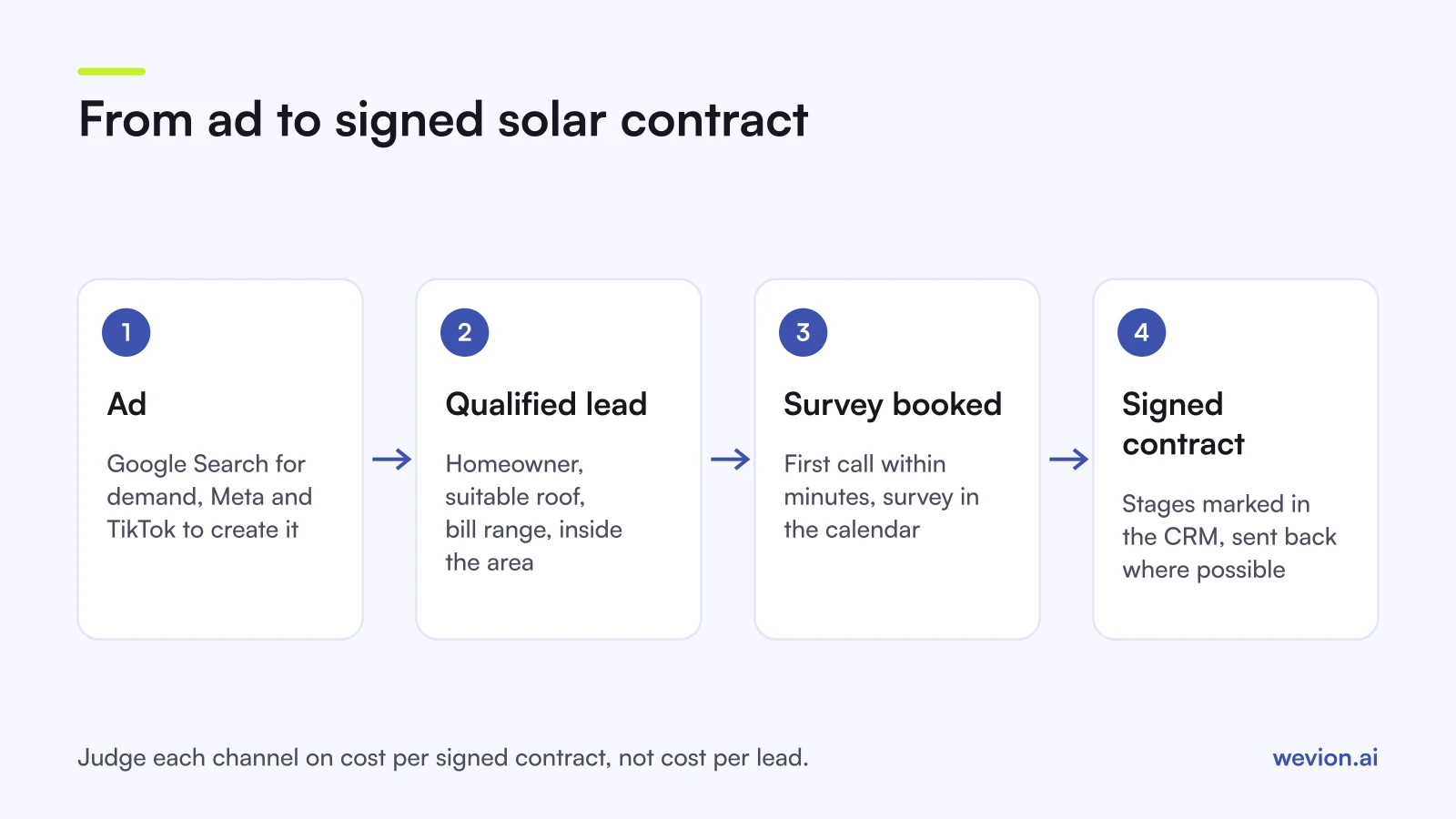
A worked example with hypothetical numbers shows why cost per lead is the wrong target. An installer spends $6,000 a month across Meta and Google and gets 200 leads at $30 each. Of those, 120 are homeowners inside the service area. Sales reaches 80 of them, books 24 surveys and signs 6 contracts. That is $250 per survey and $1,000 per signed contract.
Now suppose a cheaper, broader offer brings 300 leads at $20, the same $6,000. If only 90 are qualified homeowners and 4 sign, cost per contract rises to $1,500, even though cost per lead fell by a third.
To see those numbers, record the platform, campaign and form on every lead, mark each stage in the CRM and send the stages back where the platforms can use them. On Meta, conversion leads optimisation learns from CRM stages if you have about 200 leads a month and a stage that 1% to 40% of leads reach within 28 days, so a booked survey is often the right target. On Google, offline conversion imports do the same job, as our guide to lead scoring for paid ads explains. For routing and call cadence, see our guide to speed to lead.
Where Wevion fits
Wevion is not part of the lead or compliance path: it does not set special ad categories, check incentive claims, store leads or send conversions to the platforms. Categories are declared in each platform's campaign setup, and leads live in the client's CRM.
Wevion connects Meta, Google, TikTok, Taboola, Snapchat and Outbrain ad accounts through each platform's official API, syncs data about every 15 minutes, and shows platform-reported leads, cost per lead and spend for every client in one view, so an installer's Meta, Google and TikTok campaigns sit side by side.
Each solar client gets its own workspace, and team roles such as manager, media buyer, finance and viewer decide who can change what. Automated rules can pause ad sets, change budgets or just send an alert when cost per lead crosses a threshold you set, with a cooldown and a daily cap on runs, which helps when the survey calendar is full and spend should drop.
You can try it on your own ad accounts with a 14-day trial on the Pro plan. No card to start. We ask for one on day 7, or earlier if you use up the trial credits, and billing starts on day 14 only if you add it.
Key takeaways
- Solar lead generation ads fail on qualification more than on volume: renters, unsuitable roofs, small bills and out-of-area addresses cost the same as good leads.
- Use Google Search for existing demand and Meta or TikTok for new demand, with Higher intent forms where every lead gets a call.
- Financing offers bring credit or financial ad category rules on Meta, TikTok and Google in the US and Canada; plain product ads are not clearly covered.
- As of November 2026, the US federal residential clean energy credit is not available for new installs, and "free solar" wording copies a pattern the FTC warns about.
- Qualify on homeownership, property, roof, bill range, postcode and timeline, and judge campaigns on cost per survey and per signed contract.