
January Sales Ads: How to Plan Paid Media After BFCM and Christmas
Priya Raghunathan
E-Commerce Performance Manager
January sales ads are a different job from Black Friday ads. By the time the January sales start, most of your customers have just bought, many of them gifts for someone else, and the people still browsing are looking for a reason to buy for themselves. A good January plan picks one main goal, treats Q4 buyers as their own audience, uses offers that protect margin and measures profit rather than revenue.
Quick answer: Plan January sales ads around one goal: clearing stock or winning new customers at a profitable cost. Exclude or cap Q4 buyers, retarget them with self-purchase and replenishment offers, design discounts from your contribution margin, refresh every Christmas creative before the sale starts, and judge the month on new customers and contribution margin, not platform ROAS.
This guide picks up where our BFCM 2026 paid social checklist ends. If you have not yet split your reporting into new and returning customers, read our guide to new customer acquisition cost first, because January is where that split matters most.
What should January sales ads try to achieve?
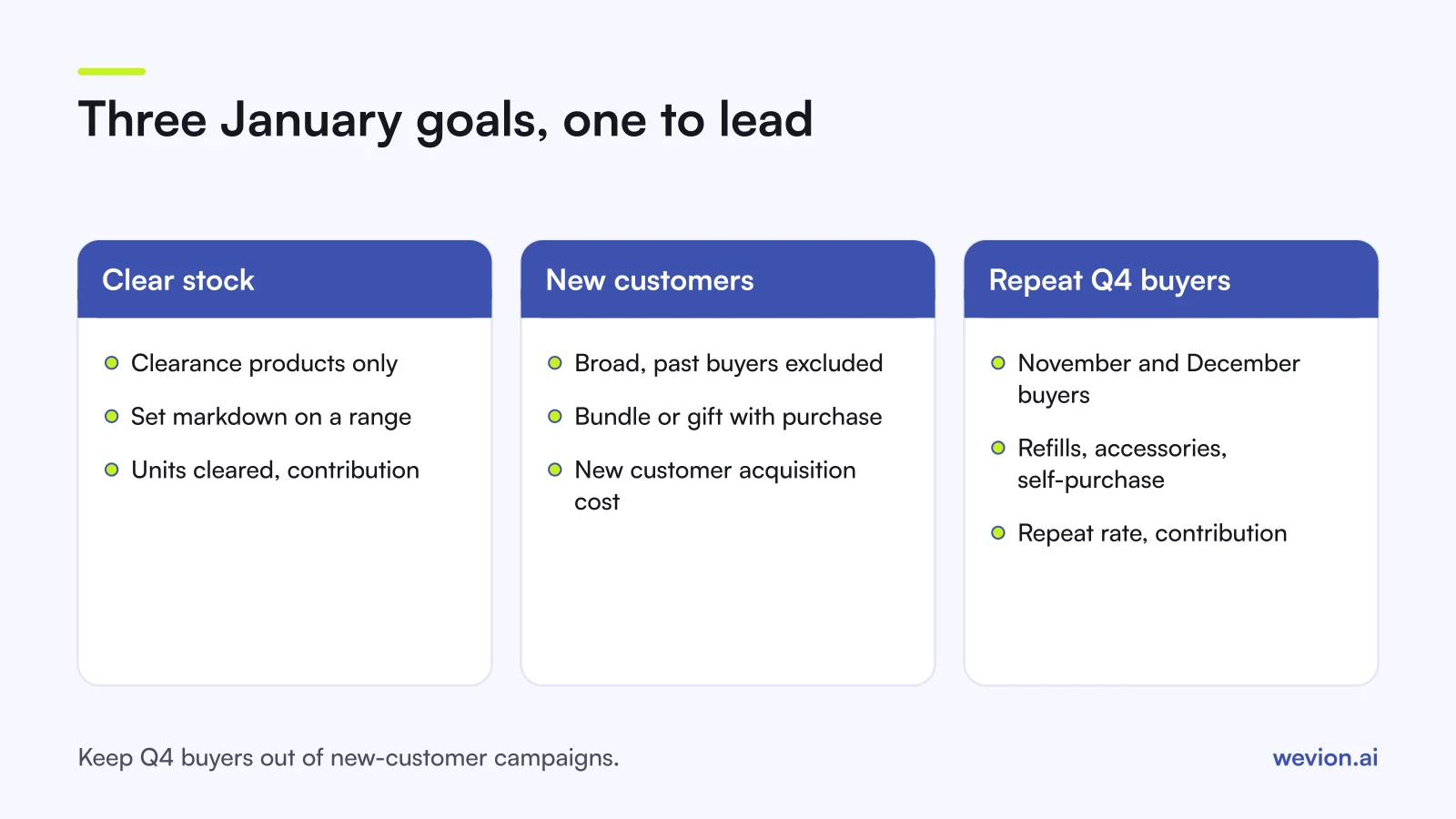
January sales ads work best when one goal leads, because clearance, acquisition and repeat sales need different audiences, offers and metrics. Trying to do all three in the same campaigns usually means a deep sitewide discount shown to everyone, which clears stock but sells it mostly to people who would have bought anyway.
| Goal | Who you target | Offer that fits | Main metric |
|---|---|---|---|
| Clear seasonal stock | Past visitors and broad audiences, on clearance products only | Clearance range at a set markdown | Units cleared and contribution per order |
| Win new customers | Broad prospecting, past buyers excluded | Bundle, gift with purchase or first-order offer | New customer acquisition cost (nCAC) |
| Turn Q4 buyers into repeat buyers | Customers who bought in November and December | Replenishment, accessories, self-purchase | Repeat rate and contribution per order |
Most DTC brands run clearance and repeat purchase as supporting goals, with a limited budget each, and keep most of the spend on new customers. The right split depends on how much seasonal stock is left and how much a repeat customer is worth to you. Our LTV to CAC ratio guide shows how to put a number on the second part.
When do the January sales run?
The January sales calendar depends on the market, so check the dates in every country you sell to before you set budgets. In the UK, sales commonly start around Boxing Day on 26 December and continue into January. Other markets regulate the period.
France is the clearest example. According to the French government's service-public.gouv.fr page on sales, winter sales start on the second Wednesday of January at 8 a.m., or on the first Wednesday if the second falls after the 12th, and last four weeks. Online sales follow the same national dates. In January 2027 the second Wednesday is the 13th, so by that rule the sales start on Wednesday 6 January. Some departments have different dates, so confirm the official calendar before you launch.
Price rules also apply to how you advertise the discount. In the EU, the Price Indication Directive, as amended in 2019, says any announced price reduction must show the prior price, defined as the lowest price you applied in a period of at least 30 days before the reduction. If a product stayed discounted from Black Friday into December, your January "was" price may be the lower December price, not the full price. Check this with your legal adviser for every market before you write "50% off" in an ad.
How do you retarget your Q4 buyers in January?
Q4 buyers are your warmest audience in January, but they bought at a discount and often for someone else, so the message has to change. Start with three audiences built from your store data and pixel events:
- November and December buyers. A customer list exported from the store, plus a website audience of purchasers with a window that reaches back before Black Friday.
- Gift buyers who never bought for themselves. If your checkout has a gift option or gift message, tag those orders in the store and export them as a separate list.
- Engaged non-buyers. People who viewed products or added to cart in December but did not buy.
Then keep these audiences out of your new-customer campaigns. On Meta, the existing customer budget cap is no longer available for new Advantage+ sales campaigns, so the control is now two ad sets under one campaign budget: one for past buyers with a maximum spend limit, one that excludes them. Our guide to the Advantage+ existing customer budget cap covers the set-up step by step.
On Google, the new customer acquisition goal in Performance Max and Search lets you bid higher for new customers or bid only for new customers, using your customer lists and conversion data. Use it for the acquisition campaigns and leave retention to separate campaigns with their own budget.
For the retargeting creative, follow the logic of our retargeting strategy guide: a product they have not bought yet, a refill of what they did buy, or an accessory that goes with it. A discount is optional here. Many Q4 buyers will respond to "complete the set" without one.
How do you design a January offer without training discount-only buyers?
A January offer should be built from your contribution margin per order, not copied from Black Friday. Customers who only buy at 30 percent off and only in sale periods rarely come back at full price, so every sitewide cut teaches your list to wait for the next one.
Here is a worked example with invented numbers, excluding VAT, for a product that sells at €80, costs €28 to make and €10 to ship and process:
| Offer | Price paid | COGS | Shipping and fees | Contribution before ads |
|---|---|---|---|---|
| Full price | €80 | €28 | €10 | €42 |
| 30% off | €56 | €28 | €10 | €18 |
| Bundle of 2 at 15% off | €136 | €56 | €12 | €68 |
| Full price plus €6 gift | €80 | €34 | €10 | €36 |
At 30 percent off, each order leaves €18 to pay for the ad that brought it in. If you usually need €30 of ad spend to win a new customer, every new customer at that offer loses €12 on the first order. The bundle and the gift with purchase both leave more room, which is why they suit acquisition. Our guide to first order profitability explains when a first-order loss is acceptable.
Three ways to run a sale without a sitewide cut:
- Clearance as a range. Mark down only last season's stock. On Meta, tag those products with a custom label in your catalogue and build a product set from it, as our Meta catalogue ads guide explains.
- Bundles and sets. Higher order value carries shipping and fees better than a single discounted item.
- Gift card redemption. People who received gift cards at Christmas are already holding credit. A "spend your gift card" message to your list and site visitors needs no extra discount.
How should budgets and bids change in January?
Budgets and bids should come down in steps after Christmas and then follow the goal you chose, rather than jumping between peak and quiet settings. Large, sudden changes push Meta ad sets back into learning, and Google's Smart Bidding needs time to adjust to a new conversion rate.
- Wind down gifting campaigns first. Pause campaigns with Christmas delivery messages as soon as your last shipping date passes.
- Reset targets to January economics. If your sale offer lowers contribution per order, your target CPA or target ROAS needs to move with it. Our Meta ads bid strategies guide and Google Ads Smart Bidding guide cover the settings.
- Use seasonality adjustments only for short spikes. Google's seasonality adjustments page says they are ideal for short events of 1 to 7 days and may not work as well for more than 14 days at a time. A four-week sale is too long for one, but a launch weekend can qualify.
- Raise budgets in moderate steps when the sale starts, and keep a share for prospecting at full price, so January does not become the only month your new customers ever see.
What creative should you refresh for January?
Every Christmas creative needs to be replaced or switched off before the sale starts, because gift and delivery messages turn wrong overnight on 26 December. Make a list of all live ads that mention gifts, Christmas, delivery dates or Black Friday offers, and replace them in one pass.
Meta's Advertising Standards page says ad review is typically completed within 24 hours, although it can take longer. Build and submit your January creative in the last week of December, so it is approved when the sale opens.
New angles that suit January: "for you this time" for people who spent December buying for others, new-year routines and resets where they fit the product, and clear sale end dates. Keep the sale end date in the ad truthful, and do not extend a sale you advertised as ending. Our ad creative brief template helps you brief the set in one go.
What should you measure in January?
January results should be judged on new customers and profit, because platform ROAS is inflated by Q4 buyers coming back and by people who would have bought in the sale anyway. Track these weekly:
- New customer acquisition cost (nCAC): total ad spend divided by first-time customers from the store.
- New customer share: first-time customers as a share of all January orders.
- Contribution per order after discount, before and after ad spend.
- Clearance progress: units of seasonal stock sold against the plan.
- Refunds: returns from December orders also reach your books in January, so keep them visible and separate from sale performance.
Our ecommerce KPI dashboard guide shows a layout for these numbers, and MER vs ROAS explains why store revenue, not platform revenue, belongs at the top of the report.
Where Wevion fits
Running January sales across several ad platforms means checking spend and results by channel every day while budgets, offers and creatives change, and doing it by hand across tabs is where mistakes slip in.
Wevion connects Meta, Google, TikTok, Snapchat, Taboola and Outbrain through each platform's official API and syncs data about every 15 minutes, so you see spend and platform-reported results for every channel in one view. Automated rules can pause, activate or change budgets on a single platform by a set percentage, or just send an alert, with a cooldown and a daily cap on runs. Profitability tracking, in beta, brings Shopify or WooCommerce orders and costs next to that spend, so you can check whether the sale is making money and not only sales.
Start a 14-day trial with no card. We ask for one on day 7, or earlier if you use up the trial credits, and billing starts on day 14 only if you add it.
Key takeaways
- Pick one lead goal for January: clearance, new customers or repeat purchases from Q4 buyers.
- Check legal sale dates and the EU prior price rule for every market before you advertise a discount.
- Keep Q4 buyers out of new-customer campaigns and give them their own capped budget and offer.
- Build offers from contribution per order: bundles, gifts and clearance ranges often beat a sitewide cut.
- Use seasonality adjustments for short spikes only, and move bid targets with your new margin.
- Replace all Christmas creative before the sale starts and measure the month on nCAC and contribution margin.