
Meta Special Ad Categories: What Lead Generation Agencies Need to Know
Lena Brandt
محلل سياسات الإعلانات والامتثال
Meta special ad categories are the labels an advertiser must declare when a campaign promotes housing, employment or financial products and services, or is about social issues, elections or politics. Declaring one switches the campaign to a restricted set of targeting: no age or gender choices, no postcodes, no lookalikes and very little detailed targeting. For lead generation agencies in mortgages, property, recruiting, loans and insurance, the category decides how a campaign can be built before a single ad is written.
Quick answer: As of November 2026, Meta's four special ad categories are housing; employment; financial products and services; and social issues, elections or politics. The first three apply to advertisers based in the US or reaching the US, Canada or parts of Europe, and they fix age at 18 to 65+, remove gender, postcode and lookalike targeting, and limit detailed targeting to approved interests. Declare the category at campaign level in Ads Manager; ads in an undeclared category may be rejected or not run.
This guide covers Meta only. For the matching rules on Google and TikTok, see our vertical guides to real estate lead generation ads and insurance lead generation ads. Nothing here is legal advice: the advertiser is responsible for the declaration, so agree it with the client and their counsel.
What are Meta's special ad categories?
Meta's special ad categories are four groups of ads that Meta handles under extra rules, because the ads touch areas where targeting could exclude people from opportunities or where the public interest in transparency is high. Meta's Special Ad Category documentation lists them as follows:
| Category | Typical lead generation offers | Main effect |
|---|---|---|
| Housing | Property listings, lettings, estate agents, mortgages tied to a home | Restricted targeting |
| Employment | Job vacancies, recruiting campaigns | Restricted targeting |
| Financial products and services | Loans, credit cards, mortgages, insurance, other financial offers | Restricted targeting |
| Social issues, elections or politics | Advocacy, campaigns, ballot issues | Authorisation and a "Paid for by" disclaimer |
Financial products and services is the newest of the four. The same documentation says it replaced the older credit category in January 2025, and the page gives both 14 and 21 January 2025 as the start date. Meta's discriminatory practices policy notes in its change log that credit is a subset of financial products and services, so loans and credit cards sit inside the wider category.
Insurance is not named in the category list itself, but Meta's advertising standards file it under financial and insurance products and services, so plan on the financial category for insurance offers shown in the US.
The fourth category works differently. Ads about social issues, elections or politics need the advertiser to complete Meta's authorisation and carry a verified "Paid for by" disclaimer, according to Meta's policy on social issue, electoral and political ads. The developer documentation adds that since 6 October 2025 these ads are no longer allowed to run in the EU and associated territories. Few lead generation offers belong here, so the rest of this guide focuses on the first three.
Which countries do the special ad categories apply to?
The special ad categories apply by where the advertiser is based and where the ads are shown, and the rules arrived market by market. Meta's documentation gives this timeline for housing, employment and credit ads:
- United States: businesses in the US or reaching people in the US have had to declare the category on new and edited campaigns since 4 December 2019.
- Canada: advertisers reaching Canada have had to declare the category since 3 December 2020.
- Europe: advertisers reaching Europe have had to declare the category since 7 December 2021.
- Financial products and services: required since January 2025 for advertisers based in the US or showing ads to audiences in the US. The documentation says the credit policy still applies in the US, Canada and certain parts of Europe.
Two details trip agencies up. First, the rule follows the audience, not the agency: a UK agency running a mortgage campaign for a US client is inside the US rules. Second, Meta refers to "certain parts of Europe" without listing countries, so check the policy for each European market you run rather than assuming every country is or is not covered.
Outside these markets, Meta still asks every campaign to state a category. The documentation says businesses outside the US, Canada and Europe must pass the field but can choose no category.
Which targeting options are restricted?
Declaring housing, employment or financial products and services removes the targeting options most likely to exclude people by age, gender or neighbourhood. Meta's documentation lists the same limits for all three categories:
- Age is generally fixed at 18 to 65+. Credit ads in Europe can use a different age range.
- Gender cannot be selected; all genders are included.
- Location must include a radius of at least 15 miles or 25 km around any city, address or dropped pin in the US and Canada, and 15 km in Europe. Location exclusions are not supported.
- Small areas are not available: postcodes, neighbourhoods, metro areas and electoral districts are on the unsupported list.
- Detailed targeting cannot use demographics or behaviours, interests must come from an approved list, and interest and detailed targeting exclusions are not allowed.
- Lookalike audiences are unavailable.
- Saved audiences must be removed from the campaign.
- Bid multipliers cannot be used.
Some options survive. Custom audience inclusion, exclusion and expansion are kept, as is Advantage+ audience. Customer list audiences have an eligibility check in the API, so an old list may not be usable in a declared campaign. Our custom audiences guide covers how to build the website, video and lead form audiences that remain the most precise targeting a declared campaign has.
What happened to special ad audiences?
Special ad audiences, the restricted version of lookalikes that Meta once offered in these categories, no longer exist. In June 2022 Meta announced that it was sunsetting special ad audiences for housing ads as part of a settlement with the US Department of Housing and Urban Development, and that it was choosing to sunset them for employment and credit ads as well.
Nothing has replaced them as a lookalike-style tool. The same announcement described a new method, which Meta calls the variance reduction system, meant to make the people who see a US housing ad closer to the eligible audience by age, gender and estimated race or ethnicity, and said Meta planned to use it for employment and credit ads too. That changes how delivery works inside the category; it does not give back any targeting.
In practice, the replacement for lookalikes in a declared campaign is a combination of three things: first-party custom audiences, broad delivery inside the allowed location, and creative that speaks to the right person. Our guide to broad targeting on Meta explains why broad delivery often holds up better than agencies expect.
How do you declare a special ad category in Ads Manager?
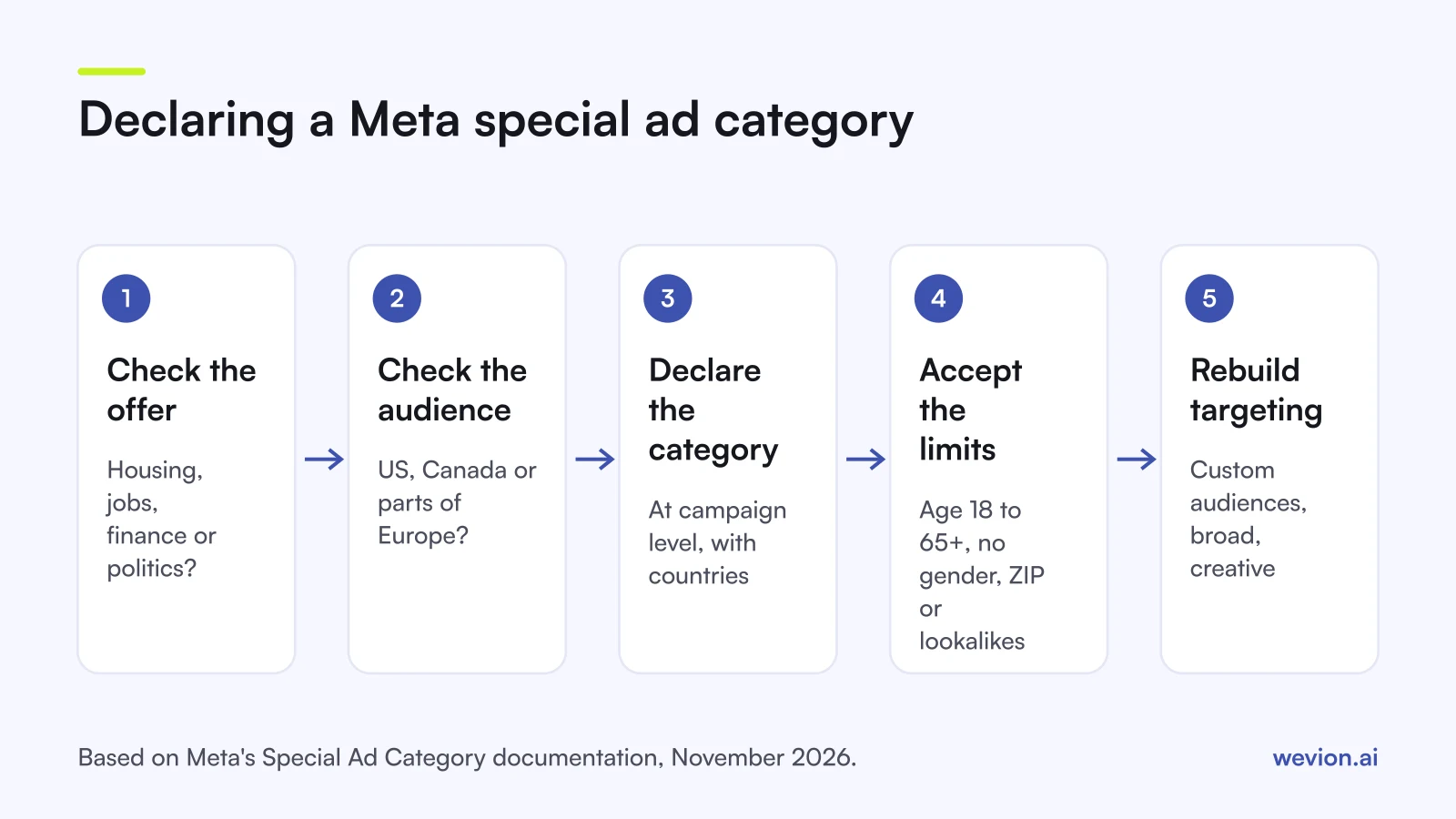
You declare a special ad category at campaign level, when you create the campaign, before you build any ad sets. In Ads Manager the campaign settings include a Special Ad Categories section: select the category that matches the offer, then choose the countries where the ads will run.
A few points make the declaration go smoothly:
- Declare before building audiences. Ad sets inherit the restrictions, and Meta's API returns an error when an audience breaks them, so it is quicker to start from the declaration than to fix ad sets afterwards.
- Pick the countries. Meta's API stores the countries alongside the category; for housing, employment and financial products and services it defaults to the account's tax country if none is set. Choose them explicitly for multi-market clients.
- Keep unrelated ads out. A campaign for a recruiting agency's vacancies and a campaign for its employer branding are different campaigns. For political ads, the documentation says they cannot share a campaign with unrelated ads.
- Check property catalogue ads. Advantage+ catalog ads that use a home listing catalogue must be declared as housing.
- Check templates. If you launch campaigns from templates or duplicates, check that the category travelled with them. A template built for an ecommerce client has no category set.
Political ads add a step: the advertiser and the Page must be authorised in each country, and the ad needs the disclaimer before it can run.
What happens if you don't declare the category?
Ads that belong in a special ad category but are not declared may be rejected or may not run, and a wrong category can pause ads until the campaign is fixed. Meta's documentation says ads in the relevant categories for US, Canadian and European audiences "may not run" without the declaration, that ads "may be rejected if an appropriate category is not chosen", and that choosing an incorrect category risks ads being paused until the campaign is adjusted.
The cost of getting it wrong goes beyond one campaign. Rejected ads and repeated policy problems are among the reasons Meta restricts ad accounts, Pages and business portfolios, as our guide to a restricted Facebook ad account explains. For an agency, one client's undeclared loan ads can create work across a business portfolio that also holds other clients.
The reverse mistake is costly in a different way. Declaring a category for an offer that does not need it removes targeting the campaign could have used. Meta's discriminatory practices policy asks advertisers to self-identify when their ads fit a category, so the decision sits with you: read Meta's definitions against the actual offer, not the client's industry label.
What should lead generation agencies do by vertical?
Lead generation agencies should map each client offer to a category before planning, because the same client can run declared and undeclared campaigns side by side. The table reflects Meta's documentation and policies as of November 2026 and applies to audiences in the markets covered above:
| Vertical | Likely category | Watch for |
|---|---|---|
| Mortgage brokers | Financial products and services, or housing | Both carry the same targeting limits |
| Estate and letting agents | Housing | Home listing catalogues must be declared |
| Recruiting agencies | Employment, for vacancy ads | Keep employer branding in its own campaign |
| Loans and credit | Financial products and services | Different age rules for credit ads in Europe |
| Insurance | Financial products and services in the US | Meta files insurance under financial products |
| Solar and home improvement | Financial, when the ad promotes financing | Plain product ads are not clearly covered |
A mortgage broker can sit under two categories, because the product is a financial one tied to a home. Meta's targeting limits are the same for housing and for financial products and services, so the campaign build does not change; pick the category that best describes the offer and record why. Our guide to solar lead generation ads shows how a financing offer can pull an otherwise unrestricted vertical into the financial category.
How do you get results with fewer targeting options?
You get results in a declared campaign by moving the work from audience selection to the offer, the creative, the form and the signal you send back to Meta. With age, gender and lookalikes gone, the people who respond are the people the ad speaks to.
- Let the creative qualify. Name the product, the area and who it is for in the first seconds: "Remortgage advice for homeowners in Bristol" filters better than any interest.
- Use the form to qualify. Multiple choice questions about the product, timing and budget sort leads without asking for protected information. Conditional logic in lead ads can route each product to its own questions.
- Send quality back. Optimising for leads that reach a CRM stage tells Meta which leads became customers. Our guide to conversion leads optimisation covers the setup.
- Grow first-party audiences. Website visitors, video viewers and past form openers are allowed in declared campaigns and age well over time.
- Follow up fast. Fewer targeting levers means more mixed leads, and the first call sorts them. Our guide to speed to lead covers routing and call cadence.
Copy still has its own rules on top of the category. Meta's personal attributes policy bars ads that assert or imply someone's vulnerable financial status, with "Are you bankrupt?" as its example, so a debt or loan ad should describe the service rather than the reader.
Where Wevion fits
Wevion is not part of the compliance path: it does not declare special ad categories, review ads against Meta's policies or store leads. The category is set in Meta's own campaign setup, and the advertiser stays responsible for it.
Wevion connects Meta, Google, TikTok, Snapchat, Taboola and Outbrain ad accounts through each platform's official API, syncs data about every 15 minutes, and shows platform-reported leads, cost per lead and spend for every client in one view, so a client's declared and undeclared campaigns can be compared side by side.
Each client gets its own workspace. Automated rules can pause an ad set, change a budget or just send an alert when cost per lead crosses a threshold you set, with a cooldown and a daily cap on runs, which helps when a newly declared campaign loses its old targeting and costs move.
You can try it on your own ad accounts with a 14-day trial on the Pro plan. No card to start. We ask for one on day 7, or earlier if you use up the trial credits, and billing starts on day 14 only if you add it.
Key takeaways
- Meta's four special ad categories are housing; employment; financial products and services; and social issues, elections or politics.
- Financial products and services replaced credit in January 2025 and is required for advertisers based in the US or reaching US audiences; housing, employment and credit rules also cover Canada and parts of Europe.
- Declared campaigns lose age, gender, postcode, location exclusion and lookalike targeting, and keep custom audiences and Advantage+ audience.
- Special ad audiences were sunset in 2022 and nothing replaced them directly.
- Undeclared ads in a category may be rejected or not run, and repeated policy problems can lead to account restrictions.
- Map every client offer to a category before planning, and let creative, forms and CRM signals do the targeting.