
Blended CAC: Formula, Paid vs Channel CAC and When It Misleads
Priya Raghunathan
مدير أداء التجارة الإلكترونية
Blended CAC is total marketing spend divided by every new customer you gained, regardless of which channel, campaign or post brought them in. It is the simplest customer acquisition cost a DTC brand can track, and the one least distorted by attribution. It is also the easiest to flatter, because customers you did not pay for sit in the same denominator as the ones you did.
Quick answer: Blended CAC equals total marketing spend divided by all first-time customers in the same period. Paid CAC divides paid media spend by new customers attributed to paid channels. Channel CAC does the same for one platform. Use blended CAC to set the total budget, channel CAC to split it, and watch all three together so organic growth cannot hide rising paid costs.
Blended CAC is the customer version of MER, which our MER vs ROAS guide covers for revenue. If you need the rules for counting first-time customers from your store, they are in our guide to new customer acquisition cost. This article is about the three CAC lenses and how they disagree.
What is blended CAC?
Blended CAC is a whole-business figure: it puts all acquisition money over all acquired customers and ignores who gets the credit.
- Blended CAC = total marketing spend ÷ all new customers in the period
Both halves need a fixed definition:
- Spend. Ad spend on every platform, plus agency and influencer fees, affiliate commissions and creative production if you count them. Pick a list and keep it.
- New customers. First-time buyers from your store, counted on the same dates and time zone as the spend.
A note on naming. Some dashboards call "blended CAC" the spend divided by every customer who ordered, returning ones included. That version falls every time your loyal base grows, and our nCAC guide shows how far it can drift from the real acquisition cost. In this article, blended CAC always uses first-time customers only, which makes it the same figure as nCAC on a total-marketing basis. What it adds is the comparison with paid and channel CAC.
How is blended CAC different from paid CAC and channel CAC?
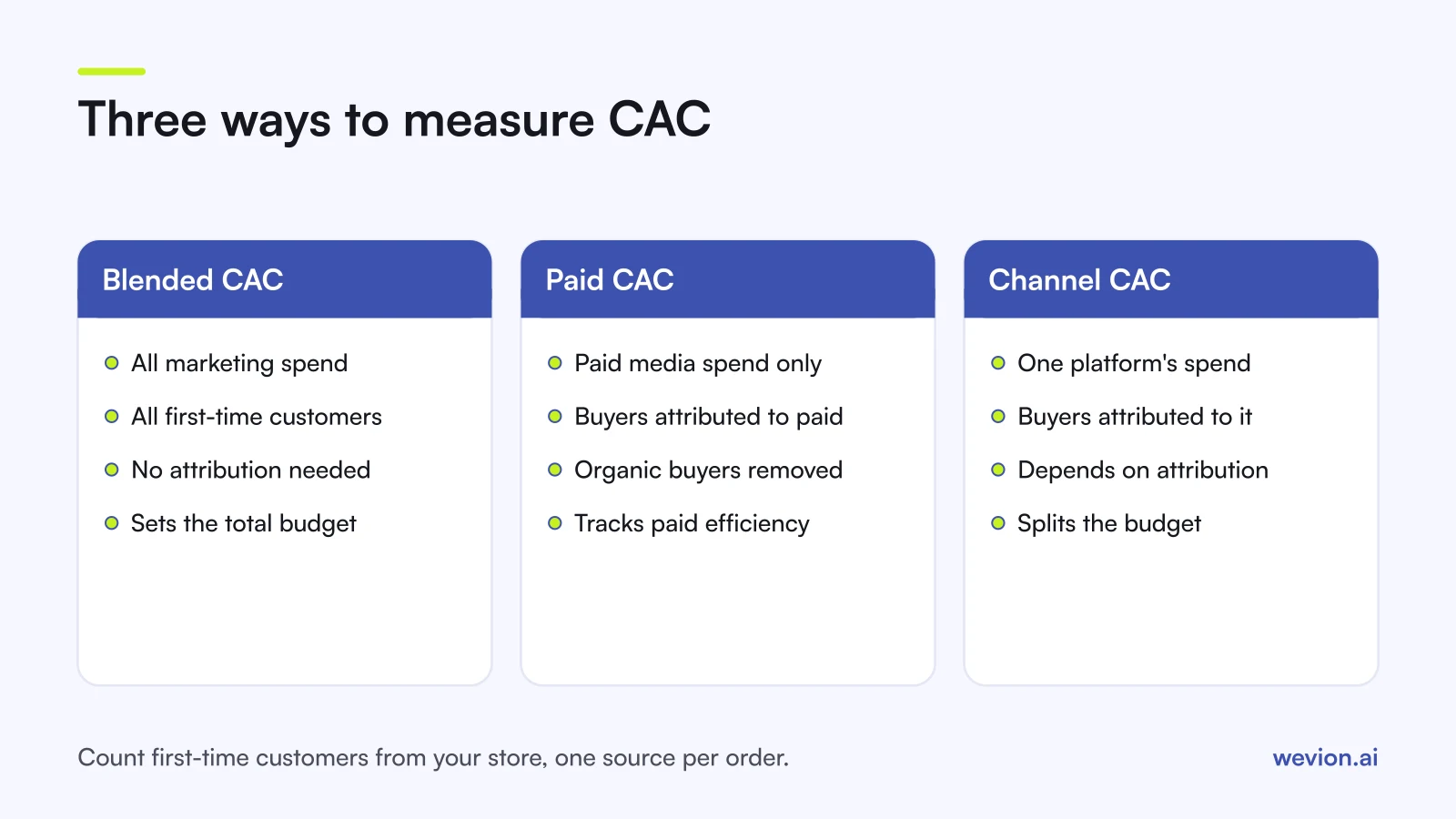
The three CAC figures differ in which spend goes on top and which customers go underneath, and each one answers a different budget question.
| Blended CAC | Paid CAC | Channel CAC | |
|---|---|---|---|
| Spend | All marketing | Paid media only | One platform's spend |
| New customers | All first-time customers | First-time customers attributed to paid | First-time customers attributed to that platform |
| Depends on attribution | No | Yes | Yes |
| Includes organic buyers | Yes | No | No |
| Best for | Total budget and affordability | Paid efficiency over time | Splitting budget between platforms |
Paid and channel CAC need a source for each first order. Most brands use UTM parameters captured at checkout and a last-click rule, which our comparison of first-touch vs last-touch attribution explains. Platform-reported conversions are not a good source here: platforms can claim the same order and count returning buyers, which is part of why Meta and Shopify numbers don't match.
A worked example: one month, three CAC figures
The figures below are invented round numbers chosen to show the method. They do not describe any real store or platform.
Spend in October:
- Meta: €26,000
- Google: €14,000
- TikTok: €6,000
- Influencer and agency fees: €4,000
- Total marketing: €50,000; paid media: €46,000
First-time customers in October, by first-order source (store UTMs, last click):
- Meta: 380
- Google: 260
- TikTok: 60
- Organic, direct, email and referral: 300
- Total: 1,000; attributed to paid: 700
The three figures:
- Blended CAC = €50,000 ÷ 1,000 = €50.00
- Paid CAC = €46,000 ÷ 700 = €65.71
- Channel CAC: Meta €26,000 ÷ 380 = €68.42, Google €14,000 ÷ 260 = €53.85, TikTok €6,000 ÷ 60 = €100.00
Each figure is correct, and each is useful. The blended €50 is what the business pays per new customer overall. The paid €65.71 is what the ads cost once organic buyers are removed. The channel figures are the starting point for moving budget, with the attribution caveats above.
When does blended CAC mislead?
Blended CAC misleads whenever the denominator grows for reasons that have nothing to do with the spend on top, because the figure then improves without any change in how well your ads acquire customers.
Organic or brand growth. Take November in the same invented store. Spend is unchanged at €50,000. A press mention lifts organic first-time customers from 300 to 500, while Meta's attributed new customers fall from 380 to 300. Google and TikTok hold steady.
| October | November | |
|---|---|---|
| New customers, total | 1,000 | 1,120 |
| Blended CAC | €50.00 | €44.64 |
| Paid CAC | €65.71 | €74.19 |
| Meta CAC | €68.42 | €86.67 |
Blended CAC improved by about 11 percent. Paid CAC got worse by about 13 percent, and Meta's by about 27 percent. A team watching only the blended figure would scale spend into the month the ads became less efficient.
Returning customers counted as new. If the store's customer records are messy, such as guest checkouts with a second email, repeat buyers show up as new and lower blended CAC. Merge duplicates before you trust the count.
Timing lag. Spend on prospecting this month can produce first orders next month. A big push in late October inflates October's blended CAC and flatters November's. Look at a rolling three-month figure next to the monthly one.
A changing spend definition. Adding or dropping agency fees, creative costs or influencer gifting from the total changes blended CAC with no change in performance. Fix the list once.
When do paid and channel CAC mislead?
Paid and channel CAC carry the opposite risk: they depend on attribution, so they can over or under credit the ads.
- Ads drive "organic" orders. Someone who saw a video ad and later searched your brand name may arrive through organic search or direct. Paid CAC then looks worse than the ads really are, and blended CAC is closer to the truth.
- Ads claim orders that would have happened anyway. Retargeting and branded search often reach people already on their way to buy. Channel CAC then looks better than the ads really are.
- Platforms overlap. Two platforms can each claim the same first order in their own reports, which is why the counts above come from the store, one source per order.
Neither blended nor channel CAC can tell you how many customers the ads truly caused. That is a question for a controlled test, which our guide to incrementality testing covers.
How should you use blended CAC in practice?
The practical way to use blended CAC is as the top-line guardrail, with paid and channel CAC underneath it and a payback check beside it.
- Set the total budget from blended CAC. It is the number the business actually pays per new customer. Compare it with first-order contribution and your CAC payback period.
- Track paid CAC next to it every month. If blended improves and paid gets worse, organic growth is covering for the ads, as in the November example.
- Split budget with channel CAC, carefully. Use one attribution rule from the store and keep it. Our cross-channel budget reallocation framework sets out how to move money in steps.
- Test before big moves. Before cutting or doubling a channel on its CAC alone, run a holdout or geo test to see how many of its customers are incremental.
- Report on a rolling window. A three-month blended CAC smooths timing lag and one-off spikes from launches or press.
Where Wevion fits
Blended, paid and channel CAC all start from the same numerator, spend from every platform on the same dates, and that total is what most spreadsheets get wrong first.
Wevion connects Meta, Google, TikTok, Snapchat, Taboola and Outbrain ad accounts through each platform's official API, brings Shopify or WooCommerce orders next to that spend in one dashboard, and syncs data about every 15 minutes, so paid and per-platform spend for every CAC figure sit in one view.
Cross-channel analytics lets you filter by date and account and converts every account into one currency at each day's exchange rate. First-time customer counts by source come from your store's customer reports and UTMs; Wevion does not decide attribution for you. For margin, Profitability Analytics is in beta.
You can try it on your own ad accounts and store with a 14-day trial on the Pro plan. No card to start. We ask for one on day 7, or earlier if you use up the trial credits, and billing starts on day 14 only if you add it.
Key takeaways
- Blended CAC equals total marketing spend divided by all first-time customers in the period.
- Paid CAC removes organic buyers; channel CAC isolates one platform, and both depend on attribution.
- Organic growth can make blended CAC improve while paid and channel CAC get worse.
- Count new customers from the store, merge duplicates and keep one spend definition.
- Use blended CAC for the total budget, channel CAC to split it, and tests to confirm big moves.