
TikTok vs Snapchat Ads: A Decision Guide for Media Buyers
Rafael Moreira
Senior Performance Marketer
The TikTok vs Snapchat ads question comes up whenever a media buyer wants a second short-video channel next to Meta. Both sell full-screen vertical ads in apps with a young audience, both run a pixel plus a server-side API, and both buy media in an auction. They differ in published reach, ad formats, bidding options and minimum budgets, and those differences decide which one to test first.
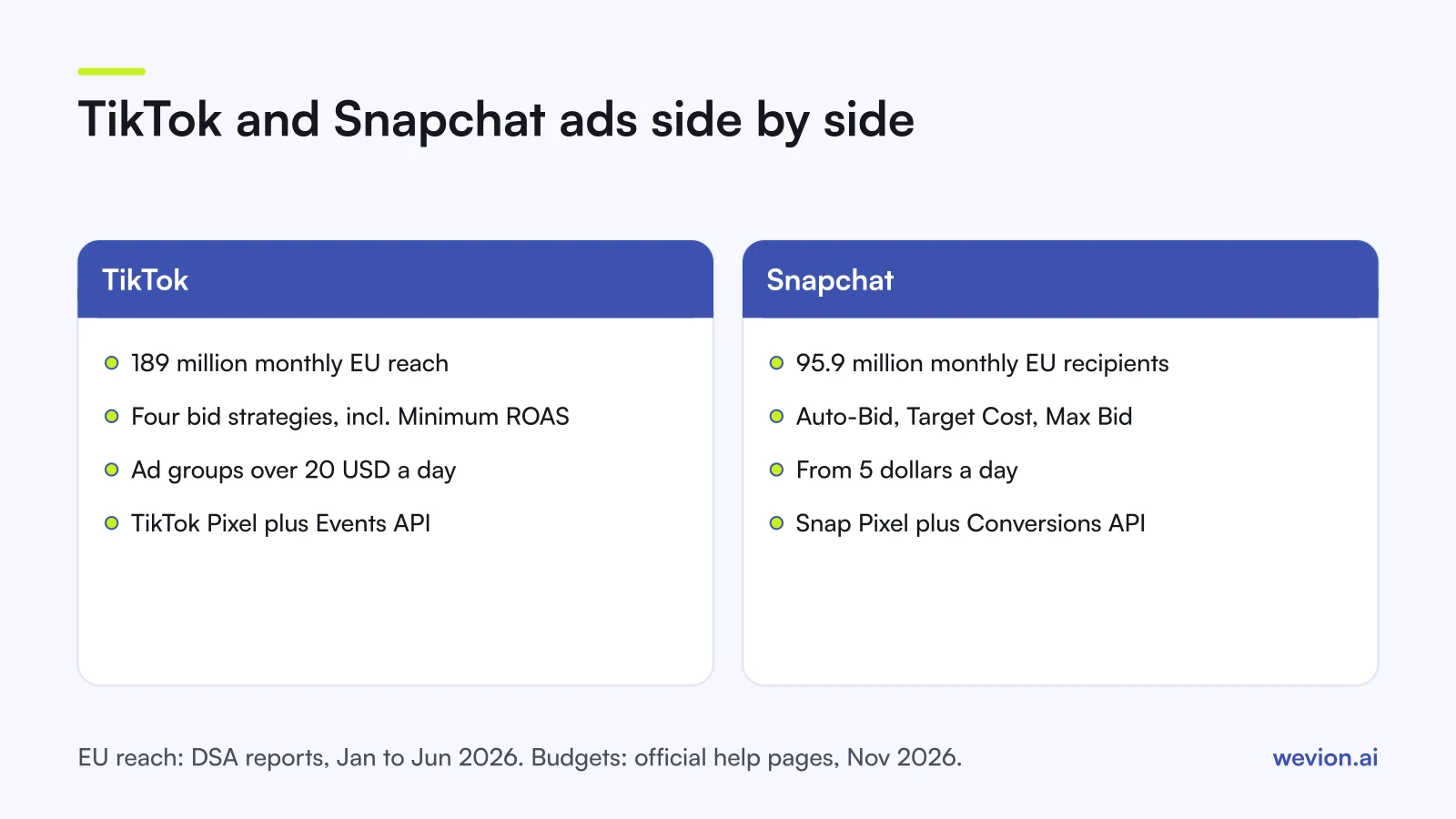
Quick answer: Start with TikTok if you need scale and value-based bidding: it reports a larger EU audience (189 million a month against Snapchat's 95.9 million in the first half of 2026) and offers Minimum ROAS and Highest Value bidding. Start with Snapchat if your budget is small (a 5 dollar daily minimum) or your audience lives in Snapchat's Chat and Stories. Run both once one channel is stable and you can fund a fair test on the other.
This guide sticks to what TikTok and Snap publish. For the structure of each platform in depth, see our TikTok ads campaign structure guide and our guide to Snapchat ads campaign structure.
How big are the TikTok and Snapchat audiences?
The two companies publish different audience figures, so the only like-for-like comparison is the EU count both must report under the Digital Services Act. Snap, which is listed, also reports global users every quarter; TikTok does not publish a comparable global figure in its newsroom.
| Figure | TikTok | Snapchat | Source |
|---|---|---|---|
| Monthly EU reach, January to June 2026 | 189 million | 95.9 million | TikTok DSA report (31 August 2026); Snap DSA report (31 August 2026) |
| Global daily active users, Q3 2026 | Not published | 495 million | Snap Q3 2026 10-Q (4 November 2026) |
| Global monthly active users, Q3 2026 | Not published | 977 million | Snap Q3 2026 results |
Two notes on reading these numbers. TikTok's report says it "reaches 189 million people across the European Union every month", while Snap's figure is average monthly active recipients; both are DSA disclosures for the same six months, but the wording differs. And Snap said in its Q3 release that it will move to monthly active users as its main audience metric from the first quarter of 2027.
Reach is only a ceiling. What matters for a media buyer is how many of your customers each app reaches in your markets, which the audience size estimate in each ads manager shows once you set location and age.
How do the ad formats compare?
Both platforms are built around full-screen vertical video, so most creative can be shared, but each has formats the other lacks. TikTok's in-feed ad specs recommend 9:16 vertical video and cover two kinds of auction in-feed ad: Spark Ads, which run organic posts, and non-Spark ads uploaded in Ads Manager.
Snap's ad formats page lists Sponsored Snaps, Single Image or Video Ads, Story Ads, Collection Ads, Commercials, AR Lenses and AR Filters.
| Format need | TikTok | Snapchat |
|---|---|---|
| Standard vertical video | In-feed ads | Single Image or Video Ads |
| Product catalogue | Catalogue ads | Dynamic Ads, Collection Ads |
| Native lead form | Instant Form | Lead form |
Beyond the shared formats, TikTok's distinctive option is Spark Ads, which run your own or creators' organic posts as ads. Snapchat's are Sponsored Snaps, delivered in the Chat area, and AR Lenses and Filters, which put a brand inside the camera.
In practice, a TikTok-native video with captions and a hook in the first seconds usually needs only a crop check and new copy before it runs on Snapchat. AR Lenses and Sponsored Snaps need their own production.
How do campaign structure and bidding differ?
Both platforms use a three-level structure, campaign, then ad group (TikTok) or ad set (Snapchat), then ad, but they differ in how many bid strategies you can choose and how budgets are shared. The table sets out what each help centre lists as of November 2026.
| TikTok | Snapchat | |
|---|---|---|
| Middle level | Ad group | Ad set |
| Objectives | Reach, Traffic, Video views, Community interaction, App promotion, Lead generation, Sales and more (objectives) | Awareness and Engagement, Traffic, Leads, App Promotion, Sales (objectives) |
| Bid strategies | Maximum Results, Target Cost per Result, Highest Value, Minimum ROAS (bidding) | Auto-Bid, Target Cost, Max Bid (bidding) |
| Campaign-level budget | Campaign Budget Optimization | Smart Budget (described as beta when we checked) |
TikTok also offers Smart+, a setup that can automate budget, audience, placement and creative pairing in one campaign.
The biggest practical difference is value bidding. TikTok's Minimum ROAS and Highest Value let a store bid for order value on web purchases. Snap's Ads API notes that its separate minimum ROAS strategy was deprecated on 10 February 2025, so on Snapchat you bid on cost per action. Our TikTok ads bidding strategy guide covers when each TikTok option fits.
What are the minimum budgets on TikTok and Snapchat?
Minimum budgets are where Snapchat is easier to start: its floor is a fraction of TikTok's, though both platforms recommend spending well above the floor. TikTok's daily budget page says campaign daily and total budgets must exceed 50 USD and ad group daily budgets must exceed 20 USD.
Snap's pricing page says "the minimum spend per day is $5", and recommends 20 to 50 dollars a day.
The recommended working budgets are higher. TikTok's budget best practices suggest 10 times your current CPA for a Purchase campaign, with a 200 USD floor.
Worked example (hypothetical numbers). A store expects a 25 dollar cost per purchase on both platforms and wants one prospecting ad group or ad set on each. On TikTok, 10 times 25 is 250 dollars a day, above the 200 USD floor. On Snapchat there is no published multiple, so plan on the same logic, enough budget for several purchases a day, which also points to around 250 dollars. The legal minimum differs by a factor of four or more; the budget needed to learn is similar. If you have 100 dollars a day in total, that is not enough for a fair test on either, and one platform at a time is the better plan.
How does tracking work on each platform?
Tracking works the same way on both platforms: a browser pixel plus a server-side API, with a shared event ID so the platform can remove duplicates. The names differ, and both platforms recommend running the two together.
- TikTok: the TikTok Pixel and the Events API. TikTok's Events API page recommends that you "use both TikTok's Pixel and Events API together with Event Deduplication".
- Snapchat: the Snap Pixel and the Conversions API. Snap's Conversions API best practices recommend that web advertisers "implement Conversions API alongside a Pixel integration" and send the same
event_idon every integration.
If you run a Shopify store, our guide to server-side tracking on Shopify covers how each platform's app sends server events. Remember that each platform reports conversions with its own attribution settings, so a sale can appear in both TikTok and Snapchat reports. Compare both against store orders, not against each other.
What do the ads managers offer?
Each platform's ads manager covers launching, reporting and access, and both add an organisation layer for agencies that manage several advertisers. The differences are in the tools around the core.
TikTok pairs Ads Manager with Business Center, where agencies hold client ad accounts, assets and member permissions; our guide to TikTok Business Center for agencies covers setup. Creative Center, including Top Ads, shows what runs in your category.
Snapchat runs Ads Manager inside an organisation with roles for members and ad accounts; our Snapchat Ads Manager guide covers account setup, the Snap Pixel and catalogues.
Neither ads manager shows the other platform's numbers. If you run both, comparing them means two exports, two attribution settings and two currencies to line up.
When should you pick TikTok, Snapchat or both?
The right pick depends on budget, product and where your customers are, so treat this as a starting point for a test, not a verdict. Each line below follows from the published facts above.
Pick TikTok first if:
- You need volume in the EU, where TikTok reports roughly twice Snapchat's monthly reach.
- Order values vary and you want value-based bidding (Highest Value or Minimum ROAS).
- You work with creators and want to run their posts as Spark Ads.
- You can fund at least one ad group at 10 times your target CPA.
Pick Snapchat first if:
- Your daily budget is small and you want to start at a low minimum.
- Your audience is active in Chat and Stories, where Sponsored Snaps and Story Ads run.
- AR Lenses suit the product, for example try-on for eyewear or make-up.
Run both when one platform is stable at your target CPA and you can fund a fair test on the second without starving the first. Reuse the winning concepts, adapt the first seconds and copy to each app, and judge both on store orders and blended cost per acquisition. Our guide to diversifying ad channels beyond Meta covers how to sequence new channels, and best ad platforms for ecommerce compares the wider field.
Where Wevion fits
Running TikTok and Snapchat side by side means two ads managers, two attribution settings and two exports every time a client asks how the channels compare.
Wevion connects TikTok, Snapchat, Meta, Google, Taboola and Outbrain ad accounts through each platform's official API, syncs data about every 15 minutes, and shows spend, results and cost per result for every account in one view, so the TikTok vs Snapchat comparison sits on one screen.
You can launch ads to several platforms from one grid with Bulk Launch, and set automated rules on each platform that pause ad sets, change budgets by a percentage or just send an alert. Rules that move budget between platforms, cross-platform rules, are in beta. Each client gets its own workspace, with roles such as media buyer and viewer.
You can try it on your own ad accounts with a 14-day trial on the Pro plan. No card to start. We ask for one on day 7, or earlier if you use up the trial credits, and billing starts on day 14 only if you add it.
Key takeaways
- TikTok reported 189 million monthly EU reach and Snapchat 95.9 million for January to June 2026; Snap reported 495 million daily users worldwide in Q3 2026.
- Both run vertical video; TikTok adds Spark Ads, Snapchat adds Sponsored Snaps, Story Ads and AR Lenses.
- TikTok offers four bid strategies including Minimum ROAS; Snapchat offers Auto-Bid, Target Cost and Max Bid.
- Minimums: TikTok ad groups over 20 USD a day and campaigns over 50 USD; Snapchat from 5 dollars a day. Learning budgets are similar.
- Both recommend pixel plus server API with deduplication: Events API on TikTok, Conversions API on Snapchat.
- Start where your budget and customers fit, and add the second platform once the first is stable.