
How to Scale TikTok Ads: A Playbook for Media Buyers
Yuki Tanabe
Creative AI Strategist
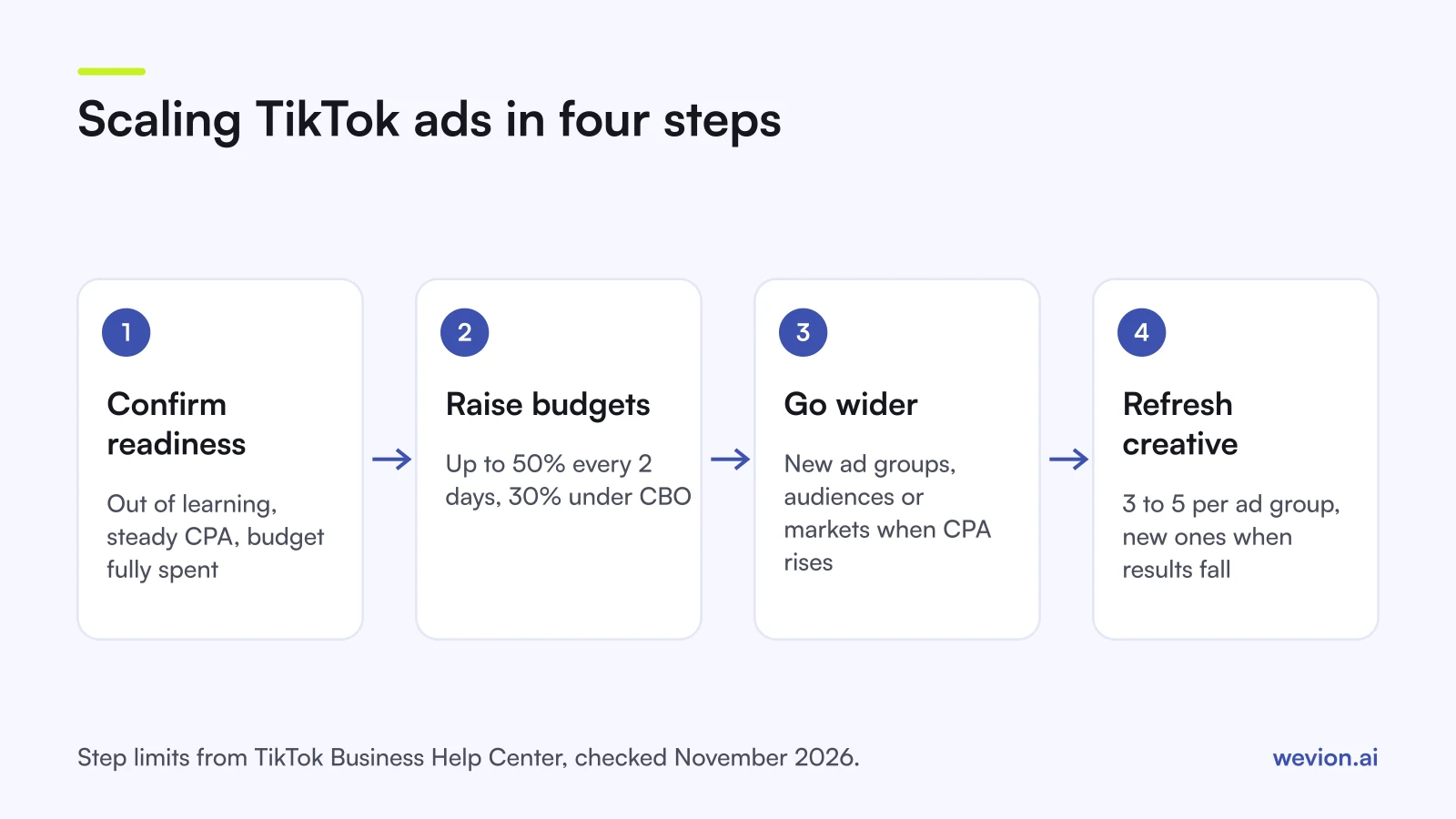
Knowing how to scale TikTok ads comes down to doing four things in order: confirm an ad group has earned more money, raise its budget in the steps TikTok recommends, widen with new ad groups, audiences or markets when budget steps stop working, and feed the account enough new creative to keep up. Skip a step and cost per result usually climbs before revenue does.
Quick answer: Scale an ad group only after it leaves learning (TikTok says about 25 results or 7 days) and holds a steady CPA. Raise budgets by up to 50% at a time with 2 days between changes, or up to 30% under Campaign Budget Optimization. When CPA rises after a step, add new ad groups or markets instead of pushing harder. Keep 3 to 5 creatives per ad group and refresh them when results decline.
This guide is the playbook. The detail behind each step lives in our other TikTok guides: the TikTok ads learning phase, TikTok ads bidding strategy, TikTok Smart+ campaigns and our TikTok ads campaign structure guide.
When is a TikTok campaign ready to scale?
A TikTok campaign is ready to scale when its results are stable enough that more budget is likely to buy more of the same, not a different, more expensive audience. Check four signals before you touch the budget.
- It has left the learning phase. TikTok's learning phase page, updated June 2026, says volatility starts to decline after about 25 campaign results or 7 days.
- Cost per result is steady near your target. Look at the last 3 to 7 days, not yesterday. A CPA that swings by half from day to day is not a base to build on.
- It spends its budget. An ad group that underspends today will not spend more just because you raise the cap. Fix the bid or the audience first.
- You have creative in reserve. More budget shows each video to more people faster, so new assets need to be ready before you scale, not after.
If all four are true, start with vertical scaling. If the first one is false, our learning phase guide explains how to get there without resetting delivery.
How do you scale TikTok ads vertically?
Vertical scaling means raising the budget on an ad group or campaign that already works, and TikTok publishes clear limits on how fast to do it. The limits differ by setup, so use the one that matches how the campaign is budgeted.
| Setup | Size of each step | Time between steps | Source |
|---|---|---|---|
| Ad group budgets | Within 50% of the previous budget | At least 2 days | Budget best practices |
| Campaign Budget Optimization | Within 30% of the current daily budget | At least 3 days or 50 conversions | CBO page |
| Smart+ Web campaign | Up to 30%, when it regularly spends 90% or more of budget | After the first 7 days | Smart+ Web best practices |
Both the budget and CBO pages were last updated in August 2026. TikTok's bidding best practices add a lower bound for Maximum Results: steps below about 20% do little, which is why the useful range for an ad group budget is roughly 20% to 50%.
Worked example (hypothetical numbers). A Purchase ad group spends $300 a day at a $30 CPA against a $35 target. It has passed learning. Under ad group budgets, the first step can take it to $450. If CPA holds for two days, the next step takes it to $675. The same budget on a CBO campaign moves in 30% steps: $300 to $390, then about $507, with three days or 50 conversions between them. If CPA rises above $35 after a step, hold the budget for a few days rather than stepping back at once; a cut is another change the system has to absorb.
TikTok's scheduled budget change feature applies a new daily budget at about midnight in the account's time zone, so you can plan the next step instead of editing in the middle of the day.
Which bid strategy should you use while scaling?
Your bid strategy decides whether a bigger budget brings a stable CPA or simply a bigger bill, and TikTok's guidance on this point is specific. Its CPA stability guide, updated August 2026, says Maximum Results has no cost controls, so CPA can move as you scale.
The guide gives a route for each starting point:
- Existing Target Cost per Result ad group: raise the budget directly. The cost control works to keep CPA near the target.
- Existing Maximum Results ad group: the preferred route is to switch it to Target Cost per Result with hybrid bidding, then raise the budget. The alternative is to launch additional Maximum Results ad groups instead of raising the current one.
- After a CPA spike: switch the ad group to Target Cost per Result rather than pausing it, which keeps its engagement history.
TikTok notes that hybrid bidding does not currently support the Product Sales (Shop) objective. Our TikTok ads bidding strategy guide explains how to set the target from your recent average CPA, and when Highest Value or Minimum ROAS fit better for value-based campaigns.
How do you scale TikTok ads horizontally?
Horizontal scaling means adding new places for the budget to go, rather than pushing more through one ad group, and it is the route to take once budget steps start to raise CPA. It costs learning time, because every new ad group starts from zero, so add them on purpose.
There are four common ways to widen:
- New ad groups with the same setup. TikTok's CPA stability guide lists this as the alternative to raising a Maximum Results budget. Use the proven creative and bid in a fresh ad group.
- New audiences. If your winner runs on broad targeting, try an interest or custom audience as a separate ad group, or the reverse. Keep one difference per ad group so you can read the result.
- New markets. A new country or language is a new auction with its own costs. Translate and adapt the creative, check that your landing page, shipping and payment work there, and budget it as a test, not as a copy of the home market.
- New creative angles. A new hook, format or creator can open a different part of the audience. Put clearly new concepts in their own ad group so they get spend.
Watch the total. TikTok's CBO page recommends 3 to 5 unique, active ad groups per campaign with 2 to 3 unique creatives each. More ad groups than your budget can fund means none of them gets enough results to learn. As a rough check, each new Purchase ad group needs a budget that can buy results: TikTok's budget page suggests 10 times your current CPA, with a 200 USD floor.
How much creative do you need to scale on TikTok?
Creative volume is the limit most TikTok accounts hit first when they scale, because a larger budget shows each video to more people in fewer days. TikTok's creative best practices for performance ads suggest 3 to 5 different creatives per ad group and 3 to 5 diversified ad groups per campaign.
The same page says to check performance regularly and refresh an ad group's creatives when delivery shows a consistently declining trend. It also suggests adding new creatives to an existing ad group rather than creating a new one, so the ad group keeps its history. TikTok does not publish a fixed refresh schedule, so set your own trigger, for example a falling click-through rate together with a rising CPA over several days.
A simple production plan for scaling:
| Budget change | Creative to have ready |
|---|---|
| First budget step | 1 to 2 new variants of the winning concept (new hook, new opening) |
| Second and third steps | 1 new concept per ad group |
| New market | Localised versions of the top 2 to 3 videos |
| New ad group | 3 to 5 creatives, not one |
For ideas, TikTok's Top Ads in Creative Center shows what is running in your category; our guide to Top Ads and Creative Center covers how to use it without copying.
Where do Spark Ads and Smart+ fit in scaling?
Spark Ads and Smart+ are two ways to put more of the scaling work on TikTok's side: Spark Ads by using organic posts as ads, and Smart+ by automating budget, audience, placement and creative pairing. Both are useful at scale, and both have conditions.
Spark Ads. TikTok's Spark Ads page describes them as ads that use your own account's posts, or creators' posts with their authorisation, with engagement credited to the original post. They let you scale creator content without re-uploading it, and they sit in normal ad groups next to other creative. TikTok also said in January 2026 that it would phase out Custom Identity and that new campaigns must run from a verified TikTok profile, naming Spark Ads as the easiest route. Our TikTok Spark Ads guide covers authorisation codes.
Smart+. The Smart+ Web best practices, last updated in April 2025, recommend at least six creative assets, a daily budget of about 30 times your historical CPA (and no less than 10 times), no edits to bid, audience or creative in the first 7 days, and bid changes of up to 15% every 2 days after that. With a $30 CPA, that means a $900 daily budget, with $300 as the floor. Smart+ suits scaling once your spend is large enough to fund it; below that, a manual campaign with fewer ad groups is often the better use of money.
What are the common TikTok scaling mistakes?
Most TikTok scaling problems come from moving too fast or from scaling the wrong thing, and they show up as a CPA that jumps a few days after a change. Watch for these:
- Doubling a budget overnight. It breaks both TikTok's 50% and 30% guidance in one step.
- Scaling a Maximum Results ad group with no cost control. Switch to Target Cost per Result first, or add ad groups instead.
- Pausing after one bad day. TikTok suggests switching bid strategy rather than pausing a live ad group.
- One creative per ad group. It burns out quickly once spend rises.
- Ten new ad groups at once. Each needs its own budget to learn; spread the launches out.
- Copying the home market to a new country. Localise creative and check costs from scratch.
Where Wevion fits
Scaling across several TikTok accounts, and often Meta and Google at the same time, means tracking which ad groups have earned a budget step and when each one last moved.
Wevion connects TikTok, Meta, Google, Snapchat, Taboola and Outbrain ad accounts through each platform's official API, syncs data about every 15 minutes, and shows spend, results and cost per result for every account in one view, so you can see which ad groups are ready for the next step.
Automated rules act directly on the conditions you set: they can raise or lower budgets or bids by a percentage, pause or activate ad groups, or just notify you, with a cooldown and a daily cap on runs. That makes it practical to keep budget steps inside TikTok's 50% or 30% limits. Our TikTok ads automated rules guide has examples, and our guide to guardrails to scale ad spend safely covers caps and limits. When you widen, Bulk Launch builds several new ad groups from one grid with the same settings.
You can try it on your own ad accounts with a 14-day trial on the Pro plan. No card to start. We ask for one on day 7, or earlier if you use up the trial credits, and billing starts on day 14 only if you add it.
Key takeaways
- Scale only after learning (about 25 results or 7 days, per TikTok) and with a steady CPA and full spend.
- Raise ad group budgets by 20% to 50% every 2 days; under CBO, stay within 30% every 3 days or 50 conversions.
- On Maximum Results, switch to Target Cost per Result with hybrid bidding before scaling, or add ad groups instead.
- Go horizontal (new ad groups, audiences, markets, angles) when budget steps start to raise CPA.
- Keep 3 to 5 creatives per ad group and refresh them when results decline.
- Spark Ads scale creator content; Smart+ needs about 30 times your CPA as a daily budget to work as designed.
Sources: TikTok Business Help Center pages on the learning phase, budget best practices, CBO, CPA stability while scaling, creative best practices and Smart+ Web best practices, checked November 2026.