
Competitor Ad Research: A Repeatable Method With Free Tools
Yuki Tanabe
Creative AI Strategist
Competitor ad research is the habit of checking what other brands run on Meta, TikTok and Google, logging it in one place and turning the patterns into tests for your own account. The free official tools show you a lot of creative and almost no results. A good method accepts that limit: it uses competitors for ideas and your own tests for answers.
Quick answer: Use the Meta Ad Library to see every active ad a brand runs on Meta's apps, TikTok Top Ads for curated high-performing TikTok creatives, and the Google Ads Transparency Center for a brand's Search, display and YouTube ads. None shows spend or results for ordinary commercial ads. Log what you find weekly, tag it by angle, format, hook and offer, and write each pattern as a hypothesis you can test.
This guide is the method that ties the three tools together. For a deep dive on each one, read our guides to Meta Ad Library search, TikTok Top Ads in Creative Center and the Google Ads Transparency Center. If you are weighing paid tools, our Facebook ads spy tools comparison covers that route.
What can the free tools tell you about competitor ads?
The free tools tell you what a competitor is running and, in some markets, roughly how widely. They do not tell you what it costs or what it sells. Every conclusion in competitor ad research has to start from that gap.
| Meta Ad Library | TikTok Top Ads | Google Ads Transparency Center | |
|---|---|---|---|
| What it covers | Every active ad on Meta's apps | A curated set of high-performing ads | A verified advertiser's ads on Google |
| Search by | Advertiser or keyword, per country | Region, industry, objective and more | Advertiser or website domain, per region |
| Performance data | None for commercial ads | Relative, second by second | None for commercial ads |
| Spend data | Political and issue ads only | None | Election ads only |
| Best use | Tracking named competitors | Format and hook ideas | Search copy and offers |
Each row has a source. The Meta Ad Library covers all active ads, plus ads that reached the EU for a year after their last impression and political or issue ads for seven years. TikTok's Top Ads help page says every ad in the collection was authorised by its advertiser. Google's Transparency Center help page lists advertiser details, verification and the ads themselves, with extra targeting data only in some regions.
What does each tool leave out?
Each tool leaves out different things, and knowing the gaps is what stops a log from turning into a list of wrong conclusions.
Meta Ad Library
Outside the EU, an ordinary commercial ad disappears from the library once it stops running, so you cannot look back. Meta's Ad Library tools page says ads that delivered an impression in the EU or associated territories carry more information and stay for one year after their last impression. For those ads you get estimated reach with age, gender and location breakdowns. That is scale, not spend, and certainly not sales.
TikTok Top Ads
Top Ads is curated, not complete. Only ads their advertisers authorised appear, so a competitor's absence tells you nothing. The See Analytics view shows relative performance second by second, which is useful for hooks, but it gives no budget, CPA or ROAS. For an archive of everything a brand ran, TikTok's Commercial Content Library covers ads shown in the EEA, Switzerland and the UK.
Google Ads Transparency Center
The Transparency Center shows Search, display and YouTube ads by advertiser, with the last date each was shown. It shows no keywords, bids, clicks or conversions for commercial ads. Responsive ads are assembled from several assets, so one preview may show only one combination. For the competitors in your own auctions, Google Ads Auction insights adds impression share and overlap rate, which the Transparency Center never shows.
What is a repeatable competitor ad research method?
A repeatable method is a fixed list of competitors, a fixed weekly slot and one log that every tool feeds into. The routine below takes about an hour a week for one brand with eight competitors.
- Fix the list. Five to ten brands: direct competitors, brands selling to the same buyer, and one or two category leaders.
- Fix the market. Search the countries you sell in. A brand's US and German ads can differ completely.
- Check each tool in the same order. Meta by advertiser, Google by domain, then TikTok Top Ads by your industry and region.
- Log only what is new or long-running. New ads point to a fresh test or offer. Ads live for weeks are worth studying.
- Tag every entry with the same five fields, so patterns can be counted.
- Review the log monthly and turn the strongest patterns into two or three hypotheses.
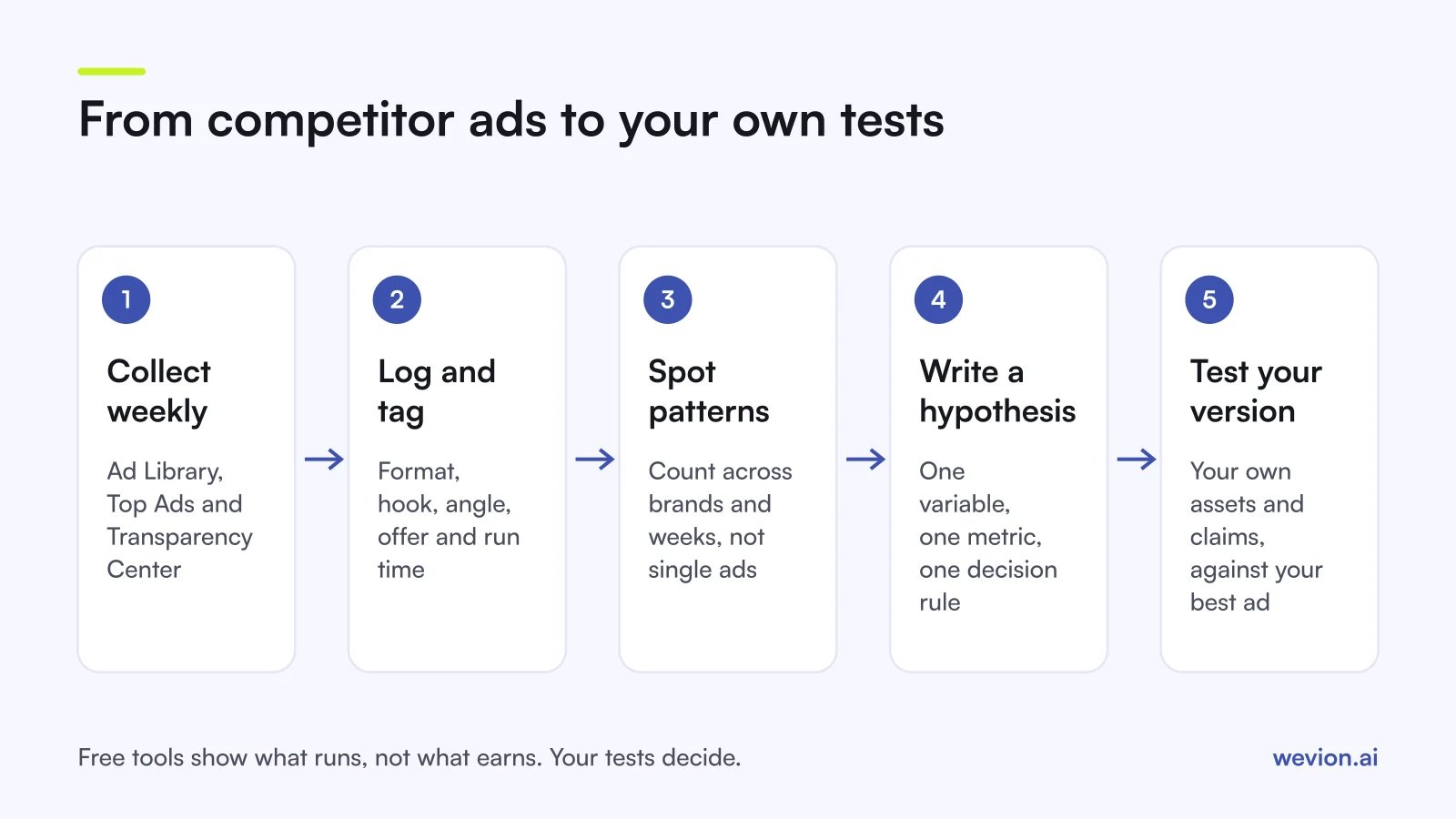
The order matters less than the consistency. A log kept every week for a quarter shows trends; ten hours of browsing once a quarter shows a snapshot.
How do you log what you find?
A competitor ad log is a shared sheet or creative library with one row per ad and a fixed set of tags. Tags turn screenshots into something you can count. Here is a set that works across all three platforms:
| Field | Example |
|---|---|
| Date seen | 12 Nov 2026 |
| Brand and platform | Brand B, Meta |
| Link or ID | Library ID or Transparency Center link |
| Format | 9:16 video, 22 seconds |
| Hook (first 3 seconds or headline) | Founder to camera, states a problem |
| Angle | Speed of delivery |
| Offer | 20% off first order |
| Run time or last shown | Live since 18 Sep |
| Notes | Same script in 3 languages |
Keep the tag lists closed. If one person writes "UGC" and another writes "creator video", you cannot count either. Our guide to ad creative library management covers how to store and name assets so the log and your own creative library use the same words.
How do you turn patterns into testable hypotheses?
A pattern becomes useful when you write it as a hypothesis with a variable, a metric and a decision rule, and test it against your current best ad. "Competitors use founder videos" is an observation. "A founder-to-camera hook will raise our hook rate compared with our product demo, at the same offer" is a test.
A hypothetical month shows how it works. You track 8 competitors and log 64 ads. Of the 20 ads that ran for six weeks or more, 9 open with a person speaking to camera, 7 with a product close-up and 4 with on-screen text only. Seven of the 20 lead with a delivery promise. Your own ads open with product close-ups and lead with price.
That gives two hypotheses worth testing, one variable each:
- Hook: a person-to-camera opening against your current close-up, same script, same offer.
- Angle: a delivery promise against a price lead, same video, if your delivery times can back it.
Decide the metric before launch: hook rate for the first test, cost per purchase for the second. Our creative testing framework covers the structure, our guide to hook rate and hold rate explains the first metric, and the A/B testing statistics guide covers how much data you need before calling a winner.
What should you never copy from competitor ads?
Some things in a competitor's ad belong to them, and some only work because of their business. Copying either costs you more than it saves.
- Their assets. Footage, photos, music, scripts and logos are someone's intellectual property. Meta's copyright and trademark policy for ads prohibits ads that infringe the rights of others, and ads can be removed after a rights holder reports them.
- Their claims. A "next-day delivery" or "clinically tested" line is only allowed if it is true for you. Unsupported claims are a policy risk and a trust risk.
- Their offer, without your margin. A 30% discount that works for a brand with a 70% gross margin may lose money on every order for you. Check against your break-even ROAS first.
- Their landing page. You see the ad, not the page behind it, the audience or the funnel. Half the result often sits there.
- Their creators. A creator's face and voice are tied to their contract with that brand. Brief your own.
What you can take is structure: hook types, formats, angles, pacing, the order of proof and offer. Nobody owns "problem, demo, proof, offer".
How often should you run competitor ad research?
Weekly logging and a monthly review is the cadence that suits most media buyers, because it catches new launches without crowding out work on your own account. Add a short extra check before big trading periods, when competitors tend to launch new offers.
Two warnings keep the routine honest. First, do not change your account because one competitor launched one new ad; wait until the log shows a pattern across several brands or several weeks. Second, judge every idea on your own numbers. A competitor's hook that fails in your test has failed for your brand, however long it ran for theirs.
Where Wevion fits
Competitor ad research ends where your own testing begins, and that is the part Wevion is built for: launching the test variants, then reading which hypothesis won.
Wevion connects Meta, Google, TikTok, Taboola, Snapchat and Outbrain ad accounts through each platform's official API, syncs data about every 15 minutes, and shows spend and results for every account in one view, so a hypothesis tested on Meta and TikTok can be compared side by side.
You can launch a hook or angle test as a set of variants with Bulk Launch, and produce new images and videos from a brief in Creative Hub. Automated rules can then pause losing ads, activate winners, change budgets or just send an alert, with a cooldown and a daily cap on runs.
You can try it on your own ad accounts with a 14-day trial on the Pro plan. No card to start. We ask for one on day 7, or earlier if you use up the trial credits, and billing starts on day 14 only if you add it.
Key takeaways
- The Meta Ad Library, TikTok Top Ads and the Google Ads Transparency Center are free, and none shows spend or results for ordinary commercial ads.
- Meta keeps commercial ads after they stop only if they reached the EU; Top Ads is curated; Google shows no keywords or bids.
- Track five to ten competitors weekly, in your own markets, in one log with closed tags.
- Count patterns before acting: a long run time is a hint, not proof.
- Write each pattern as a hypothesis with one variable, one metric and a decision rule.
- Take structure, never assets, claims or offers your margin cannot carry.