
How to Localize Ad Creatives for New Markets
Yuki Tanabe
Creative AI Strategist
When an ecommerce client opens a new country, the agency has to localize ad creatives, not just translate them. The winning ad from the home market carries a hook, an offer, a face, a price and a set of claims, and any of those can fail abroad even when the words are perfectly translated. This guide covers what to change, in what order, and how to run the work as a repeatable process across clients.
Quick answer: To localize an ad creative, keep the idea that made it win and rebuild everything the new market reads differently. Transcreate the hook and offer, swap in local proof and creators, show the price, currency and shipping terms of that market, check each claim against local rules, adjust text length for the format, and have a native speaker review the final file before launch.
This article is about the creative itself. For account structure, billing, currencies and time zones per market, see our guide to managing client ads in multiple countries. For Meta's feature that serves several languages from one ad, see Meta ads in multiple languages.
What does it mean to localize an ad creative?
Localizing an ad creative means adapting every element a customer in the new market sees, so the ad feels made for them rather than imported. Language is one layer of that work, and often not the one that decides whether the ad converts.
Think of a creative as five layers, from the most visible to the least:
- The words: hook, headline, on-screen text, voiceover and call to action.
- The offer: discount, bundle, free shipping threshold, guarantee.
- The proof: reviews, ratings, creators, press mentions, customer faces.
- The commercial facts: price, currency, delivery time, returns terms.
- The claims: anything a regulator or platform could check, such as "best", "lowest price" or a before-and-after result.
A direct translation touches only the first layer. The other four are where most localized ads gain or lose their edge, and where most compliance problems hide.
How do you transcreate hooks and offers?
Transcreation keeps what a line does to the reader and rewrites the words so the effect survives in the new language. In ads, that matters most in the first two seconds, because the hook decides whether anyone sees the rest.
Brief the native writer on the job of each line, not only its text. A useful format per line:
| Line | Its job | Keep or rebuild |
|---|---|---|
| "Your feet will thank you" | Promise comfort, light humour | Rebuild: idioms rarely travel |
| "Free shipping over €50" | State a fact | Keep, but check the threshold and currency for the market |
| "Rated 4.8 by 12,000 customers" | Social proof | Keep only if the reviews are visible to local buyers |
| "Ends Sunday" | Urgency | Keep, but set the date in local time |
Offers need the same scrutiny. A free shipping threshold that works in one country can look stingy or odd in another once it is converted and rounded. A bundle that suits one market's basket size may not suit the next. Agree the offer for each market with the client before the creative team starts, and put it in the creative brief so writers and designers work from the same numbers.
Register is part of transcreation too. Some markets expect a formal "you" in brand copy, others a casual one, and the right choice depends on the brand and category. For a full worked market, our Meta ads Japan guide shows how far the changes can go.
Why do local proof and creators matter?
Proof only persuades when the buyer recognises it as coming from people like them, so a review count from another country or a creator speaking accented English often weakens a localized ad more than any translation error.
Practical swaps, from cheapest to most effective:
- Reviews: quote reviews from the new market once there are any. Until then, keep proof that is true everywhere, such as total customers, and avoid quoting a review in translation as if a local customer wrote it.
- Faces and settings: reshoot or recut with models, homes and streets that look local.
- Creators: brief one or two native creators per market. Meta partnership ads and TikTok Spark Ads let the brand run ads from a creator's own handle with their permission, which keeps the native voice intact.
- Press and awards: use them only if the outlet is known in that market.
How should prices, currency and shipping appear on the creative?
The price, currency and shipping terms on a creative must match what a visitor from that market sees after the click, because a mismatch is both a conversion leak and a trust problem.
This is easy to get wrong with multi-market stores. Shopify, for example, can convert prices automatically per market, apply rounding and percentage adjustments, or use fixed prices per country. The creative team needs the final local price list, not the home price run through a currency converter. Our guide to Shopify Markets ads covers how those prices reach catalogues and landing pages.
A short checklist for this layer:
- Price shown in the local currency and format, using the market's own rounding.
- Shipping promise ("free over 50", "delivered in 2 days") true for that country.
- Returns or guarantee terms that the client actually offers there.
- Sale dates and countdowns set in the market's time zone.
- Dynamic catalogue ads pull the local price from a country-specific feed, not the home feed.
Which claims change from one market to another?
Advertising claims are judged by the rules of the market where the ad runs, so a line that is fine at home can need evidence, extra wording or removal abroad. Treat this as a checklist for the client's legal team, not as legal advice.
Two examples show how concrete the differences are:
- Discounts in the EU. Article 6a of the Price Indication Directive, added by the Omnibus Directive, requires an announcement of a price reduction to show the prior price, defined as the lowest price the trader applied in a period of at least 30 days before the reduction. A "−40%" creative needs a reference price that meets that rule. Ask the client's counsel how it applies to their ads.
- Superlatives in China. Article 9 of China's Advertising Law prohibits words such as "national-level", "the most" and "the best" in advertisements. A "best-selling" hook that works in English cannot be carried over word for word.
Beyond those, check health, environmental and results claims, comparisons with competitors, and age-restricted categories in every new market. Each platform also applies its own advertising policies on top of local law.
What changes in formats and specs?
Platform specs such as aspect ratios and safe zones do not change by country, but the space your localized copy needs does, so the same template can break in a new language.
Plan for these differences:
- Text length. Some languages run noticeably longer than English for the same message. Leave room in headlines and on-screen text, and write a short version for tight placements.
- Right-to-left scripts. Arabic and Hebrew read right to left, so layouts with text, arrows or before-and-after sequences need mirroring, not just new text.
- Fonts. Check that the brand font supports the script. Accents, Cyrillic or CJK characters often fall back to a default font.
- Subtitles and voiceover. Viewers may watch with the sound off, so burn in subtitles in the local language and check timing after the voiceover changes length.
For current sizes per placement, see our TikTok ad specs guide.
What does the localization workflow look like?
A repeatable workflow keeps localized creatives consistent across markets and clients, and makes it clear who owns each decision before anything goes live.
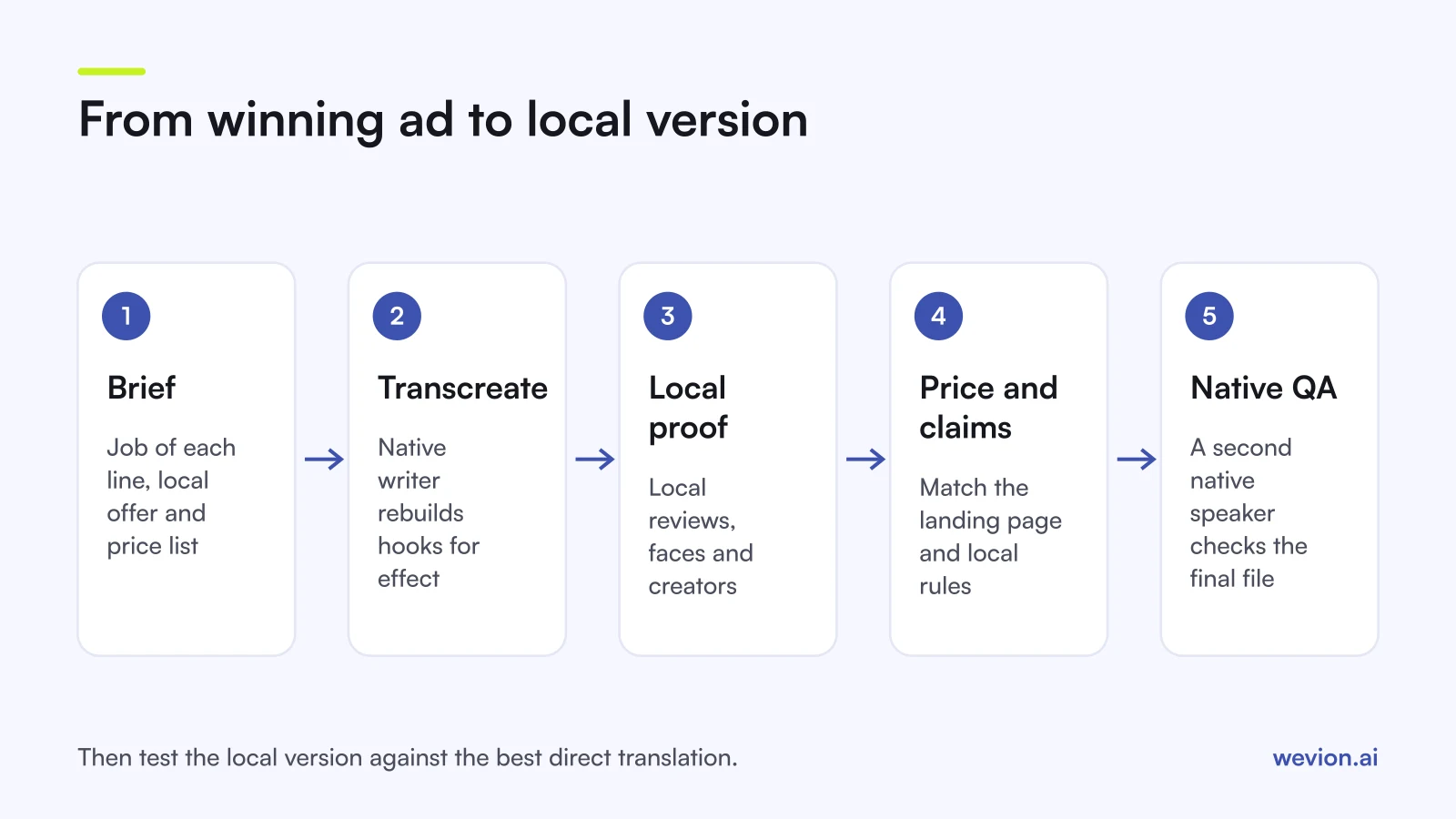
- Brief. Pick the winning creative, write the job of each line and agree the local offer, price list and claims with the client.
- Transcreate. A native writer rewrites hooks, headlines and voiceover for effect, with a short version for tight placements.
- Local proof. Swap reviews, faces and creators for local ones where you have them.
- Price and claims check. Compare every price, currency, shipping line and claim with the market's landing page and the client's legal notes.
- Native QA. A second native speaker, not the writer, checks the final exported file in every placement, including subtitles and cropping.
Then test. Run the localized version against the best direct translation in the same market and judge both on store results, using a creative testing framework. Sometimes the translation wins, and that is useful to know before you fund a full local shoot.
Where Wevion fits
Every new market multiplies the files, ads and settings an agency has to keep in step for each client, and launch errors such as a home-market price on a local ad usually come from copying work by hand.
Wevion connects Meta, Google, TikTok, Taboola, Snapchat and Outbrain ad accounts through each platform's official API, syncs data about every 15 minutes, and gives each client its own workspace, so every market's localized ads can be launched and compared from one place.
With Bulk Launch, you build ads from one grid on Meta, Google, TikTok, Taboola and Snapchat and save templates for repeat setups. On Meta, one row can carry language variants. After launch, cross-channel analytics shows every market in one display currency at each day's exchange rate, so the local version and the translation are easy to compare.
You can try it on your own ad accounts with a 14-day trial on the Pro plan. No card to start. We ask for one on day 7, or earlier if you use up the trial credits, and billing starts on day 14 only if you add it.
Key takeaways
- Translation changes the words; localization keeps the effect and changes whatever the new market reads differently.
- Brief writers on the job of each line and agree the local offer before production.
- Use local proof and native creators; avoid passing translated reviews off as local ones.
- Price, currency, shipping and sale dates on the creative must match the market's landing page.
- Check discounts, superlatives and results claims against each market's rules, with the client's counsel.
- Leave room for longer text, mirror right-to-left layouts and have a second native speaker check the final file.